




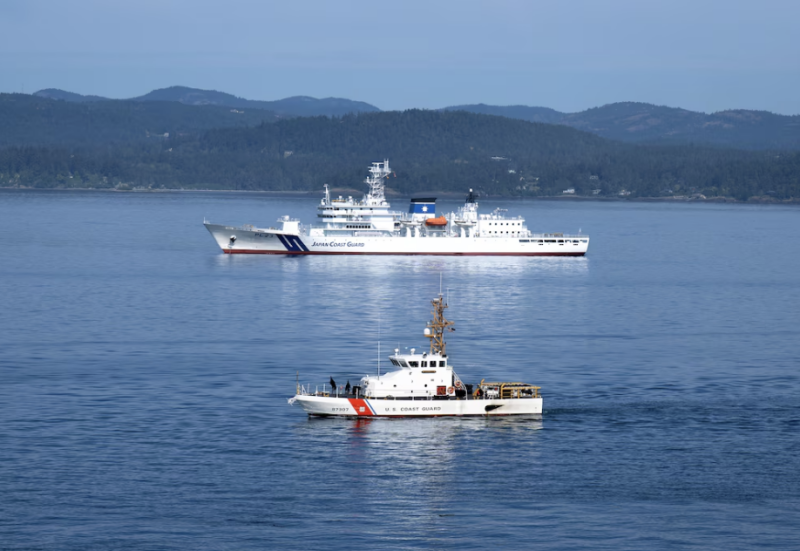
The U.S. Coast Guard, Japan Coast Guard and Canadian Coast Guard conducted a joint search and rescue exercise May 21 in the Strait of Juan de Fuca near Victoria, British Columbia, waters heavily traveled by fishing, passenger and cargo vessels.
“The joint operation aimed to enhance interoperability, communication, and coordination among the three nations during complex maritime emergencies,” according to a U.S. Coast Guard statement.
The exercise directed crews to respond to a simulated sailing vessel in distress, “requiring multi-national coordination to locate, recover and transport mock casualties. The scenarios tested joint communication, search pattern execution, and the safe transfer of personnel between vessels from different nations.”
Working alongside the Itsukushima, the Japan Coast Guard’s largest and most technically advanced training vessel, the exercise was an opportunity to forge partnerships alongside future Japan Coast Guard officers. The crew of the Itsukushima collaborated with U.S. and Canadian personnel, exchanging knowledge of best practices and “strengthening the longstanding maritime partnership between the three Pacific Rim countries,” according to the U.S. Coast Guard.
“This exercise represents a critical opportunity for our nations to train together in the demanding environment of the Pacific Northwest,” said Douglas Samp, the U.S. Coast Guard Pacific Area Search and Rescue program manager. “Search and rescue is a universal language. By working deck-to-deck and in the air with our partners from Canada and Japan, we ensure that when a real emergency occurs, our combined response is swift, seamless, and effective.”
Participating units and their crews included Japan’s Itsukushima; the U.S. Coast Guard Cutter Osprey; a 45-foot Response Boat–Medium from Coast Guard Station Port Angeles, Washington; and a MH-65 Dolphin helicopter from Coast Guard Air Station Port Angeles.
The Canada Coast Guard contributed its Joint Rescue Coordination Center Victoria; the motor lifeboat Cape Calvert; and ships Tanu and Legacy.
“The conclusion of the successful exercise demonstrated the ability of the three Coast Guards to collectively respond and effectively operate together in complex maritime emergencies,” according to a summary of the exercise.
“The Japan Coast Guard and United States Coast Guard continue to strengthen our enduring partnership through SAPPHIRE; the Solid Alliance for Peace and Prosperity with Humanity and Integrity on the Rule-of-law based Engagement. SAPPHIRE embodies the integrity and shared values of both nations as we work seamlessly together to enhance maritime domain awareness, uphold international standards, and ensure a stable, free, and open maritime environment across the region.”
.jpg.small.400x400.jpg)
