



State and tribal fishery managers in Washington are using a floy-tag study to track how Dungeness crab move through parts of Puget Sound, with the goal of improving how catch quotas and fishing seasons are set in areas where crab populations have struggled.
The Washington Department of Fish and Wildlife (WDFW), working with the Suquamish and Jamestown tribes, has tagged and released 885 legal-size male Dungeness crab since September 2025 across Marine Area 9 (Admiralty Inlet), Marine Area 10 (Seattle and Bremerton area) and the portion of Marine Area 12 (Hood Canal) north of Ayock Point.
In late September 2025, WDFW and the Suquamish Tribe tagged and released 555 crab across six sites in Marine Area 10, ranging from Alki Point in West Seattle north to Apple Cove Point near Kingston. As of June 25, 2026, 84 of those crab had been recaptured in recreational, state, and tribal commercial fisheries.
On June 9, 2026, WDFW and the Jamestown Tribe tagged and released another 330 crab in Marine Areas 9 and 12. Two had been recaptured as of June 25.
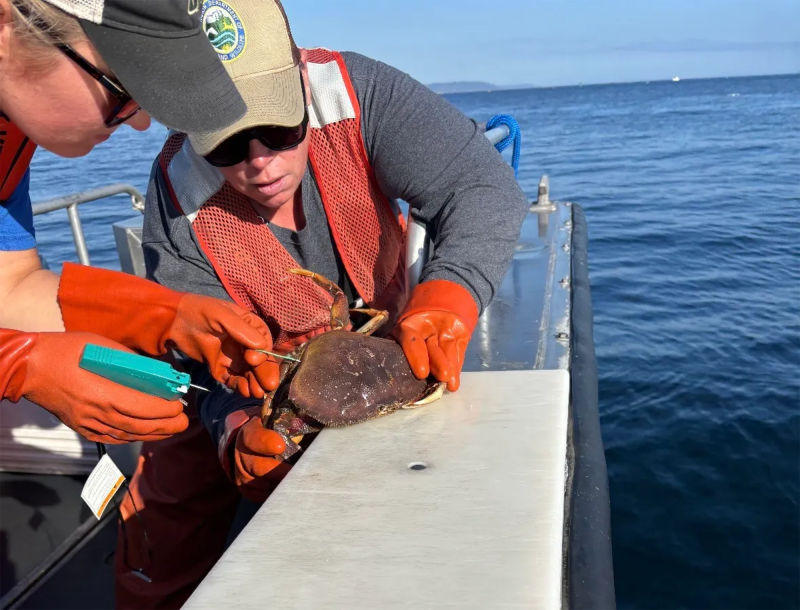
Each tagged crab carries a two-inch, wire-like floy tag with an individual identification number and a phone contact, inserted along the suture line on the back of the carapace — a spot researchers say can retain the tag through multiple molts. Researchers recorded each crab’s size, shell hardness and capture location before release.
Anglers who catch a tagged crab are asked to report the tag number, approximate catch location, and catch date, either by calling or texting the number on the tag or through an online form with GPS mapping. WDFW said there is no food-safety concern with a tagged crab as long as it is a legal-size hardshell male.
“This study will help us determine how crab move around in certain areas of Puget Sound,” said Katelyn Bosley, WDFW crustacean program leader. “This could even provide more insight about crab abundance and assist us in how we manage crab fishing seasons and set annual catch quotas.”
The summer recreational Dungeness crab season opened in July under a patchwork of area-specific schedules. Marine Areas 9 and 12 are open Thursdays through Mondays from July 2 through Sept. 7, while Marine Area 10 is open Sundays and Mondays only over the same period. WDFW publishes a full schedule of dates for other marine areas on its website.
The current work builds on an earlier WDFW tagging study conducted from 2002 to 2007 along the western side of Hood Canal and near Port Townsend and Discovery Bay in the eastern Strait of Juan de Fuca, in which 7,137 tagged crab were released and 567 recaptured.
“Since that time, we’ve explored repeating that study in other places of Puget Sound where there are pressing management questions,” Bosley said. “We have low or poor crab populations within Marine Areas 10, 11, and 13, and are hopeful studies like this can lead to creating more viable sustainable fisheries in Puget Sound.”
A pilot tagging run preceded the current study: WDFW released 100 tagged crab in Port Townsend Bay in Marine Area 9 on June 12, 2025, of which 10 had been recaptured as of June 25, 2026.
Other tribes have run parallel efforts. The Swinomish Tribe tagged and released 500 crab with blue floy tags in Similk Bay, in Marine Area 8-1 near Deception Pass, Hope Island and Skagit Bay, in April 2025. It added 200 more tagged crab in Similk Bay in April 2026, along with 300 in the southern end of Saratoga Passage and 41 in northern Skagit Bay in May 2026.
“In the 2025 summer crab fisheries, recreational anglers reported several of the blue colored tags in that area,” Bosley said. In May 2025, a tribal test fishery recaptured a tagged crab in Skagit Bay south of its release point.
WDFW also convened a tagging and shell-condition workshop in Port Townsend in June, drawing representatives from the Lummi, Suquamish, Jamestown, Port Gamble, Skokomish, Puyallup and Swinomish tribes, along with WDFW coastal shellfish managers and coordinators from the Pacific Northwest Crab Research Group.
WDFW and tribal co-managers regularly run test fisheries in Puget Sound to gauge Dungeness crab abundance and inform winter and summer season-setting, dividing the Sound into marine areas that each carry their own catch quota.
.jpg.small.400x400.jpg)
