




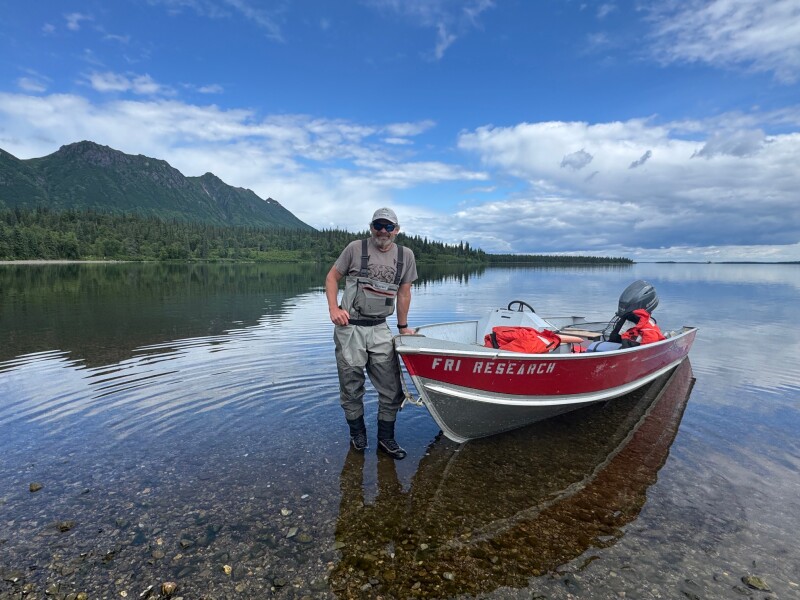
Nearly three decades into his research on how aquatic systems are responding climate change in Bristol Bay, University of Washington (UW) veteran fisheries biologist Daniel Schindler says smart development will be needed to protect Alaska's salmon habitat.
"I think it is an important message that Alaska must protect its habitat," Schindler said in an interview with National Fisherman from a UW field camp in the Bristol Bay watershed, on July 13. "We have destroyed so much habitat in so many places due to ignorance, only to learn afterward how important that habitat was to our fisheries.
"All over the West Coast and in Europe, habitat has been destroyed," he said. "Alaska still has most of the pieces on the table. We are in a position to protect most of these ecosystems, and I hope we wake up and realize we can seriously degrade their capacity to support fisheries."
To Schindler and many others, mines such as Pebble and Donlin mine in salmon habitat, along with certain energy and road development projects, pose distinct threats. Backers of mineral exploration and development say that using state-of-the-art practices will protect the fisheries, but history and science do not support these claims.
The University of Washington's Alaska Salmon Program, which dates back to the 1940s, focuses on all aspects of the ecology and evolution of Pacific salmon in watersheds in western Alaska, the Bering Sea, and Gulf of Alaska. Every summer, as many as 30 researchers, including undergraduates, graduate students, and faculty professors, rotate through several field stations for the program, with a handful of them there for the entire summer.
One of them is Schindler, who began his research there in 1997 on the invitation of UW professor Ray Hilborn before joining the faculty and beginning to teach on the UW campus. Program facilities include a network of field camps on Wood River, Lake Iliamna, and at Chignik.
UW also has a broad web of collaborators in Alaska, nationwide, and globally, but they have to pay their own way to Bristol Bay and for accommodations at the field camps.

UW research is funded from several sources, including federal grants, "but the core of it is provided by the processing industry," Schindler said. "They were the reason we started in the 1940s."
Other funds come from the National Science Foundation, the Gordon and Betty Moore Foundation, Bristol Bay Regional Seafood Development Association, the Chignik Regional Aquaculture Association, and U.S. Fish and Wildlife grants.
Decades earlier, after trashing the Columbia River, fishing fleets had moved north to Bristol Bay with their wooden boats, and for some years, they had relatively robust harvests of sockeye salmon in Bristol Bay. When those harvests declined, the processors turned to the University of Washington for help in managing the fisheries. "There was no state of Alaska," Schindler noted. "There really wasn't much science to guide management up here, so the canning industry came to us to develop information about the ecosystems needed to sustainably manage the fisheries."
Today, the research team actively pursues discovery science in an era of rapid global change to produce data and knowledge for managing and conserving regional ecosystems and their fisheries, and to provide insights relevant to fisheries and watershed management globally.
The research also includes an educational mission providing research opportunities for undergraduate and graduate students and engagement with local internship programs, other citizens, and management agencies to improve their collective understanding of these ecosystems.
This summer, researchers are in the second year of a project looking at the upper Nushagak River, which has shown a recent surge of sockeye production. The Wood River is a lower tributary of the Nushagak,they have studied the lakes and streams since the 1940s.
"We have seen long-term responses to warming climate and the buildup of Wood River sockeye populations," said Schindler, "but only in the last decade has the upper Nushagak really taken off.
"From the 1940s to the 1970s, the Wood River run averaged 2-3 million sockeyes, and now it can produce over 10 million fish a year. Warming of the lakes has allowed juvenile sockeye salmon to grow faster before heading to the ocean in recent decades compared to the first years of UW observations in the Wood River. Juvenile fish can't grow if they are constrained by temperature, so as the lakes warm up, the fish grow faster," Schindler explained. "That's why we think Bristol Bay has more fish than it did historically. The adults are definitely smaller now, though, and that has to do mainly with competition with pinks and each other in an increasingly crowded ocean."
"Data suggests that as the ocean has warmed, survival of Bristol Bay sockeye smolts has increased. It is the perfect world for Bristol Bay sockeyes right now, and that is why the last decade of sockeye returns have been off the charts in Bristol Bay," he said.
Meanwhile, the Gulf of Alaska is warming as well, but it is about three degrees Celsius warmer, which suggests that the Gulf of Alaska is closer to a tipping point in response to climate change, as indicated by relatively low returns to places like the Copper River in the last decade. "It's a patchwork quilt of where the winners are and where the losers are," Schindler said. "Bristol Bay has been one of the winners in past years of climate warming."
The question now is how much more warming these ecosystems can absorb and still be productive. Places like the upper Nushagak are still very cold and seem to have lots of additional capacity to warm up and be productive nursery lakes for sockeye salmon.
Something else is going on with the Chinook salmon, and that remains a puzzle.
Schindler said the evidence is strong that killer whales eat a lot of Chinook salmon, whose body size in harvests and escapements is much smaller than it used to be. "The causes of declining body sizes in Chinook salmon are not understood but are consistent with size-selective predation by growing killer whale populations — they pick off the big ones."
Changes in the abundance of Yukon River Chinooks look almost exactly like what has been seen in Chignik and the Nushagak River.
The Yukon is over 1,000 miles long, and the ocean is a long way from where the Chinook spawn. In Chignik, it is just a mile from the spawning area, so the dramatic decline in Chinook salmon in both areas suggests something of a broad-scale regional impact, such as something going on in the ocean.
"Bycatch of Chinook salmon by the pollock fishery is very well managed and monitored," said Schindler. "The numbers are small, a few thousand Chinooks from western Alaska every year, but if you compare that to 30 years ago, we are missing almost one million Chinook salmon. It is simply not likely that the pollock industry is holding down these populations."
Schindler said the biggest thing that researchers have learned is that the more they discover about these ecosystems, the more they realize how little they know.
"Science just produces one surprise after another," he said. "The flip side is that this complexity is what makes these ecosystems productive and sustainable and forgiving to management errors.
"Management of Bristol Bay salmon fisheries has been very effective, but the complexity in these ecosystems is what will ultimately provide resilience to climate change," he said.
.jpg.small.400x400.jpg)
