When the Denmark-based door manufacturer Thyborøn Trawldoor launched its controllable doors in 2018, it turned heads. Now the company has added automated height control. “With the auto height feature, you can maintain your doors at a preset distance from the bottom,” explains Henrik Andreassen, Area Sales Manager at Thyboron Trawldoor. “Once you set the height, the door will fight to stay at that height.”
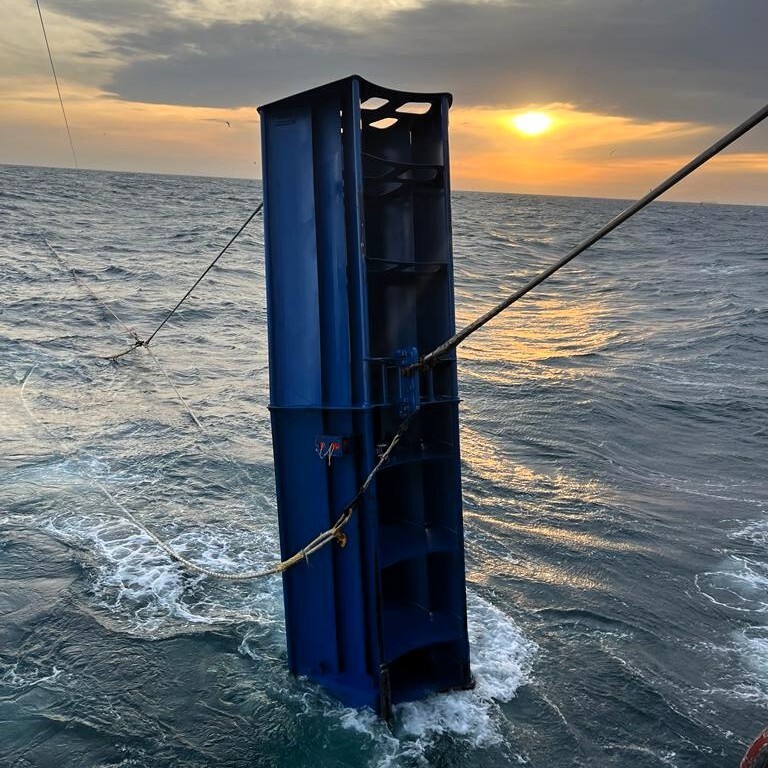
The controllable doors that Thyborøn began developing nine years ago feature top and bottom foils that could be opened and closed with a hydraulic pump when out of the water. “Then we put a small engine room on the door with a 100-hour, subsea lithium battery and depth sensor, a motor controller, and a high-pressure unit,” says Andreassen. “We put two hydrophones on the keel of the vessel and a wire to the software in the wheelhouse. We control the doors acoustically or via the third wire and netsounder.”
To this arrangement, Thyborøn has now added a height sensor. “We had a depth sensor,” says Andreassen. “Now we have like an altimeter that tells the captain the height of the door above bottom. It’s a unit about 35 centimeters long that fits into the engine room on the door, and there is a hole drilled out where it can look down and see the bottom.”
The new height sensor runs on the battery in the engine room, which, Andreassen notes, has been upgraded with a heater to help with fast charging.
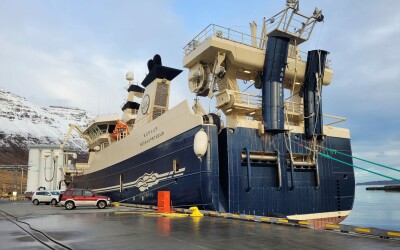
While Andreassen cites the increasing need to keep heavy gear off bottom to protect habitat as a key motivation for developing the height sensor, for Ola Hansson, skipper and part owner of the Swedish trawler Kristin, it’s also about having better control of his gear so that he can catch more fish faster, while burning less fuel.
"In sprat fishing in the North Sea, the trawl goes on the bottom, the whole groundrope of the trawl has to have contact with the bottom,” says Hansson. “From there we steer the height of the doors, typically between 2-3 meters above the bottom. In the evening or at night, the fish moves towards the surface and we can easily control the doors upward.”
Hansson notes that before getting the height control doors from Thyborøn, he would have to increase RPMs or shorten the wire. But that also has a negative impact on the spread of the doors and also the shape of the trawl,” he says. “We have also seen that we can turn around with good control of the doors and keep a good shape of the trawl. The whole operation to place the doors and trawl where you want it is easier, more accurate than if we control it by giving more or less power to the main engine.”
Andreassen notes that besides Hansson on the Kristin, many other boats are using the height control technology. “We have forty-four boats using our controllable door systems,” he says. “Of those, twelve are using height control, including a Spanish trawler taking the new doors to Argentina to use in the Loligo squid fishery, and a Norwegian Trawler is taking a pair to the Barents Sea,” Andreassen adds that ten pairs are being built for other vessels, and he is about to bring them to the North American fleets.
"We just finished the Danfish show in Denmark, and we’ll be bringing the doors to a show in St. John’s, Newfoundland, in November,” says Andreassen. “And then to Pacific Marine Expo.”
While no U.S. boats have bought the new doors yet, Andreassen is hopeful that at least one of the large factory trawlers already using the controllable doors may eventually choose to upgrade.