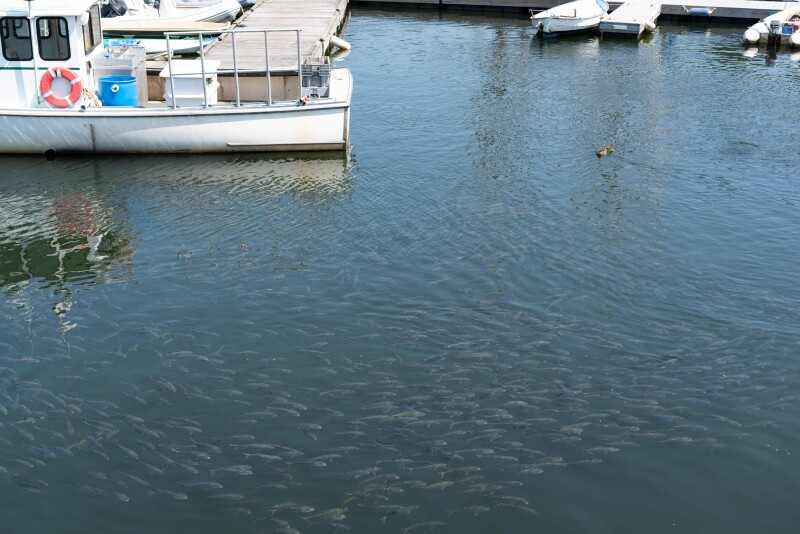
A recent fish wash-up along beaches from Cape Henry, Va., to Nags Head, N.C., has reignited tensions between environmental advocates and the menhaden industry, with the Menhaden Fisheries Coalition accusing the Chesapeake Bay Foundation (CBF) of mischaracterizing the event to attack Virginia’s reduction fishery.
In a statement released on March 6, the coalition criticized comments by CBF’s Will Poston linking the die-off to broader concerns about the Atlantic menhaden fishery, calling the claims “misleading” and part of a broader campaign against the industry.
“The Chesapeake Bay Foundation is using this natural event to make false accusations and continue the campaign of anti-menhaden misinformation,” the coalition stated, arguing that the beach wash-up was unrelated to fishing activity.
According to reporting by WTKR News 3, the Virginia Marine Resources Commission (VMRC) said the event was not connected to a fishing accident. VMRC public information officer Zach Widgeon told the outlet the die-off was “not a result of a fishing spill or a net bust,” but rather a natural occurrence tied to a sudden offshore temperature drop.
Menhaden plays a key role as forage for larger predators and can be vulnerable to abrupt environmental shifts. Large schools moving through coastal waters during rapid weather changes sometimes experience mortality events that later wash ashore.
Industry representatives say the presence of large numbers of fish is itself evidence of a healthy population. “As Mr. Widgeon noted, ‘There are so many menhaden out on the East Coast that you’re going to see them affected and washing up more than any other species,’” the coalition said in its statement.
The coalition also pushed back on claims that industry groups have slowed research into menhaden populations in Chesapeake Bay. Poston suggested that efforts to fund additional research had been delayed by Omega Protein and its lobbying partners in Richmond. “There is no truth to that statement,” the coalition said, adding that companies involved in the reduction fishery have supported numerous scientific studies over the past two decades and regularly provided operational data to federal and interstate fisheries managers.
The debate over menhaden science and management has been ongoing for years. Environmental grounds, including CBF, have argued that more precautionary management is needed to ensure adequate forage for predators such as striped bass and osprey.
Industry groups counter that the current management already accounts for ecosystem needs. The Atlantic States Marine Fisheries Commission’s most recent benchmark stock assessment concluded that Atlantic menhaden are not overfished and that overfishing is not occurring. Beyond the science debate, the coalition emphasized the economic role of the fishery in Virginia’s Northern Neck, particularly around the town of Reedville, home to the last remaining menhaden reduction operation on the East Coast.
A VMRC economic analysis found that the operation supports hundreds of jobs, with the majority of employees living in Northumberland County.
“These attacks are aimed at real people in a real working community,” the coalition said, noting that the Reedville industry provides stable employment with benefits and union representation in a region with limited economic alternatives.