
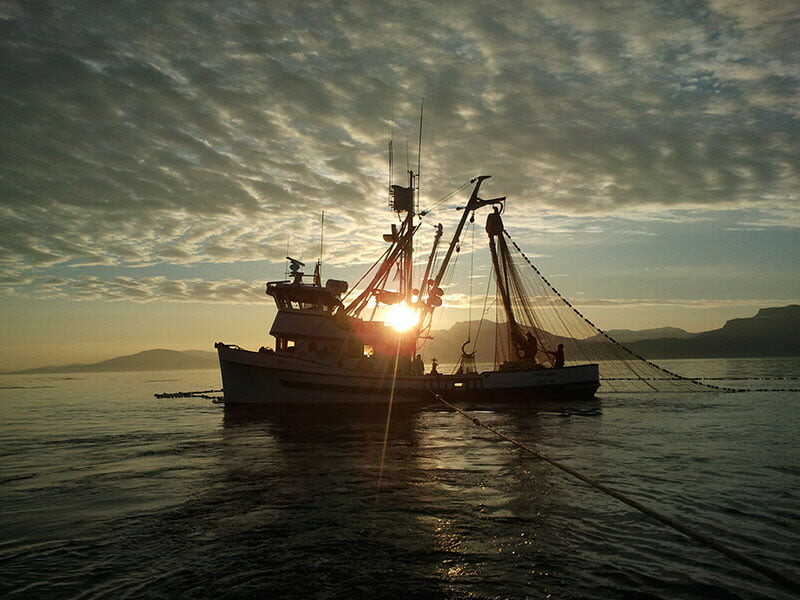
At Bulletproof Nets, keeping Alaska’s seine fleet on the water is equal parts tradition, craftsmanship, and innovation. The Homer-based shop, now owned by LFS Inc., Bellingham, Wash., is the largest of its kind in Alaska, servicing gear for fishermen across the West Coast and Alaska, with some odd jobs extending as far as St. John, U.S. Virgin Islands, for Atlantic skipjack tuna. National Fisherman visited the shop in August, and met with seine production manager, Sid Paulino, and operations lead, Cody Stadler.
The company builds custom seine nets designed to meet the specific needs of commercial fishermen, adapting each net to factors like deck space, horsepower, water depth, regulatory requirements, and budget, ensuring that every build is tailored to the operation.
While newbuilds are less common, repairs make up the bulk of the work. Crews bring in their nets before the season, decide which sections are a must to be fixed, and leave the rest for another year. “Every season some guys come in for what we call a tune-up,” said Paulino. “We’ll fix the first 30 fathoms, then they decide what they’re okay with leaving. It’s the least money you have to spend to keep fishing.”
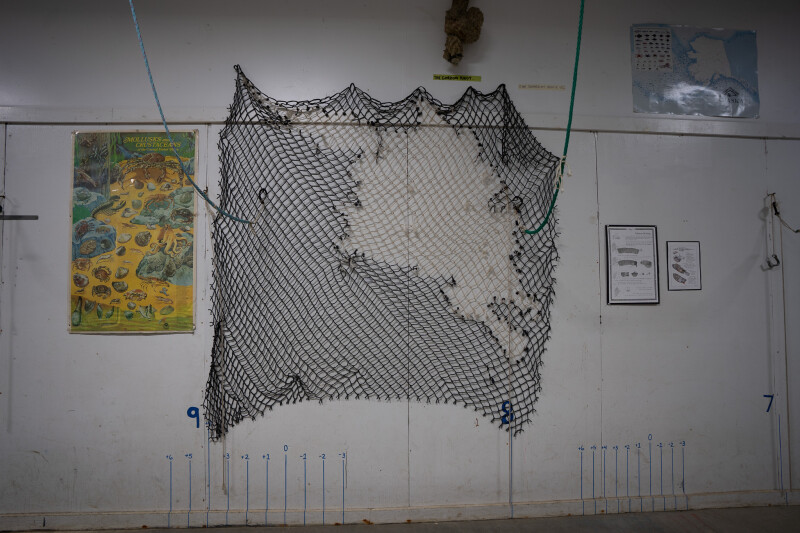
The shop has formalized this process with a detailed checklist and repair log. Customers review each section of the net and mark whether they want repairs completed, deferred, or customized. A budget section helps align expectations. “If what they want doesn’t match the budget, we can have that conversation: 'Do you want to push your budget, or do you want me to dial back?'” explained Stadler.
Bulletproof has also modernized its recordkeeping. What began on graph paper has moved into Excel spreadsheets. Each net has a corresponding file with color-coded updates by year and a notes section for completed work and items deferred for future seasons. This running history allows both the shop and the fishermen to track the changes to their nets over time.
“Every year that it gets worked on, we note things that were done and things that need to be done but we didn’t have time,” Stadler said. “It’s a way to slowly check things off year after year, 'okay, we had budget for this, we didn’t for that.'”
Customization is central to the shop’s work. Some clients can add removable extensions to meet regional permit allowances, such as Prince William Sound’s 25-fathom add-on that brings a net up to Kodiak length. Others prioritize speed and low drag, using Spectra material. "Spectra is popular because it can provide similar strength as the poly chafe we typically use while being a much smaller diameter," Paulino said. "It’s all priced differently, and it depends on how you want to fish...Some guys want durability, others want light, fast nets that let them tow harder.”
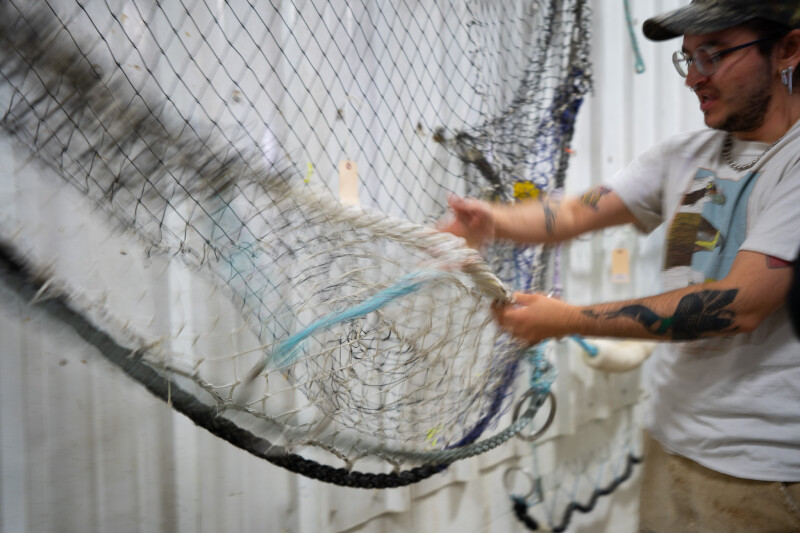
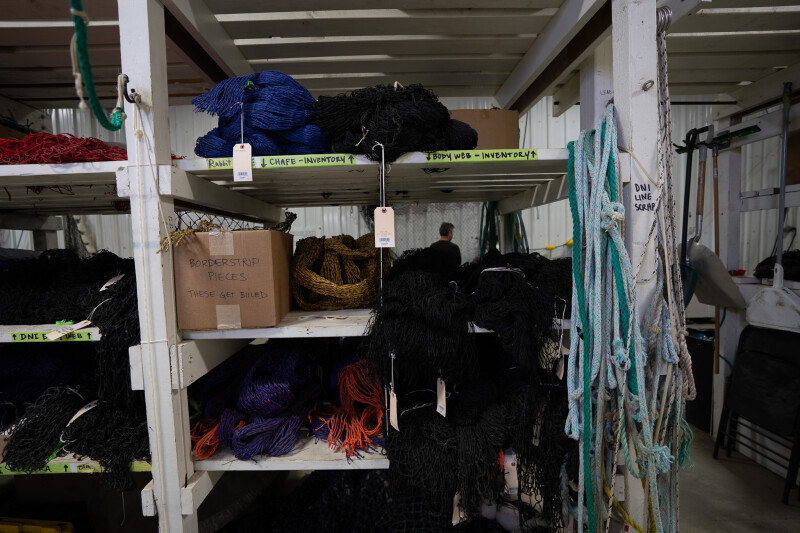
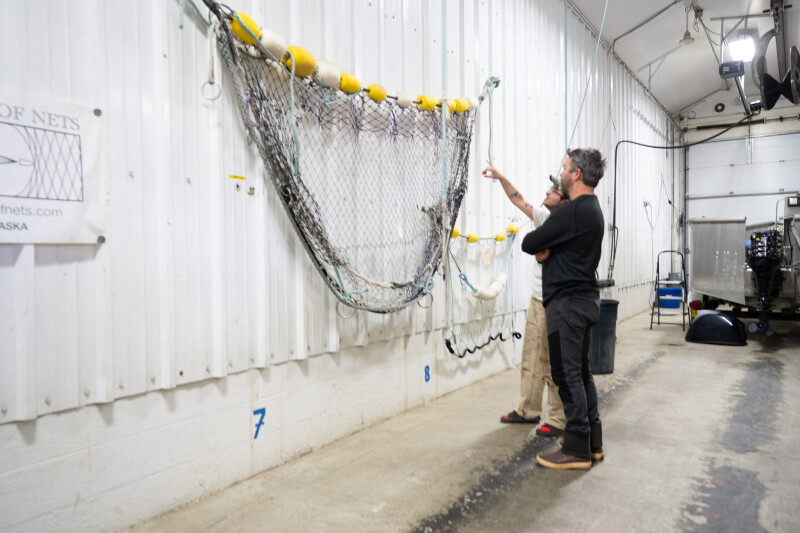
The intricacy of a seine net becomes clear in the shop’s material samples. Each component, from cork lines to rib lines, has options that affect how the gear performs. “There are so many components and so many things you can do,” Paulino said filing through a net sample hanging on the wall, showing the differences between traditional knotted cork lines to modern stick-through connections that make reattaching broken lines more precise.
“With stick-through, you know exactly where to reconnect…That’s the rib line. Here’s a Spectra rib line. This is the lacing,” they said. “That’s how we put it all together. Here’s your chafe gear. We use a poly-blend for durability, or Spectra chafe gear if you want it super soft and light. Some guys go all out with Spectra for low drag."
This level of customization means no two projects are the same. “One guy in Prince William Sound wants to tow really hard with his big boat, so his net is almost entirely Spectra,” Paulino said. Despite Spectra being deemed "stronger than steel", he noted this particular fisherman shreds his every year due to his vessel size and how hard he tows.
Longtime net builder Matt Alward, who owned the shop before its 2020 sale, still comes in for major builds. His speed and experience are considered unmatched. “He trained our boss, who trained us,” Stadler said. “Watching him mend is craftsmanship at its highest level.”
While the shop rarely builds fully-new nets, its diagnostic and section-replacement work keep fleets fishing. Most nets are purchased used and then adapted piece by piece. “Nets are built for someone else’s style,” Stadler noted. “We help the new owner learn how to fish it and adjust what’s needed.”
Beyond repairs, Bulletproof collaborates with Japanese hardware maker Asano to test new designs. “They’ll work with our boss, Josiah, on a new concept, something that maybe hasn’t been improved in a long time,” Paulino explained. “They’ll basically just talk with him, design something, work a bunch of it out, they’ll print it, and then they give us the 3D printed model. We take that to Pacific Marine Expo every year,” they said. One of the recent developments was a redesigned pelican hook, a device commonly used in gillnet fisheries to release brailer bags from cranes.
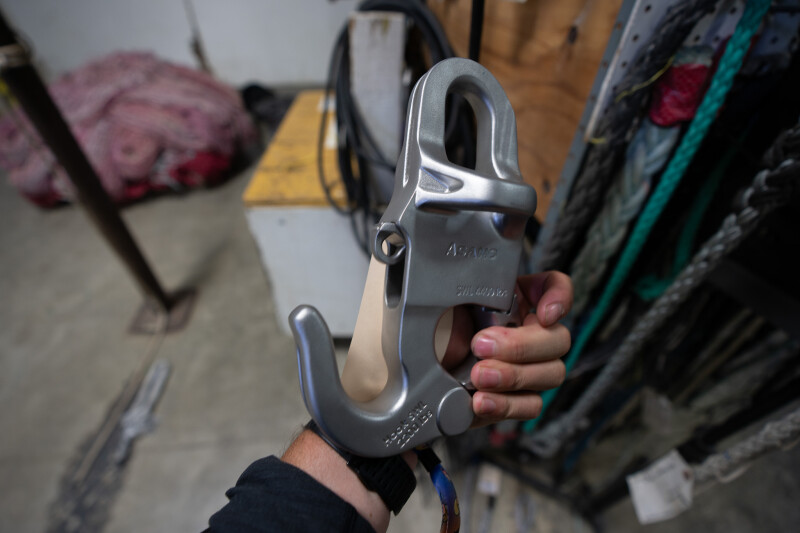
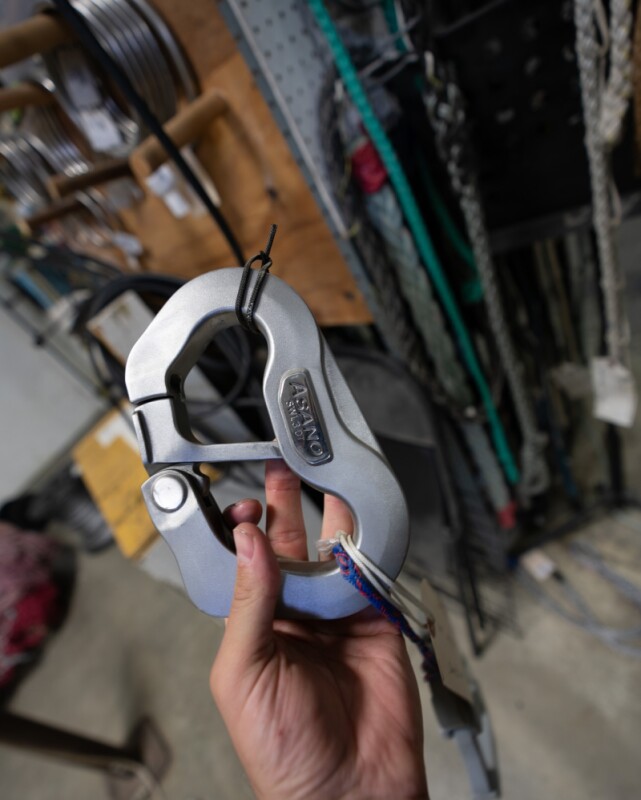
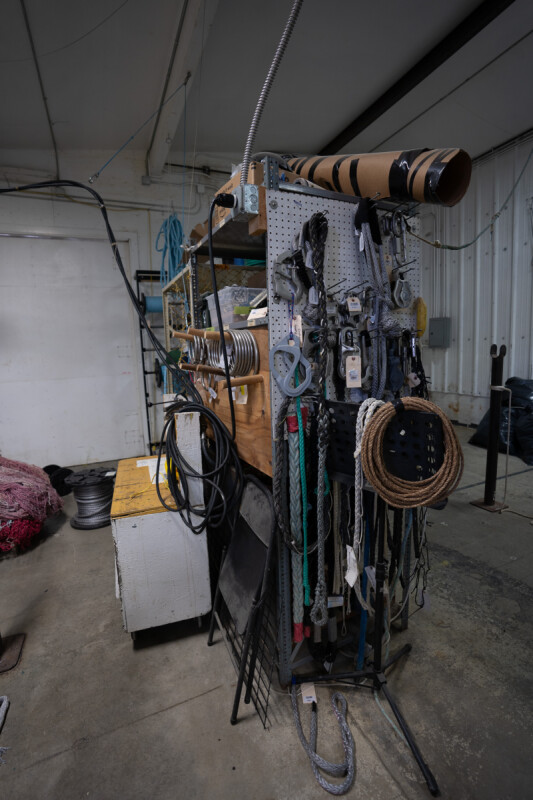
“A pelican hook typically is this huge contraption. They’re massively difficult to deal with. You need two hands to open and reset it,” Paulino said, grabbing a small piece of equipment from a nearby shelf. “This is their version of a pelican hook. It’s so much easier to use. This new one is lighter, way stronger, and you can open it with one hand. It’s insanely more efficient,” he said.
After showing early models at PME, Paulino said Asano adjusted the design so that lines wouldn’t catch on a knuckle near the hinge, moving the release point farther back and strengthening the hook. Paulino noted the new model is rated to Japanese standards. “It says it’s rated for 2,200 pounds, that’s in Japan. Which means in the U.S., it’s rated for like 6,600 pounds,” they added.
Despite the shift to corporate ownership under LFS, the shop maintains its focus on the fleet. Employees share information freely with other net builders across Alaska. “If someone else wants to start a shop, please do,” Paulino said. “There’s plenty to go around. I’d rather talk through it with another net builder and have it done right than fix it later.”
Speaking to the work, Stadler said, “It's that old tradition. Quality, worksmanship, cutting edge materials, that we're still doing it. We're pretty damn good at what we do. And we're standing on the shoulders of the people that did it before us...Still trying to keep that same small culture that fishermen have always relied on."