

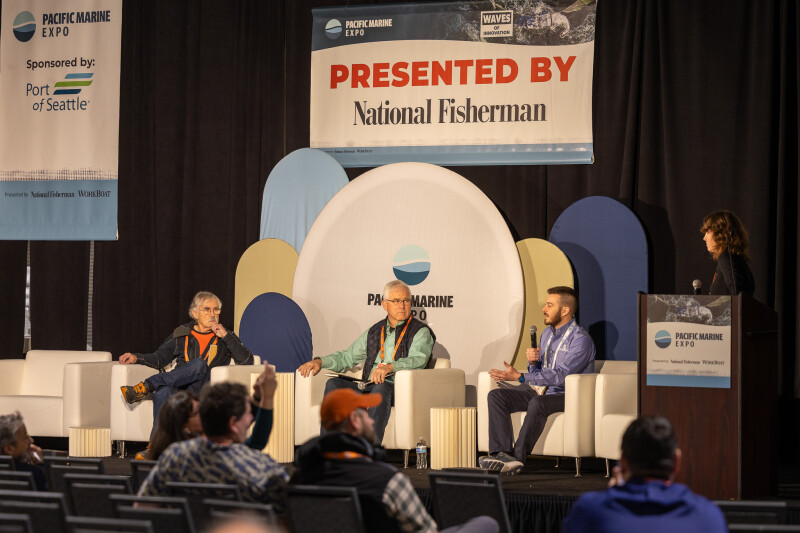
Jerry Dzugan, founder of the Alaska Marine Safety Education Association (AMSEA), opened the Pacific Marine Expo’s conference sessions by dispelling the notion that 80 percent of commercial fishing fatalities are the result of what we refer to as the “human factor.”
“Human factors are really responsible for 100 percent of all incidents,” said Dzugan.
Whether it’s design, building, or operation, it’s hard to get away from the effect people have on fishery operations and safety.
But the human factor is also what keeps the industry thriving, and that’s never been more apparent as the industry continues down the road of managing the graying of the fleet.
Workforce development is a critical component across trades in general. However, the unique challenges in maritime trades continue to be introducing new candidates to the full spectrum of on-the-water jobs.
As familial traditions have transitioned away from fisheries, the industry’s primary objective is to bring new people to the jobs.
Robert Maw, Fisheries Specialist for Washington Sea Grant, reviewed the upcoming Washington Fishermen’s Convention, which will focus on key entry-level skills for fishermen, including first aid, AMSEA Drill Conductor training, net-mending, and HACCP regulations.
Taking a slightly different tack that includes maritime training as part of a broader trade development effort, Oregon has nine local workforce development boards that work on fulfilling the needs specific to their community. Each local board has a staff that’s funded through the state general fund as well as federal grant funding. That staff works with the local board of stakeholders to get the skilled workers they need for their local trades.
Andrea Tomlinson, director of the New England Young Fishermen’s Alliance, emphasized the dual approach of training deckhands to invest in their own fisheries businesses and filling their boots on deck with greenhorns.
Tomlinson noted that graduates of the Alliance’s Deckhand to Captain Training Program will be pairing up with new entrants to help them train for the organization’s Greenhorn Apprenticeship.
And Tomlinson takes the human factor one step further.
While fishermen are accustomed to advocating for themselves — and the Alliance helps train them to be engaged with the regulatory process, including lessons in public speaking — they also need support from the regulators to incorporate their experience into the management process.
“We need more social scientists to turn fishermen’s knowledge into data,” Tomlinson said.
In a NOAA-hosted session reviewing the importance of Alaska fisheries observer data, Bill Tweit, who is now retired from the Washington Department of Fish and Wildlife, noted that the human component for scientific data collection is as yet irreplaceable by electronic monitoring.
“The holy grail of EM is that you can train a camera on a conveyor belt and it will tell you what kind of fish is going by,” Tweit said.
But he predicted that onboard observers will still be necessary even 20 years from now — though the expectations for what tasks they’ll be performing on board remains to be seen.
“Environmental DNA and other new technology will continue to be helpful, but we’ll also be expecting more and more from our human observers to help extend the reach of new technologies,” Tweit added.
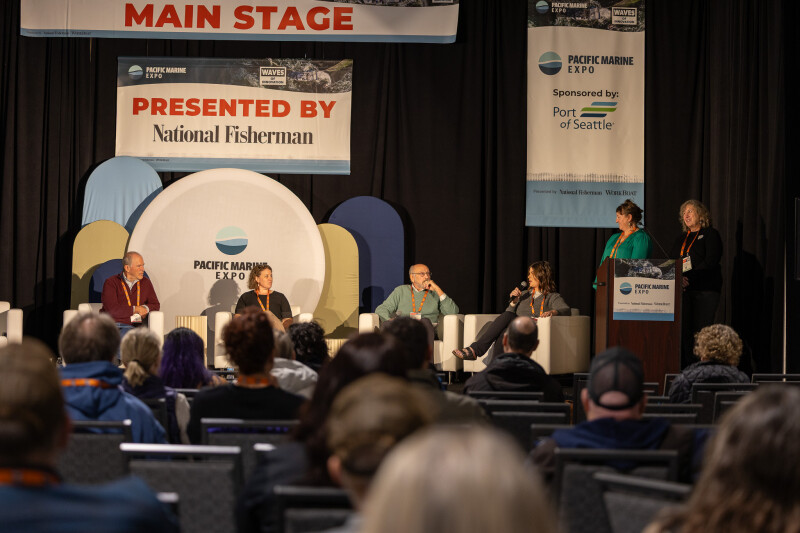
Fishermen in the audience asked about the burden of carrying observers on board and instead training fishermen to collect observer data. While Sarah Webster, the Science Projects Director for the Alaska Seafood Cooperative, and Sara Bunker, Data Manager for Ocean Peace, emphasized the importance of unbiased, third-party data collection, Karl Haflinger, founder of Sea State, noted that the Canadian model for data collection could be one alternative for paid observers.
In that model, “boats submit logbooks that are cross-referenced with EM, and if there are discrepancies, there’s a higher requirement for in-person observers,” Haflinger said.
The future of fishing will depend squarely on engagement with new generations and the unique subcultures that come with them.
Denielle Christensen, executive director and CEO of WaveWorks Alliance, asked about the tipping point where the industry will have to adjust to younger generations rather than the other way around.
“The biggest message from the young generation is that they need to feel listened to,” Maw said. “They don’t need to be right, but they want to be heard.”