For some National Fisherman Highliners, you could almost predict it. You’ve seen them at conferences, on panels, in meetings. Sometimes their names are known on coastlines far beyond their home ports.
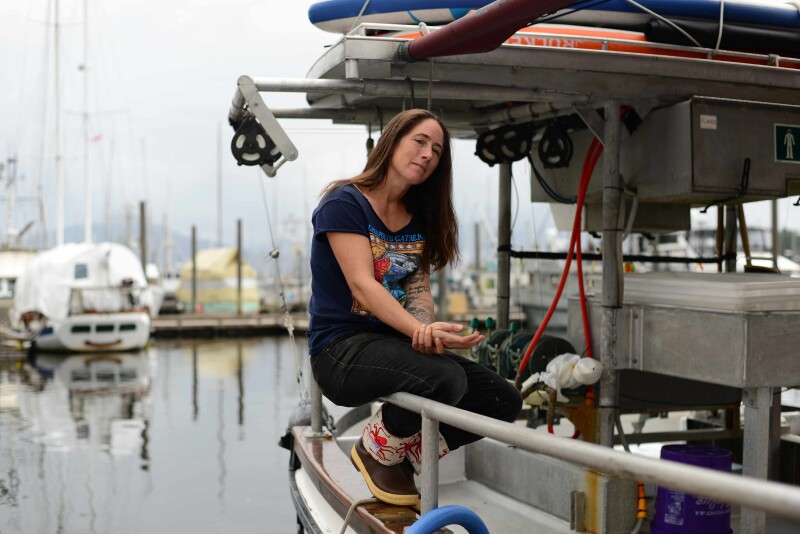
But for Tele Aadsen, the announcement that she had been awarded the distinction came as a shock. “Immediately I felt imposter syndrome,” Aadsen says. “I thought about my idols like Linda Behnken and Joel Kawahara, people who spoke to big groups and did big things in big ways. That’s not how I have done things. I do things one at a time: one fish at a time, one word at a time, one conversation at a time. But if they’ve selected me, maybe that’s why?”
Aadsen often refers to herself as a tofu-eating, tree-hugging, feminist writer, and fisherman, and maybe we need some of that in a decidedly macho, dangerous catch-type industry. Through her lyrical prose, rich with subtle attention to details such as a feather floating on the surface, Aadsen opens a door to the feminine energy of the sea. “As we treat women, so we treat the sea,” said Indian fisheries activist and feminist, Nalini Nayak.
It was through her parents, but more her mother, Val, that Aadsen found her way to the sea. “We started out living in the Matenuska Valley,” says Aadsen. “Both my parents were veterinarians, and they had a clinic there. My earliest memories were of the parking lot full of sled dogs.” But Aadsen’s parents were planning an escape from that world. They were building a 45 trimaran in their backyard, and when Aadsen was 7 years old, they sold the clinic and traded it for a nomadic life at sea.
“They tried hand trolling using hand crank gurdies,” says Aadsen. “The hand trolling permits were cheaper, so that’s where they started. But I look at their old logbooks from those days, and the numbers didn’t add up.” After three years of trying to fish the sailboat, Aadsen’s parents sold it and built a 54-foot troller, the Willy Lee II, but continued to struggle. “At that point their marriage started breaking down,” says Aadsen. “My dad didn’t think we could make it, but my mom wanted to keep trying. They divorced when I was 13, and my mother got the boat. She still wanted to make the dream come true; she believed in it, and I continued fishing with her. I left her house when I was 15 but fished with her until she finally sold the boat when I was 19.”
Raised in a family that did not talk much, Aadsen found her voice in writing. She spent six years away from fishing, working with troubled youth. “Fishing is what I went back to when I burned out on being a social worker,” she says. “I was working on different boats when I met my partner, Joel Brady-Power. We met in the Pioneer Bar in Sitka. He was 22 and was just getting ready to buy his family's boat, the Nerka. I didn’t want to be part of his learning curve, so I kept fishing on other boats, but in 2006 we started working together, and I took over his family’s fish business, selling the catch.”
Running Nerka Sea-Frozen Salmon, Aadsen sells all the fish she and Brady-Power catch. “Mostly local,” she says. “But we ship some further, wholesale.”
Plenty of people in the commercial fishing industry catch and market high-quality seafood; what separates Aadsen from the pack and ranks her as a Highliner is her writing, in particular, her book, What Water Holds, and more recently a book of poetry and essays she helped edit, Cascadia Works: Tend Gather Harvest Restore, which centers on fishing and farming in the Cascadia bioregion.
“I edited the sea portion,” says Aadsen, whose writing about the sea enables her to express all she carries in that relationship and her commitment to the water and all it holds, as the title of her book says. “What I love about writing is the progression of drafts and articulating more clearly what I’m trying to express,” she says. “You can’t do that with talking.
In 2012, Aadsen started going to the annual FisherPoets gathering in Astoria. “I first went as a performer,” she says, noting that as time went on, she started accepting little responsibilities that grew and grew until she became an organizer.
“Twelve years of FisherPoets’ essays put my evolving obsessions on full, undeniable display,” Aadsen says about her own writing in a 2023 article for the North Cascades Institute. “The narrator’s voice shifts from that of a young woman struggling to maintain agency within a male-dominated industry, to establishing equity in the inescapably hierarchical ‘captain/crew’ dynamic, to broader environmental observations and questions. Commercial fisherfolks have front-row seats to the changing climate; citizen scientists are directly engaged with ever-shifting marine ecosystems. As land-friends place increased value on knowing their harvesters, how to communicate the complex network of conservation-based fisheries management and responsible harvest practices that ensures a sustainable sea-to-plate story? What does it mean to be both harvester and environmentalist? How to convey deep salmon reverence, as written by bloody hands?”
The FisherPoets gathering in Astoria is the right place to express reverence with bloody hands, but Aadsen, as she says, seeks to reach a wider audience. “I want to be both a mirror for those who know the life, and a window for land people who are further removed from it,” she says. “I want to help them understand that fishermen want to protect fisheries and protect salmon. I hope that they can gain an understanding of how many fishermen are invested in conservation and habitat restoration.”
Aadsen wants to wake people up to the realization that fisheries management is not enough. “What happens on land is just as important,” she says. “When we’ve gone fishing the last five years, we’re seeing things we never saw before: jellyfish so thick in a place we used to fish that we couldn’t set a line without it getting all goobered up; there’s albacore in southeast Alaska every year, which would have been a shock in the 2010s.”
Within Adasen’s lyrical poetic prose is a siren’s call for seafarers and land people alike. The world that she found her true home in is in trouble, and she needs help saving it. Her gift with words, aimed at reaching readers beyond the fishing community and the fisher poets gathering, is what makes her a highliner.
“Joel and I don’t have a plan B,” she says. “We want to fish for as long as we can, and we want coming generations to be able to do it. I want to communicate through art and writing, to raise awareness and connect people to who we are and what we do. As a Highliner, if other people feel moved to share their experiences through writing, I’d be happy to see that unfold.”