


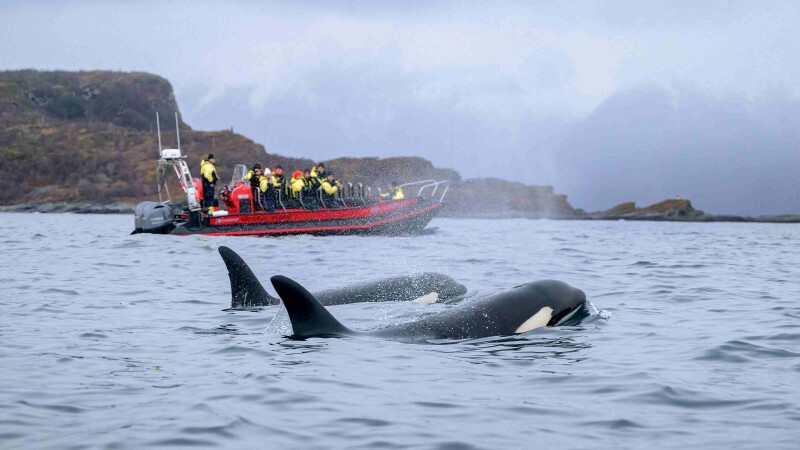
Killer whales in Alaska's Prince William Sound and Kenai Fjords have a diverse, seasonally changing diet of salmon and groundfish, consumed across regional foraging hotspots, a new study shows.
This population of about 1,000 animals, with a growth rate estimated in 2014 at 3.4 percent, shifts from Chinook, chum, and coho salmon to smaller amounts of Pacific halibut, arrowtooth flounder, and sablefish, depending on where the orcas are hunting. The study was published recently in the journal Ecosphere.
An actual estimate of the number of fish these killer whales eat was not part of this study, said Hannah Myers, an assistant professor at the University of Alaska Fairbanks College of Fisheries and Ocean Sciences, and lead author of the study. Researchers found that the orcas consumed mostly Chinook salmon in one foraging hotspot, mostly chum salmon in another, and mostly coho salmon in the third, Myers said. Pacific halibut, arrowtooth flounder, and sablefish also showed up in fecal samples as important prey items.
The study is part of a long-term monitoring program launched in 1984 by the North Gulf Oceanic Society, a small non-profit in Homer and Seward, Alaska, dedicated to whale research and education.
Working from May to September, researchers have gathered a total of roughly 400 remnants of prey fish and scat to develop a picture of what these whales eat.
Historically, killer whale diet research relied on surface sampling of prey fragments, usually scales, helping researchers to determine primarily salmon species. Newer techniques that analyze DNA in scat showed the full depth of the orca diets.
Dan Olsen, a biologist with the North Gulf Oceanic Society and a co-author of the paper, said these DNA studies from fecal samples offer much more information than previous techniques. “This prey diversity is important to understanding the ecosystem, and perhaps future winter samples will show even more variability when times are lean.”
“Switching between these salmon species — with important contributions from groundfish — is a different narrative from the one we usually hear about the diet of fish-eating killer whales in the North Pacific, which emphasizes Chinook salmon as their primary prey,” Myers said. The study also focuses on the importance of accounting for sampling bias in diet studies.
In this study, Chinook salmon samples were collected most often but were also easiest to gather, Myers said. Separating the diet by season and location showed the importance of other prey species.
Prey samples were collected by following whales as they foraged. Researchers scooped up scales or pieces of flesh with a pool net. Fecal samples were collected by following behind the animals at a distance, looking for scat floating up in the upwellings of water from their flukes as they dove.
Researchers noted that orcas that exclusively eat fish are a distinct subspecies from two other types: one that eats only marine mammals and one that eats mostly sharks.