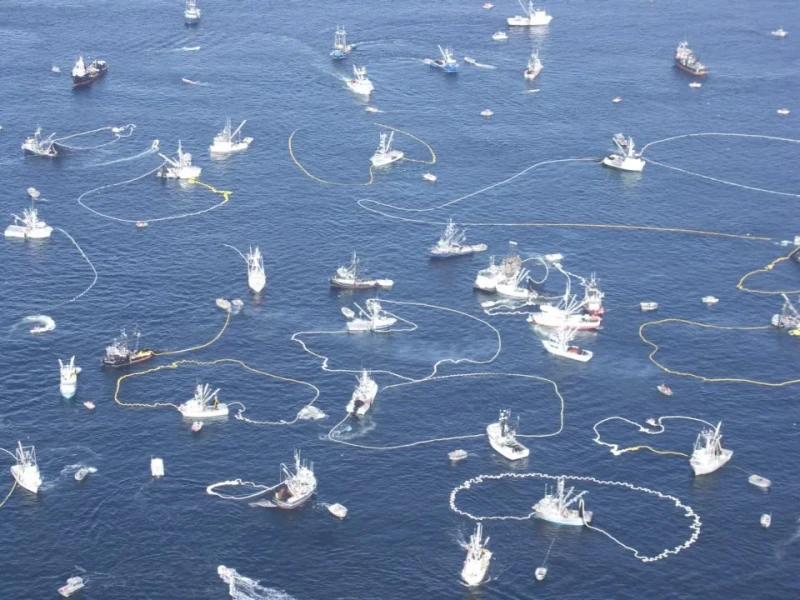
The Sitka Sound sac roe herring fishery opened for the first time this season on Friday, March 27, with commercial seiners getting a six-hour window to fish Crescent Bay.
The Alaska Department of Fish and Game (ADF&G) announced the opening Friday afternoon, allowing seiners to fish from noon to 6 p.m. Two test sets pulled from the area earlier that morning showed roe maturity averaging between 10 percent and 12 percent, with average fish weights ranging from 151 to 177 grams.
State managers have been conducting aerial surveys of the sound since mid-March. In Friday's announcement, they reported observing a typical number of herring predators for this time of year — including humpback whales, grey whales, and sea lions — but no schools of herring or spawn were visible from the air.
Strong Stock, Weak Market
The state set a guideline harvest level of 35,015 tons for the 2026 fishery, with a forecasted average fish weight of 156 grams across all age classes. The forecast is based on an estimated biomass of 233,433 tons of mature herring, a slight decrease of 6 percent from last year's estimate of 247,081 tons.
Despite the healthy stock projection, market conditions and low fleet participation are expected to keep actual landings well short of the GHL — a repeat of recent history. In 2025, just 6,198 tons were landed from a GHL of 35,720 tons, representing only 17 percent of the available allocation. An additional 266 tons were taken in test and bait fisheries. The fishery drew little attention from buyers, and fewer than three harvesters participated.
One bright spot from last season: the 2025 egg deposition estimate came in about 26 percent greater than in 2024, ranking as the fifth-highest on record since the department began egg deposition surveys. Managers also mapped 89.5 nautical miles of unique shoreline with herring spawn in the Sitka Sound area during the spring of 2025, compared to the recent 10-year average of 72.6 nautical miles.
Management Changes
Two new management measures adopted at the Board of Fisheries meeting in early 2025 are in effect for 2026. The maximum harvest rate for the sac roe fishery was reduced from 20 percent to 15 percent, and the threshold required to open the fishery was raised from 25,000 tons to 26,000 tons.
Fish and Game staff had recommended the lower harvest rate as a precaution while the state works to confirm new Canadian research suggesting that a 20 percent harvest level may be too high for herring stocks.
The 2026 forecast carries a wider margin of uncertainty due to variability among the population models used to track herring trajectories, though the department noted this uncertainty is not sufficient to reduce the current GHL.
ADF&G is scheduled to release its next fishery update on Saturday.