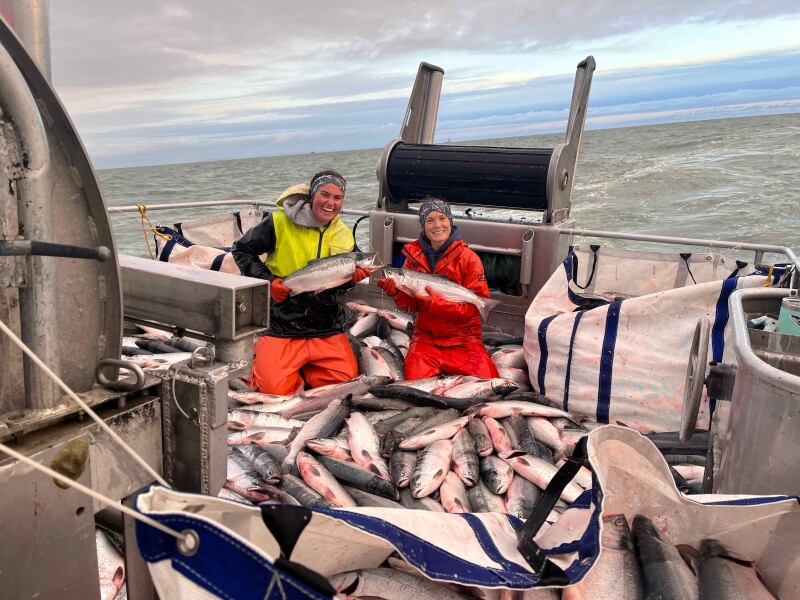
University of Washington's Alaska Salmon Program researchers are forecasting a 2026 total Bristol Bay sockeye salmon run of 41.5 million fish, with slightly larger fish than in 2025.
The report, released on Wednesday, May 6, in Seattle, projects that most of the returning sockeye will be fish that spent either two or three winters in the ocean before returning to Bristol Bay to spawn. Researchers expect about 46 percent of the run to be 2-ocean fish and 54 percent to be 3-ocean fish, with average weights ranging from 4.9 to 6.6 pounds.
The forecast is 32 percent below the recent 10-year average of 60.1 million fish, according to data made available in November 2025,
The Alaska Department of Fish and Game in a separate forecast of March 24, projected a run of 45.32 million fish, allowing for a projected harvest of 32.26 million red salmon. That forecast is 26 percent lower than the recent 10-year average, but still 21 percent higher than the long-term average.
Fisheries ecologist Daniel Schindler, an associate professor of aquatic and fishery sciences and biology, noted during the UWASP Zoom presentation that the North Pacific is warming faster than any other ocean in the world, with odds are favorable for an El Nino later this year, with warmer spring temperatures for most of Alaska and the west coast.
"El Nino is just starting to develop and we are seeing a big band of hot water on the equator, while in Alaska things are much colder than average," Schindler said.
El Nino and La Nina are opposite phases of the El Nino-Southern Oscillation cycle, representing natural fluctuations in tropical Pacific Ocean temperatures and winds. El Nino brings warmer sea surface temperatures and weakened trade winds, while La Niña is characterized by colder waters and stronger trade winds. Together, they irregularly alternate every 2–7 years, profoundly altering global weather patterns.
Smolt have a higher survival rate when ocean surface temperatures are higher than average.
The Eastern Bering Sea was cooler than the 1981-2010 average in the summers of 2022, 2023 and 2024, and a little warmer in 2025,
Shindler said. The Eastern Bering Sea summer sea surface temperatures were exceptionally warm in 2014, 2016 and 2019, and corresponded to increased runs in Bristol Bay, he said.
The UWASP forecast is a sum of individual predictions for all nine major river systems that flow into Bristol Bay. The predicted inshore harvest based on this forecast is 29.1 million sockeye salmon with an estimated weight of 168.4 million pounds