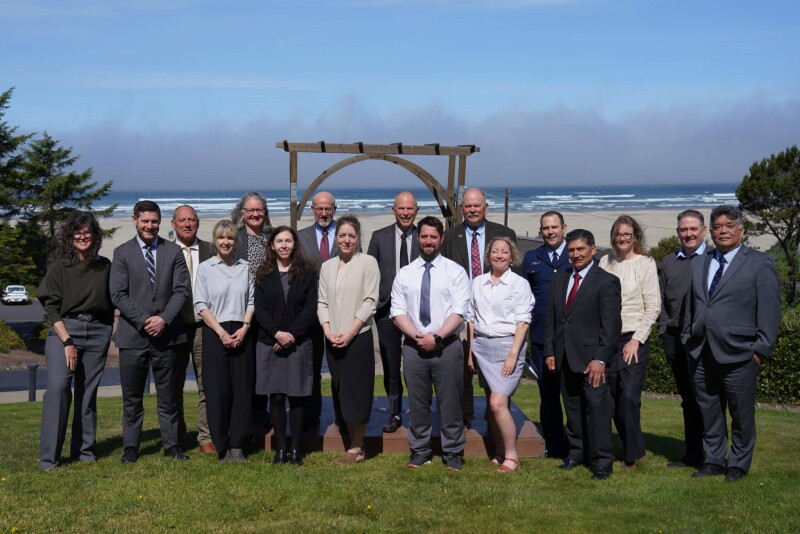
The North Pacific Fishery Management Council (NPFMC), responsible for overseeing federal fisheries off Alaska, is navigating turbulent waters marked by both budget uncertainty and the government shutdown. NPFMC is one of the eight regional councils established by the Magnuson-Stevens Fishery Conservation and Management Act in 1976.
After months of delays due to the Trump administration's cuts to NOAA, the council finally secured its 2025 operational funding this summer. However, as Yereth Rosen reported for Alaska Beacon on September 30, a federal government shutdown now threatens to derail the science-based decision-making that the fisheries depend on.
This week’s meeting, typically held in Anchorage, Alaska, has been fully moved online. Executive director of the council, Dave Witherell, told Rosen that the council’s initial lack of funding left it with no choice but to cancel the in-person gathering, despite funds eventually being restored in July and August. “The good news is that in July, we received an additional allotment of grant funding, and in August, we received the remainder of the 2025 grant funding,” Witherell said by email to Alaska Beacon.
The shutdown’s timing forced major last-minute adjustments. Ian Stewart, co-chair of the Scientific and Statistical Committee, told his colleagues, “We have got some fairly major schedule changes today in order to make the best use of our time with the federal employees while they’re with us,” Stewart said on Tuesday, the second day of that committee’s meeting.
Big decisions are on the table, including decisions on Bering Sea snow crab and red king crab, both returning from stock collapses and multi-year closures. In August, Margaret Bauman reported for National Fisherman that the council is also scheduled to hear the observer 2026 annual development plan and review several topics related to Bering Sea/Aleutian Island crab issues related to the Stock Assessment and Fisheries Evaluation (SAFE) report and adoption of acceptable biological catch (ABC) and overfishing limits (OFLs) for Bristol Bay red king crab, Tanner crab and snow crab.
Key discussions, such as Essential Fish Habitat designations, may be dropped if federal scientists are furloughed.
Witherell told Rosen that in-person meetings are “highly preferable” for the council because they allow for conversations and information exchanges between advisers, scientists, council members, council staff, and the public; however, for now, the council and the public are left with a virtual format.
Broader implications
The fisheries council is just one example of how the shutdown is rippling through federal agencies. Monica Alba and Raquel Coronel Uribe reported to NBC News that the Interior Department’s contingency plan will keep national parks “partially open,” with trails, roads, and open-air memorials accessible but visitor centers closed. About 64 percent of the National Park Service workforce will be furloughed, leaving only individuals doing “excepted duties such as law enforcement, coastal surveillance, and emergency response.
NBC shared live updates from the Associated Press and other sources that the shutdown, which began after lawmakers failed to pass a funding bill, will affect various aspects of the government to a lesser or greater degree.
Back to AK
For NPFMC, the stakes are immediate and high. NOAA’s Alaska Fisheries Science Center director Bob Foy told the Scientific and Statistical Committee that the shutdown length will be a key variable. A closure under five days would likely leave this year’s stock assessment intact. But “if we go greater than 15 business days, that’s going to dramatically impact our ability to produce our stock assessments in time,” likely causing the council to not meet any deadlines.
For commercial fishermen waiting on crab decisions, bycatch rules, and stock science, the gridlock in Washington is more than just politics; it’s a threat to timelines and the industry's future.