



Early evidence suggests salmon runs on British Columbia rivers are growing where salmon farms are removed
While many wild salmon runs in Canada have rebounded in the absence of salmon farms on their British Columbia migration routes, the salmon farming industry is lobbying hard to convince the country’s new prime minister, Mark Carney, to rescind the ban on open net pen salmon farming.
Advocating salmon aquaculture with the familiar litany of jobs, feeding the world, and reducing pressure on wild stocks, Fabian Dawson, writing in the online publication Sea West News, cites a new study that says that sea lice from salmon farms have little impact on wild salmon. He also makes claims about new feed ingredients, while everyone in the industry acknowledges that nothing can replace wild fish and krill.
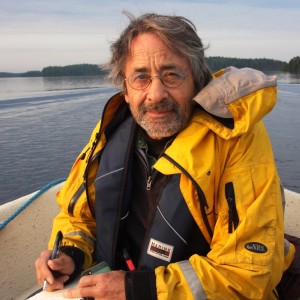
“Fabian gets paid to write controversial things like that,” says longtime wild salmon scientist and activist Alexandra Morton. “Nobody reads it or believes it.”
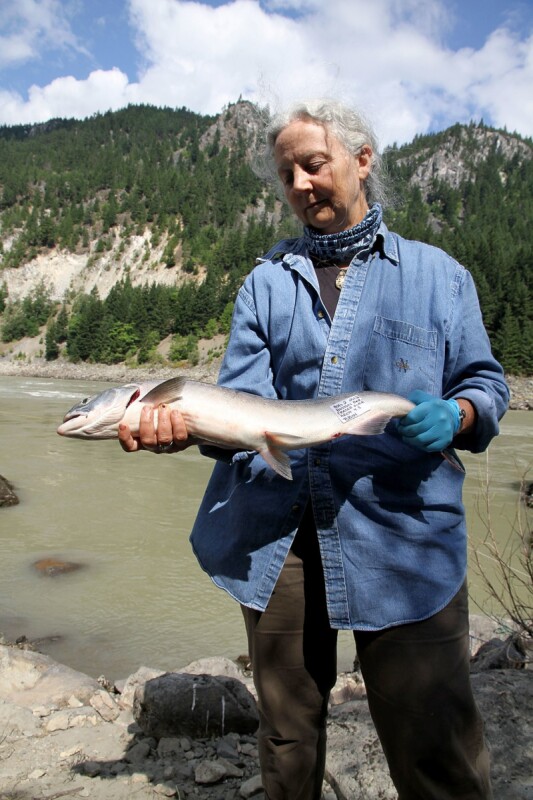
Morton points to growing evidence that salmon runs rebound when salmon farms shut down. “Admittedly, all we have is corollary evidence, but it's growing. If you look at the Fraser River sockeye this year, the returns were more than twice what was predicted.” Morton notes that all salmon farms were taken out of the Discovery Islands approaches to the Fraser, though there are farms continuing to operate further north, and she believes that Cermaq and Mowi are fearful that tribes where salmon farms still operate will also pull the plug on them.
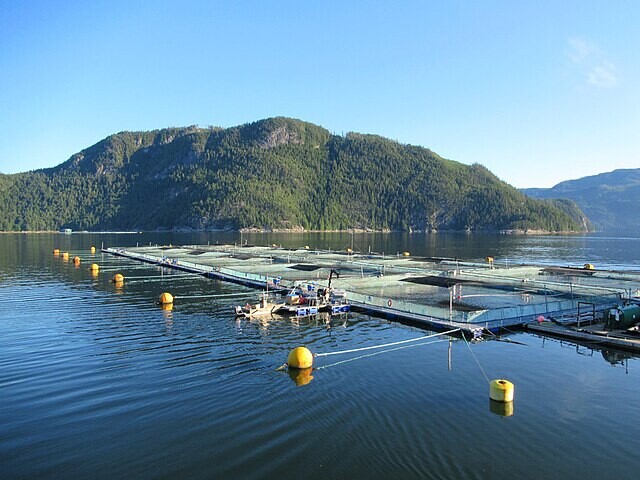
Such concerns are justified in light of their experience in many First Nations territories. In 2018, the Namgis Nation and two other nations demanded that their researchers be allowed to access the farms to collect data on disease, sea lice, and the potential impacts on wild salmon runs.
“Our young people occupied two farms in the Broughton Archipelago,” says Don Svanvik, a hereditary chief of the Namgis. According to Svanvik, the Namgis Nation and neighboring nations negotiated an agreement with the provincial government and the salmon farming companies, Mowi and Cermaq, based on their aboriginal rights to protect the wild salmon.
“The systematic removal of 10 farms started in 2020, and then there were seven more that we said, if they can prove they’re not harming wild fish, they may be able to stay. But our data didn’t support that, and they couldn’t demonstrate it, so we took those out too.”
Like Morton, Svanvik saw the decline in salmon runs that coincided with the development of the salmon farming industry around Vancouver Island and the British Columbia mainland. “I believe 100 percent that salmon farms kill salmon. When you take out over 40 farms and the salmon come back…”
Svanvik notes that Canada’s Department of Fisheries and Oceans has tended toward support of salmon farming, echoing the industry’s promises of jobs and economic growth. The DFO currently claims to be working to bring the farms ashore to land-based facilities. “I don’t know why they have an affinity for salmon farms. Last year, when the fish came back, they started looking for reasons why. They don’t even consider that when you take out the farms, the fish come back. They call that a coincidence. But 100 coincidences? I mean, if you’re a scientist, wouldn’t you look for what’s different?”
According to a 2023 report by the North Pacific Anadromous Fish Commission, an international body that reviews the science on salmon and other anadromous fish, the list of stressors on salmon passing back and forth from the rivers to the sea does not include sea lice or pathogens from salmon farms.
The Tlowitsis First Nation hosts the three remaining salmon farms in the Broughton Archipelago. “I haven’t talked to them,” says Svanvik. “Though we look forward to a conversation, and plan to share our information with them.”
.jpeg.medium.800x800.jpg)
Commercial fishing jobs are scarce in the region, and the salmon farms do offer jobs. “According to Mowi, 25 percent of their workforce self-identifies as indigenous,” says Svanvik. “Yes, salmon farms offer employment, but to the detriment of wild salmon. I was a fisher. Our whole community relied on fishing. But 20 years ago, the wild salmon runs were declining as farms grew, and the DFO divided the coast into zones. If you wanted to fish the whole coast, you had to buy one or two more licenses for $450,000. Most people couldn’t afford that and sold out instead.”
He notes that when the salmon come back, the biggest challenge for the Namgis and other First Nations will be rebuilding their capacity to catch fish. “We’ll need boats,” he says.
But with a new administration in Ottawa, people like Fabian Dawson are pushing the jobs and food narrative hard, hoping to get a break from the coming ban.
“The trouble is that no one in Carney’s cabinet is familiar with what has been going on behind the scenes in DFO when it comes to salmon farms,” says Morton. “The Canadian Access to Information Act allowed me to read internal emails and see how science, management, and policy have all been strong-armed in favor of industrial salmon farming, not wild salmon.”
Morton notes that Cermaq, which has bought Grieg, had a major die-off in September 2025 that it did not report. According to the DFO, one Cermaq farm lost 37 percent of its fish, another, 19 percent, and another, 17 percent. “Cermaq is fighting to keep farms in an environment that is killing their fish,” she says. “Cermaq is no longer reporting its sea lice levels.”
Salmon farming companies, backed by organizations like the Fraser Institute and the Global Aquaculture Alliance, argue that government science has shown that salmon farms have a minimal impact on wild salmon. “Many studies overestimate the risk of pathogens transmitted from farmed salmon to wild Pacific salmon,” says one industry report cited by Fraser Institute Fellow Kenneth P. Green.
“The Trudeau government in 2024 opted to kill a pioneering Canadian industry founded partly to protect the environment. The decision will cost money, jobs, Aboriginal welfare, kill millions of delicious salmon dinners beloved by Canadians, and offer no environmental benefits or protect wild fish stocks. The 2024 Trudeau government’s ban will kill millions of delicious salmon dinners beloved by Canadians and offer no environmental benefits or protect wild fish stocks,” Green writes.
BC fisherman Jody Eriksson has been sampling salmon smolts around fish farms for 21 years and finds statements like Green’s preposterous.
“If the salmon farms killed every fish in the sea, there would be no evidence,” Eriksson says. “We seined about 40,000 smolts near Port Hardy in August, and I would say the number of sea lice per fish was around 200.” Eriksson took photos of many of the fish, still barely alive and covered with sea lice. “You have to zoom in to see the little ones,” he says. “But when you do, you’ll understand why we say 200 per fish.”
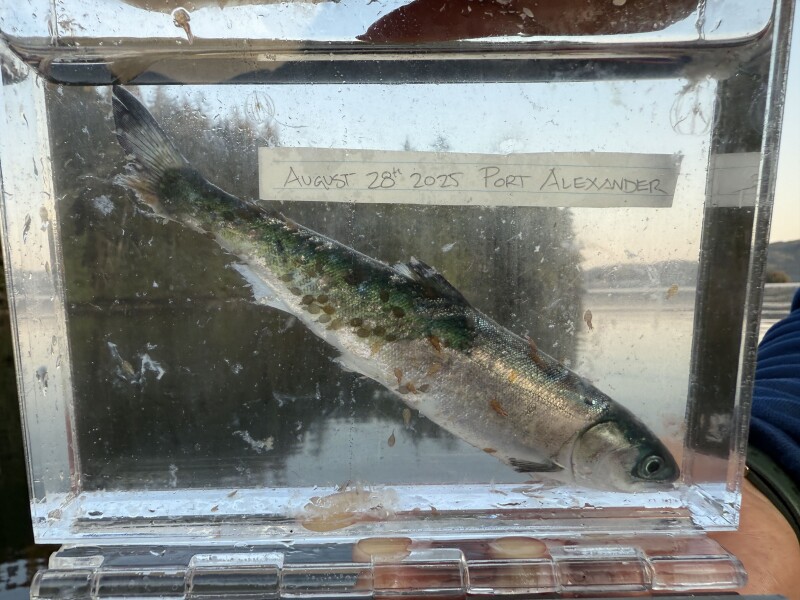
Eriksson notes that while the farm operators and government criticize his work, they don’t try to verify its validity.
“In 21 years, not one salmon farmer or DFO person has asked to come out with me,” he says. “When we started sampling around the farms around here, we found fish with lice, but after July, we didn’t find any. The theory was that they had gone to sea. But since the farms had been removed, we find the fish are in good shape and hanging around until late October. I think that when the salmon farms were here, the smolts were all dead by July, not gone to sea.”
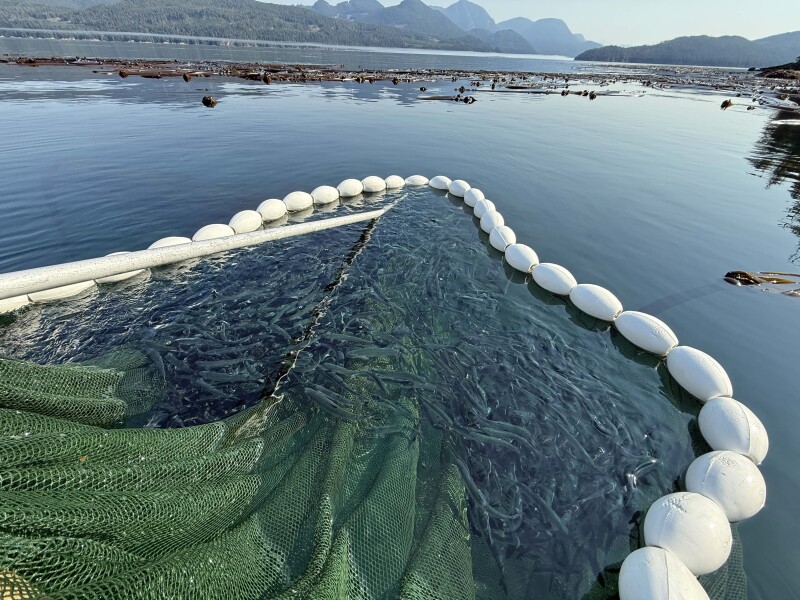
Although many runs are rebounding in the absence of salmon farms, Eriksson is still waiting to go fishing again. “I own a fishing boat,” he says. “But out of the big Fraser sockeye run, my quota was 244 fish. I gave it to another boat.”
Morton, like Svanvik and Eriksson Morton, contends however, that the weight of scientific evidence coming from Canada’s leading universities, the Pacific Salmon Foundation, and DFO itself, is providing the details on how farm salmon pathogens are weakening wild salmon that migrate past the farms.
“There is a scientist, Dr. Kristi Miller, who has picked up a recently discovered tool to determine when a fish’s immune system starts working and what stressors the fish is facing.” Called genomic profiling, Miller and others can detect responses in wild salmon to viruses, bacteria, and other stressors as they swim past salmon farms. It’s like plugging your car into the computer that provides a readout on the state of the car’s engine.
Dr. Kristi Miller (Saunders) is an aquatic molecular biologist with the DFO, and expertise in genetics, genomics, transcriptomics, immunogenetics, and fish health, with research on Pacific and Atlantic salmon spanning 27 years.
“We present the first data to link physiological responses and pathogen presence with subsequent fate during migration of wild salmonid smolts. We tagged and non-lethally sampled gill tissue from sockeye salmon (Oncorhynchus nerka) smolts as they left their nursery lake (Chilko Lake, BC, Canada) to compare gene expression profiles and freshwater pathogen loads with migration success over the first ~1150 km of their migration to the North Pacific Ocean using acoustic telemetry. Fifteen percent of smolts were never detected again after release and these fish had gene expression profiles consistent with an immune response to one or more viral pathogens compared with fish that survived their freshwater migration,” says the abstract of a 2024 paper she co-authored with ten other scientists.
“It can’t identify what pathogen the immune system is fighting,” says Morton. “But she has created a tool that allows the fish to talk to us, so that researchers know what tests to perform next, and a lot of young scientists are using it. This is going to be a red warning light flashing in salmon exposed to farm salmon pathogens. It will allow us to be highly strategic in how we protect salmon where they need it most. This is powerful science, and it has a lot to say."
.png.small.400x400.png)

