Along the Maine coast and across New England, conversations around a lower-carbon fishing fleet often start with fuel. But spend enough time on the dock, and the talk inevitably shifts– down to the wheel turning beneath the hull.
Propulsion efficiency, long treated as a matter of matching horsepower and hull design, is now being pulled into a broader conversation about emissions, operating costs, and the future of the fleet. Still, for many fishermen and the shops that support them, the path forward isn’t as simple as swapping out parts.
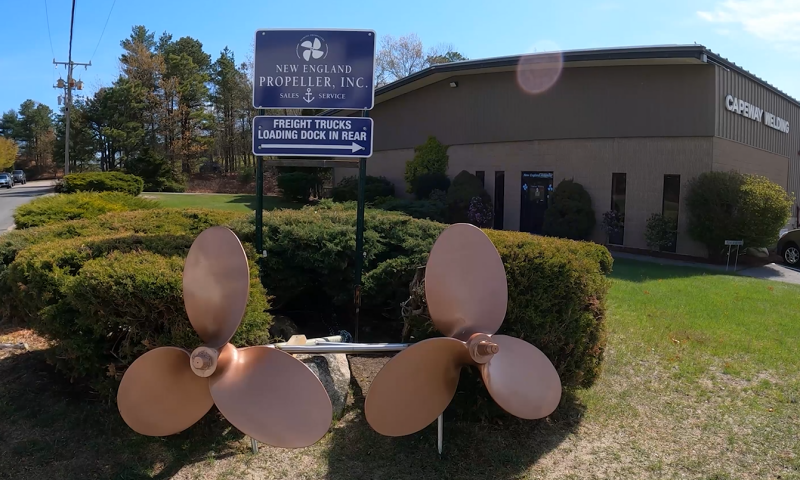
“It’s not really about having a variety of propeller styles,” says Doug Peck of New England Propeller Inc. “It’s about matching the diameter and pitch of the propeller to the vessel so the engine performs in its rated RPM range. That’s what gives the boat its best performance and fuel efficiency.”
New England Propeller was the first Michigan Wheel distributor and carries a large inventory of their wheels along with Federal Propellers, Hytorq propellers, Acme propellers, ZF Marine propellers, and Power Tech high-performance S/S propellers. They also carry a full line of outboard and sterndrive propellers for all makes and models.
That practical, performance-first mindset echoes across the industry and is highlighted in recent findings from the Transition to a Low Carbon Fishing Fleet initiative. The research points to propulsion optimization as one of the most immediate, cost-effective ways to reduce fuel use, but also shows a key challenge: to be cost effective, most improvements must work within the realities of existing vessels, tight margins, and fishermen’s day-to-day priorities.
Performance first, efficiency second
For Peck, whose shop works primarily with lobster boats, tuna vessels, scallopers, and draggers, the conversation around efficiency doesn’t always start with fuel savings.
“I’m not often consulted by fishermen who are doing repowers,” he says. “I’m not sure those repowers are always done with fuel efficiency at the forefront. Sometimes they just want their boats to go faster—get from point A to point B quicker, or be able to pull more gear.”
The tension between speed, power and efficiency shows up clearly in the low-carbon fleet research. While improved fuel efficiency can reduce both costs and emissions, adoption often hinges on whether a change also delivers immediate operational benefits, like increased towing power or shorter transit times.
Meaning the baseline work of propulsion efficiency still evolved around fundamentals: ensuring the propeller, engine, and gear reduction are properly matched.
“These boats traditionally have run Michigan DQ’s or Michigan Workhorse propellers,” Peck explains. “There are other brands out there, but they’re all similar in style. The goal is making sure the propeller meets the engine’s rated RPM range.”
It’s not flashy, but it matters. Even small mismatches can lead to engines running outside optimal ranges, burning more fuel than necessary over the course of a season.
Incremental gains–and their limits
The Transition to a Low Carbon Fishing Fleet research emphasizes that incremental upgrades– like optimizing propeller pitch, diameter, and maintenance–can deliver measurable fuel savings with relatively low upfront cost. But Peck notes that for many vessels, the room for change is limited.
“There’s not a lot of variation in the style of propeller being used on everyday lobster boats,” he says. “And some of the more high-performance designs don’t translate well into that kind of work.”
For example, fully computer numerical control (CNC)-machined propellers have shown promise in certain fisheries. “There have been opportunities to equip tuna boats with fully CNC propellers that are a little more high-performance,” Peck says. “They can give better speeds and fuel efficiency.”
But what works for a fast-moving tuna vessel doesn’t necessarily hold up in the stop-and-go, gear-intensive world of lobstering. “Those don’t translate as well into an everyday lobster boat and the way they function,” he says.
The same goes for other technologies often discussed in efficiency circles. Kaplan-style propellers in nozzles, for instance, are widely used in some commercial fleets but remain rare in Peck’s day-to-day work.
“I know about nozzles, but we hardly ever see those types of Kaplan props,” he says. “So I don’t really know how to address that subject.”
A system, not just a prop
One of the key takeaways from both Peck’s experience and the broader low-carbon research is that propulsion efficiency isn’t just about the propeller itself.
Hull design, shaft alignment, struts, rudders, and even loading practices all play a role in how efficiently a vessel moves through the water. Recent developments in optimizing underwater appendages– particularly in the sportfishing and yacht sectors– hint at additional gains, though their applicability to commercial fishing remains an open question.
“I’ve become aware of optimizing struts and rudders to increase speeds and performance,” Peck says. “But that’s more in the sports fishing and yacht world. It may not fit into the fishing industry the same way.”
Still, the concept aligns with the Transition to a Low Carbon Fishing Fleet findings, which stress that whole-system optimization– rather than single-component upgrades– offers the greatest potential for fuel savings.
Even when efficiency gains are clear, adoption often comes down to economics.
Fishermen weighing a propulsion upgrade have to consider not just the upfront cost, but also downtime, uncertainty around performance, and how long it will take to see a return on investment.
The Transition to a Low Carbon Fishing Fleet research highlights this as one of the biggest barriers to change, calling for expanded grant programs, technical assistance, and risk-sharing mechanisms to help fishermen make the leap.
Peck has seen some movement on that front.
“I know there is currently grant money available through a fishing institute in Massachusetts or Maine, or both, to optimize efficiency on fishing vessels, including propulsion,” he says.
Programs like these can help offset the initial cost of upgrades, making it easier for fishermen to experiment with new technologies or fine-tune existing setups.
A potential leap forward
While much of today’s progress is incremental, Peck points to one emerging technology that could represent a more significant shift.
“Sharrow Marine has partnered with Veem Propeller to manufacture the Sharrow/Veem inboard propellers,” he says. “They’re currently testing on about 50 vessels of all types, gathering data.” The design, which departs from traditional open-blade propellers, has generated significant attention across the marine industry.
“We’re expecting 15 to 30 percent fuel savings with this product,” Peck says. “It’s the newest design in propeller technology in over 100 years.”
If those numbers hold up in commercial fishing applications, the impact could be substantial– both in reducing operating costs and lowering emissions. But, as with any new technology, there are caveats.
“The upfront cost will be substantial,” Peck notes. “We’re not sure what production times are going to be yet, and that may impact how quickly this affects the fishing industry.”
Availability, cost, and real-world performance will ultimately determine whether the technology gains traction among working fishermen. For now, the path toward a lower-carbon fleet– at least when it comes to propulsion– remains grounded in practical, incremental improvements.
Matching propellers to engines. Keeping vessels operating within optimal ranges. Exploring new technologies carefully, with an eye on both performance and payback.
It may not be the most visible part of the decarbonization conversation, but it’s one of the most immediate.