

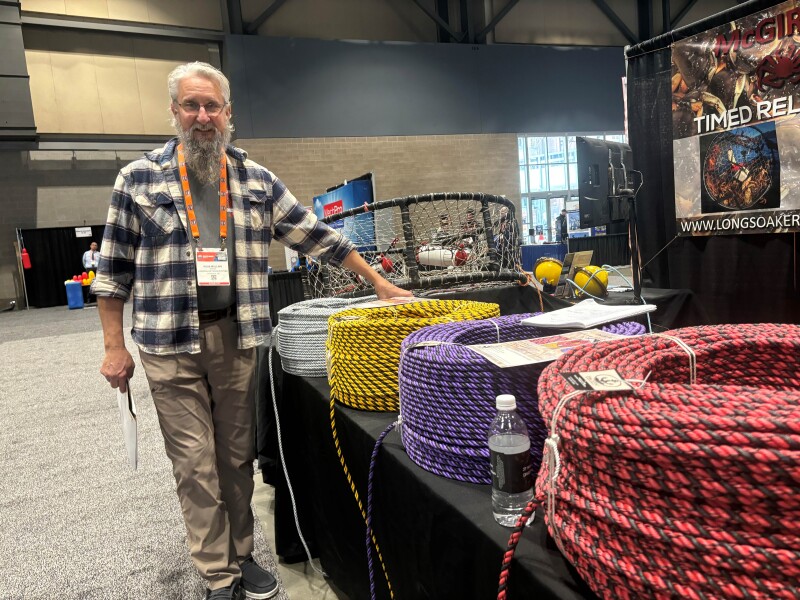
In an effort to help understand where whales are getting entangled, the Pacific States — California, Oregon, and Washington — began implementing colored markings on Dungeness crab pot buoy lines in 2020, with state-specific requirements. California fishermen must use purple and black line on traps beginning in the 2025–26 season. Oregon will require yellow and black rope beginning Dec. 1, 2026, and Washington is phasing in red and black rope between 2025 and 2028.
With tariffs on imported rope and color confusion among foreign producers, Russ Mullins of Bellingham, Wash., saw an opportunity. He launched a new company, Pacific Ropeworks, to meet the needs of West Coast fishermen. "The ropes need to be two strands of color and one strand of black," says Mullins. "I'm working with Everson Cordage Works here in Washington, and we can produce small lots of what fishermen need, and in the correct color configurations." Most importantly, Mullins notes, Everson Cordage is made in the United States.
Everson, based in Everson, Wash., has been making cordage for commercial fishermen since 1979 and, among other things, makes Whale-Safe rope approved by the National Oceanic and Atmospheric Administration as part of the Atlantic Large Whale Take-Reduction Plan. "They're very big on the East Coast," says Mullins. "I started Pacific Ropeworks to get the right rope to fishermen, and without tariffs, our price points are very competitive for a higher quality product."
At present, Mullins notes, the states only require the colored rope between the main buoy and what they call the diver. "It's a big ask for fishermen to replace all their rope in one season," he says. "So, in Washington, for example, they're phasing it in over three years."
According to Chris Berg, vice president at Everson Cordage Works, they have greater control over how they twist and treat their rope, giving them the capacity to produce a higher quality product. "A lot of the Asian rope does not get heat set," Berg says. "As we pull our rope out, we run it through tanks of very hot water, not boiling, but close. That gives the fibers a chance to relax, and it creates a different animal. The rope blends better and wears better."
The Everson rope is made from polysteel fiber, which Berg notes is itself a blend of polyolefin and polypropylene. "That will float," he says. "If we want it neutral, we'll add polyester fiber. Say we have eight bobbins feeding a three-strand rope; in the case of our very popular Everson Pro, we'll change two of those bobbins to polyester, and that will give you a neutrally buoyant rope."
Because of the technology he uses, Berg explains, he can make all the whale color rope in whatever buoyancy is required. "I twist a very small film of polysteel with the polyester in the rope," he says. "That makes it easier for us to make full sinking lines, which a lot of guys need on the East Coast."
Berg adds that he ships several containers a year to New England. "We're able to supply Russ with small lots because he's local," he says.
Mullins notes that because he can work in small lots with Everson, some fishermen are asking for different color schemes. "I have guys asking for their own color combinations so that they know when they put it on, so they know when to change it," he says. "There is also talk about putting specific colors on gear in other fisheries, a color for hook gear for black cod, a color for pots, they're talking about the prawn fishery. This is just the beginning."
 (1).jpg.small.400x400.jpg)