We’ve packed up everything you know and love about the West Coast’s largest and most trusted commercial marine trade show and brought it with us: the networking events, industry-led programming, and the chance to catch up with old friends. The heart of the show hasn’t changed, but now there’s more room for all of it.
The Pacific Marine Expo (PME) is driven by a commitment to convene industry leaders for three days of learning, connection, and community. We’re excited for you to see how our new location helps us keep delivering on that mission and serving the working waterfronts of the West Coast and Alaska as they innovate and evolve.
On the show floor, you’ll find the same dedicated spaces you’ve come to expect at PME — the Alaska Hall, Beer Garden, National Fisherman Arena, and others — in a roomier layout built for easier wayfinding. Beyond the hall, 70 meeting rooms give you a place for the type of intimate, focused conversations that drive collaboration and deals.
This year’s Expo also boasts more special events than ever, born out of partnerships with leading industry organizations. The National Future Fishermen Coalition will convene young mariners and seasoned captains for the inaugural National Future Fishermen Summit, and We Work the Waterways will host Industry Interaction Day, a hands-on introduction to maritime careers for students. National Fisherman will once again honor industry icons at the Highliner Social & Awards, now with a charitable silent auction, while the Coastal Challenge and Maritime Throwdown will put deckhand skills to the test.
In the Ballroom, the Small Shipyard Grant Coalition Breakfast will highlight investment opportunities and updates to the federal Small Shipyard Grant Program, and the Seattle Propeller Club and Port of Seattle returns with its annual Economic Forecast Breakfast.
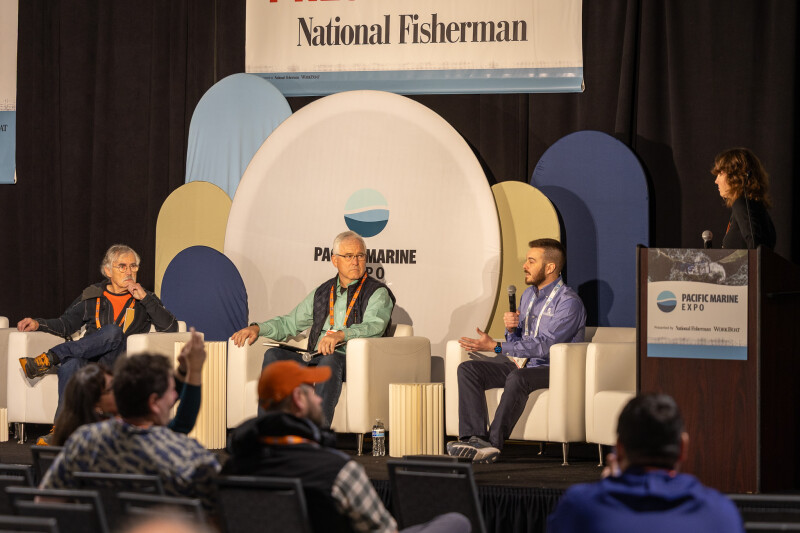
The Main Stage and Classroom will host presentations and panel discussions across three tracks: Commercial Fishing, WorkBoat West, and Ocean Technology. Together, they cover the full range of topics that are of interest to the PME audience — both longstanding attendees and newcomers who have become part of the fabric of the West Coast and Alaska maritime industry in recent years. Below are a few sessions we’re especially excited about, followed by a breakdown of key programming within each track.
In “Value Starts on Deck: Creating a Culture of Food Safety, Quality, and Sustainability Onboard,” commercial fishermen will discover how simple changes to onboard operations can drive product value, workforce engagement, and market access. Attendees will gain a deeper understanding of the inextricable link between the everyday decisions made on deck and market competitiveness. Leave with actionable strategies that can be implemented without unnecessary cost.
The Alaska Mariculture Cluster will lead the session “Shellfish, Seaweed & the Working Waterfront: Where Alaska’s Growing Mariculture Industry Fits in the Seafood Economy” to give an inside look at this sector. Attendees will learn how mariculture intersects with the state’s commercial fishing and seafood economy and how it complements existing infrastructure, skills, and marine services.
Speakers will also address some of the biggest challenges facing the industry today, including access to capital. A group of lending and financial institutions will take the stage for “Financing the Working Waterfront: Innovative Capital Solutions for Seafood and Mariculture.” This session will share real-world examples and case studies of new pathways to finance infrastructure and business ownership.
PME will wrap up on Saturday, Nov. 21, with two Main Stage sessions that offer a little something for everyone.
The morning will open with a behind-the-scenes look at a documentary that tells the harrowing and impressive story of the Columbia River Bar and Jetty System. At “Taming the Mouth: Inside a New Documentary on the ‘Graveyard of the Pacific,’” attendees will view clips from the film and hear from the director in a live Q&A.
We’ll close out the Main Stage with a focus on the maritime workers of tomorrow, featuring four Washington-based institutions that are leading the fight against the industry’s workforce crisis. Join representatives of the Port of Seattle, Seattle Maritime Academy, Northwest Maritime, and Sea Potential for the session “The Next Crew: Building the Pacific Northwest’s Maritime Workforce from the Ground Up.” This panel brings together organizations working at different points along the workforce pipeline, from middle school exposure programs to employer hiring systems. Bring the whole family out for this conversation — it’s one you won’t want to miss.
We hope that you enjoy this year’s education programming and leave with new ideas and next steps to support your businesses and communities.
We look forward to the work and fun ahead and thank you for your support of PME.
Track: Commercial Fishing
The Commercial Fishing track at PME is designed to introduce the industry to new initiatives, strategies, technologies, and gear aimed at improving operations, safety, and catch.
Speakers representing community organizations and regional businesses will share advances in safety training and equipment, highlight workforce development and hiring efforts, and demystify the latest federal actions and conversations aimed at restoring American seafood competitiveness.
Start your Expo with a 10,000-foot view of the future of West Coast seafood, as imagined by an alliance of regional Sea Grant experts who represent over 50 years of firsthand industry experience — on the water, in processing, and across coastal economies. “50+ Years of Boots on the Docks: Perspectives on the Future of West Coast Seafood” will use real-world examples to address trends that span Alaska, Washington, Oregon, and California and explore what it takes to sustain the industry’s workforce. Bring your crystal ball to this session and peer into the future with us.
In “Homeport to Helm: How West Coast Community Fishing Organizations are Driving Safety Outcomes,” speakers will share examples of grassroots efforts that have produced concrete results and set new industry standards for safety on the water. Working alongside researchers, leaders of these local groups have distributed emergency gear, raised thousands of dollars in community funding, and built trust with vessel operators in ways outside entities cannot.
Safety training also gets hands-on this year. On Thursday, the Alaska Marine Safety Education Association (AMSEA) joins experts from NIOSH, the U.S. Coast Guard, the National Transportation Safety Board, and Marine Safety Services on the Main Stage for “Surviving Vessel Disasters: Factors Contributing to Survival of Cold-Water Immersion,” a look at how crew preparation shapes survival when a vessel goes down in frigid water. Then head to the National Fisherman Arena for AMSEA’s 30-minute Survival Craft Deployment workshop, where fishermen walk through real liferaft deployment. It runs four times: Thursday at 1 p.m. and 2 p.m., and Friday at 1 p.m. and 2 p.m. On the Skybridge, Project Gabe and AMSEA lead “Working Through the Pain: Opioid Awareness & Naloxone Training for Commercial Fishermen,” a 30-minute hands-on session that connects unchecked stress and unmanaged pain to the risk of opioid misuse and includes naloxone training. Catch it Thursday at 12:30 p.m. or 3 p.m., or Friday at 3 p.m.
For a pulse check on the market, “Alaska Seafood Outlook: Market Data, Trends, and What’s Shaping the Industry” pairs economic and market data with an industry conversation about the developments shaping Alaska fisheries. Led by local seafood industry organizations, the session features speakers from the Alaska Seafood Marketing Institute, the Bristol Bay Regional Seafood Development Association, and McKinley Research Group, along with National Fisherman’s Carli Clancy.
A pair of back-to-back sessions on Friday will give attendees a close look at new federal initiatives emerging as a result of the White House’s renewed focus on the seafood industry.
“Fish is Food: Opening Doors for Seafood in Federal Programs” explores what it means for wild capture fisheries to truly be treated as a cornerstone of the domestic food system, rather than a commodity. This shift in perception and government inclusion is starting to open doors for fishermen and seafood businesses to access grants, loans, and technical assistance that have long been available to the agricultural sector. Attendees will hear from key industry voices leading this work, including Michael Illenberg, Director of the U.S. Department of Agriculture’s (USDA) newly created Office of Seafood.
The next session, “Building a Real Safety Net: Risk Management for Commercial Fisheries,” will provide an update on one area of work for the new Office of Seafood: designing a more responsive federal assistance program. Leaders engaged in this collaborative effort will share how they’re working to develop better tools and what a crop insurance model could actually look like for commercial fishing.
With regulatory conversations such as these taking place across industry, Congress, and the Executive Branch for the first time in years, now is the time to get up to speed on how your fishing business or community could benefit. Take the first step to support these efforts by attending these deep-dive sessions.
Track: WorkBoat West
The WorkBoat West education track has returned to PME. This track — an expansion of the industry-leading WorkBoat brand — brings the region’s maritime professionals together to solve problems, forge partnerships, and share knowledge about what actually works on the West Coast.
At Expo, our educational WorkBoat programming aims to provide uniquely tailored content for the maritime industry on the West Coast and Alaska, where brutal environmental conditions, specialized vessel requirements, and unique shoreside challenges require companies to harness decades of hard-won local knowledge and the latest technologies to succeed.
This year, two WorkBoat West sessions will showcase examples and lessons learned from recent projects in the passenger vessel space.
Led by WorkBoat and National Fisherman executive editor Eric Haun, “Under the Hood: Energy Storage, Shore Power, and Integration in Ferry Electrification” will convene the key players in the Washington State Ferries (WSF) electrification program for a technical discussion. Speakers representing WSF, ABB Inc., Siemens Energy, and Corvus Energy will address battery system design and real-world operational performance, charging infrastructure, utility interconnection, peak load management, and more.
The session, “Design, Propulsion & Charging: Innovations Reshaping Passenger Vessel Operations,” will take a wider view of the topic with first-person insights into how decisions in this space are made for various projects. Panelists will explore the tradeoffs between different propulsion approaches and forecast where the sector is headed next with new technologies coming on the market.
In a blend of WorkBoat West and Commercial Fishing topics, the Port of Seattle will lead a conversation about new efforts to bolster the region’s fishing fleet. “All Hands on Deck: Challenges and Opportunities in Fishing Vessel Recapitalization” will convene voices from the fishing industry, shipbuilders, and government agencies to discuss emerging challenges and opportunities, how to expand shipyard capacity and workforce, and strategies for harnessing new federal tools. Together, we’ll explore how to convert national ambition into regional jobs, investment, and ultimately, new vessels.
In another session, leaders in fishing boat construction and propulsion will share what they’re actually seeing in the yard. Using real-life examples, speakers in “Steel, Aluminum, and Credit: What it Takes to Build or Rebuild a Fishing Boat Today” will give attendees a look into order books and lead times to discover what it costs (in both time and money) to get a fishing boat back to work.
Workforce is a WorkBoat West topic, too. In “Recruit, Train, Retain: New Playbooks for the Boatbuilding Workforce,” shipyard leaders will share how they’re finding, training, and keeping skilled talent at a time when yards have more work on the books than hands to build it. Speakers include WorkBoat senior associate editor Steve Mosco, Chris Feffer of Platypus Marine, and Tuuli Snow of Snow & Company.
Join us for these sessions and discover the WorkBoat West experience for yourself.
Track: Ocean Technology
The Ocean Technology track is the newest addition to the PME education program. Through these sessions, we’re keeping an eye on what’s coming next, so you don’t have to.
The maritime industry is changing quickly, propelled by advances in engineering, autonomous systems, and growing competition for waterfront and ocean space from industries new and old. It’s our mission to ensure the PME audience knows what’s ahead, how these technologies are being used, and what it could mean for your businesses and communities.
“Marine Carbon Removal: Fishery-Friendly Guardrails for Governing a New Ocean Technology” is designed to showcase how the commercial fishing industry is already helping shape federal regulation of this technology. Led by Brad Warren, CEO of Global Ocean Health, the session will introduce attendees to marine carbon dioxide removal (mCDR), preview an active research effort, and share the ways industry can help shape mCDR governance to protect fishing grounds and support healthier marine ecosystems that fisheries depend on.
The session “Save the Catch & Hold Our Ground” will take a critical look at what it means for commercial fishing grounds to face spatial pressure from competing industries and what can be done to safeguard these areas. Fishing communities across the nation are increasingly in conflict with other ocean users, and this session aims to explore both immediate solutions within existing frameworks and more durable, long-term legislative or regulatory fixes. Speakers will focus on recent activities along California’s Central Coast as a case study for this conversation, but the takeaways could be applied to any region dealing with similar challenges.
“NOAA’s Uncrewed Fleet: How Autonomous Systems Are Changing Ocean Operations” will explore another fast-moving technology, one already in wide use across the maritime space. Speakers from industry and the National Oceanic and Atmospheric Administration (NOAA) will share examples of how uncrewed systems are changing operations across a range of applications — from fisheries enforcement and stock assessments to ocean floor mapping and vessel acquisition planning.
Fishermen have long read the ocean to decide when to leave the dock, where to set gear, and when to move, and increasingly they’re helping collect the data behind those calls. In “Fishermen and Scientists Building Better Ocean Data Together,” speakers from Hen of the Woods Consulting, Alaska Bering Sea Crabbers, the Northwest Association of Networked Ocean Observing Systems (NANOOS), and the Alaska Ocean Observing System (AOOS) will share how fishermen and scientists are working together to build better ocean data.
It’s our hope that this new track will help PME attendees feel more confident in their understanding of emerging ocean technologies, open the door to new companies active in these spaces, and spark collaboration that benefits all ocean users.