


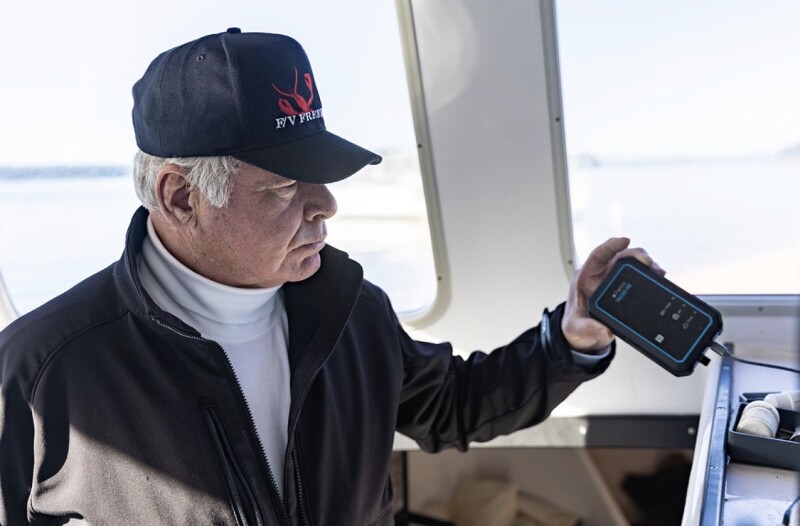
In 2023, the state of Maine mailed a package to Vinalhaven lobsterman Frank Thompson. “I got the little black thing in the mail, and the Department of Marine Resources (DMR) said, ‘hook it up and turn it on.’ I did. They wanted to track us, to collect data. Some guys mailed it back, but the DMR just sent it back to them. But I was curious, and so I sent it to a friend of mine at Google, and he said, ‘yeah, it’s tracking you 24/7 whether you’re fishing or not, and it has the potential to transmit video and audio.’”
According to legal filings, available here, “the primary purpose is to reduce the risk of North Atlantic right whales from getting entangled in fishing lines… (1) improve information available to fishery managers and stock assessment scientists; (2) support the development of offshore renewable energy in U.S. waters; and (3) improve the efficiency and efficacy of fishery management and offshore enforcement efforts in the EEZ.”
It was too much for Thompson and many other lobstermen, who contend that then DMR commissioner Pat Keliher told them that it had nothing to do with the whales or the wind, but never gave a definitive answer on what it was for, even when asked. They say it violates their 4th Amendment protection from unlawful search and seizure, and Thompson is now taking the case to the Supreme Court.
“We have to fill out landings reports and tell them how much we landed and where we fished, so they have all that. This thing is tracking us even if we’re going to the mainland for something personal. Why do they need that?”
Thompson, now 70, has fished since he was 9 years old. He has seen a few fisheries disappear. “Look what they’ve done to us on groundfish, shrimp, scallops, you name it. First, they collect all this data, then they shut us down. And look what happened when Trump gave us another 50 cents a pound, we had to submit our landings numbers, and the next thing, the Boston Globe had that information. They are not supposed to have access to those numbers, but they did.”
To fight back against what they felt was an invasion of privacy, “a few of us got together, and everybody put up some money, and we filed a suit against the commissioner of the DMR. It was Pat Keliher, then, it’s Carl Wilson now.”
The lobstermen took their case to the U.S. District Court in Bangor, Maine, asserting that the GPS tracker violated their 4th Amendment protection against unlawful search and seizure. That court dismissed their suit, at which point Thompson put up the money to take the case to the 1st Circuit Court in Boston, which also dismissed it. Now he is taking it to the Supreme Court.
With pro bono assistance from the Pacific Legal Foundation (PLF), Thompson has filed a petition for the “We’ve filed a petition for certiorari, asking the U.S. Supreme Court to strike down the tracking rule and vindicate the Fourth Amendment rights of all Maine lobstermen,” says Matt Gilliam of PLF. The petition, if granted, will require the lower courts to submit the records of the case for review.
“We submitted our briefs,” says Gilliam, “Arguing that tracking the lobstermen 24/7, even when they are not fishing, violates their 4th Amendment rights. The Maine Department of Marine Resources has until July 6 to respond.”
The DMR has argued that there are limits to the scope of the 4th Amendment in a closely regulated fishery, and Gilliam expects that they will continue to make that argument.
“SCOTUS will review the case at its long conference on September 28,” Gilliam says. “And we should hear soon after that whether it will take it up. Then we will file briefs and present oral arguments.”
If SCOTUS rejects the petition, Gilliam notes, then it’s over.