


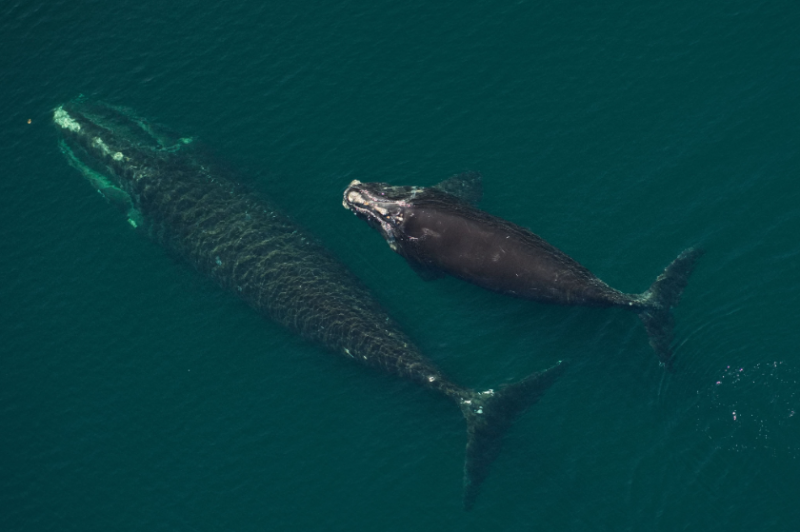
Whale researchers report endangered North Atlantic right whales have completed their most successful calving season since 2009, with 23 mother-calf pairs to help rebuild a population estimated at only about 380 animals.
The annual calving season off the southeastern United States, from the Carolinas to Georgia and Florida, runs from mid-November until mid-April and is closely monitored by aerial survey teams.
Scientists with the Anderson Cabot Center for Ocean Life at the New England Aquarium track the season closely. In an Apriln29 statement they reported there were shorter intervals between calving for the majority of the adult female whales.
“While a healthy right whale can give birth every three to four years, we had been seeing nearly 10 years between calves for some females. Many of this year’s moms have had shorter intervals – 18 of them previously gave birth within the last six years—giving us hope that they may be healthier and can help grow the population faster,” said Amy Warren, scientific program officer for the Anderson Cabot Center.
They reported three first-time whale mothers this season, and two elder right whale both at least 40 years old who have given birth to at least nine calves each. Every season is documented in the North Atlantic Right Whale Catalog, an extensive photo-identification database that allows them to track right whales’ life stories including births, injuries, migration patterns, and age to create detailed histories of each individual whale.
Scientists use the information to create a detailed list of mom-calf pairs with biographical information each calving season. This season’s list is available on the Aquarium’s website.
“We have other aunt-niece pairs and even a great aunt. These extensive family trees and life histories would not be possible without the contributions of the broader right whale research community,” said Warren.
“It is hopeful to see 23 new calves born this year, but their survival into adulthood is still a long journey ahead in an ocean with many dangers and obstacles,” Warren added.
Right whales can suffer injuries and deaths from human activities, including ship strikes and entanglement in fishing gear. In 2017 the National Marine Fisheries Service declared right whales are undergoing an Unusual Mortality Event affecting the population’s ability to survive and reproduce.
Conservation and management efforts have brought periodic declarations of 10-knot speed restrictions for large ships approaching major East Coast ports, and lobster fishing gear restrictions in areas of peak whale activity. NMFS and industry interests are looking increasingly toward new technology for detecting whales and avoiding maritime conflicts.