
The Northeast Fisheries Science Center held a two-hour webinar May 22 kicking off a new season of mackerel cooperative research and looking for fishermen to share their skills and knowledge with scientists.
According to Anna Mercer, chief of the NEFSC’s cooperative research branch, fishermen bring valuable experience to collecting and interpreting data, which will help fill research gaps and improve models of reproduction, migration, and the effects of environmental drivers on population dynamics.
Mercer notes that for the purposes of the stock assessment, the most critical information gaps include: how mackerel move between US and Canadian waters; when and where mackerel spawn; whether mackerel exhibit spawning site fidelity; how mackerel abundance and varies from year to year; and what environmental factors—such as temperature, plankton, predators, and others—drive the distribution and abundance of Atlantic mackerel.
“There are five elements to the program,” says Mercer. “The first is acoustic detection.”
In the acoustic detection element, Mercer explained that the NEFSC’s cooperative research program is looking for five vessels to collect acoustic data while fishing. In addition, the program needs a vessel with room for five scientists to make dedicated research trips to collect acoustic and catch data in winter and spring of 2027 and 2028, totaling 24 days at sea. The team is particularly interested in working with fishermen who can accurately identify mackerel when looking at the acoustic signals.
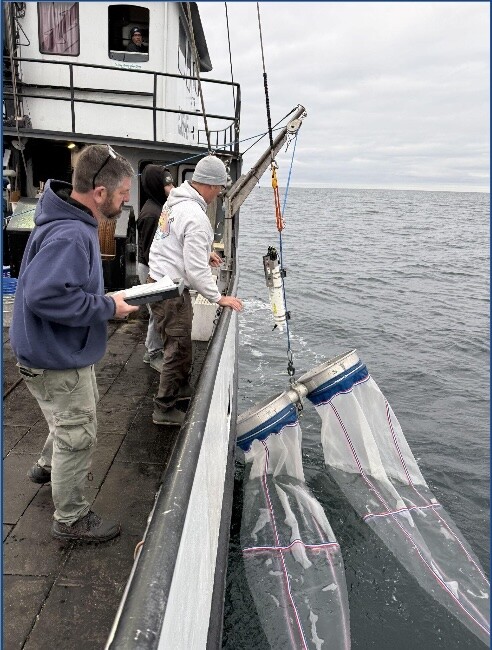
The second element of the program involves counting eggs, and the NEFSC team is looking for a vessel able to tow bongo nets at 2 knots on two dedicated 12-day cruises in May of 2027 and 2028. The scientists will compare egg counts with a later NOAA survey and other indicators of reproduction.
“The timing of the egg survey relative to the timing of peak mackerel spawning into the U.S. is critical to the egg index calculation,” says Mercer. “If the egg index values calculated using the two surveys are notably different, then it may indicate that the spawning seasonality function needs to be revised.”
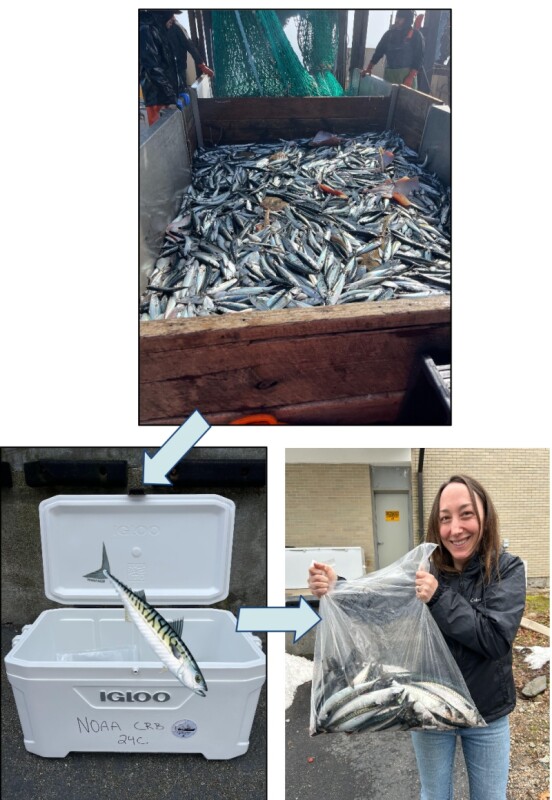
Element 3 looks at spawning seasonality by paying fishermen partners to collect mackerel samples for the NEFSC team from March 2026 until July 2028. The samples are expected to come from throughout the mackerel’s range. Researchers will dissect the fish and examine their health and spawning readiness.
Movement and mixing between Canada and the U.S. is the focus of Element 4, to assess if mackerel spawn in the same areas every year and whether U.S. spawned fish move into Canadian waters. The research will rely on acoustic tagging, and the NEFSC team is looking for a vessel or vessels capable of carrying six scientists for 2 days of jigging and tagging mackerel in the Gulf of Maine and another 2 days in Southern New England in May or June of 2027.
The fifth and final element will explore environmental drivers of mackerel abundance and distribution. For years, fishermen have seen their observations dismissed as “anecdotal,” but in this element, researchers want to hear those observations and engage fishermen in developing hypotheses about how environmental factors are affecting the resource.
“This is the largest research initiative focused on Atlantic mackerel in decades,” says Mercer. “And each research element is designed to inform future assessments of this important resource.”
Mercer says fishermen can submit an application to call for applications via the Atlantic States Marine Fisheries Commission [ASFMC] in summer 2026.”
“Fishermen interested in collaborating with us to collect mackerel should email Katie Viducic at [email protected]. Fishermen interested in working together to better understand the ecosystem drivers of Atlantic mackerel should contact Camrin Braun at [email protected].”
Mercer adds that the remaining links for fishermen to submit applications to collaborate on different elements are expected to be released in July by the Atlantic States Marine Fisheries Commission. For other questions, Mercer’s email is [email protected].