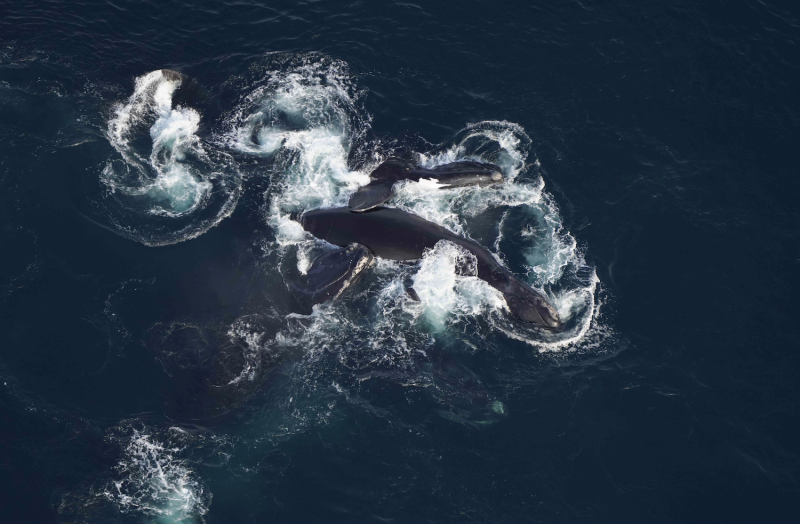
The National Oceanic and Atmospheric Administration could change its vessel speed rules where North Atlantic right whales migrate along the East Coast, potentially easing seasonal speed restrictions and adopting new technology to help avoid vessel strikes, the agency said March 3.
The proposed “deregulatory action” by NOAA’s National Marine Fisheries Service aims to “reduce unnecessary regulatory and economic burdens on the regulated community…with alternative management areas and advanced, technology-based, strike-avoidance measures that maintain or enhance conservation efficacy for the endangered North Atlantic right whale,” according to an agency notice in the Federal Register.
History and tradition hold that right whales were a preferred target of early American whalers for their habit of swimming on the sea surface, where they could be pursued by harpooners in small boats. Today the whales’ habits leave them vulnerable to accidental collision with vessels ranging from large sportfishing boats to commercial cargo ships.
The agency has used 10-knot speed limit advisories in waters off the East Coast during periods of higher right whale activity, aiming to reduce the chances of ship strikes.
Whale biologists estimated 384 North Atlantic right whales survived as of late 2025, according to the latest tally by NMFS. It’s slightly higher than previously estimated low points close to 350 animals but at such small size the population’s survival is precarious.
There has been “an increase of approximately 20 individuals since 2020. The latest estimate in 2025 marks the third consecutive year that the population has shown signs of increasing,” the agency says. “NOAA Fisheries estimates there to be only about 70 reproductively active females. The agency declared an Unusual Mortality Event in 2017 due to elevated deaths.”
Shipping companies and smaller vessel operators along the East Coast would like to see new technology to reduce potential whale strikes. NMFS has been working with MotionInfo to better utilize the Automatic Identification System network as a partial solution. The Massacusetts-based maritime data company installs and maintains the alert network’s shore-based AIS transceivers, known as “StationKeepers.” These transceivers communicate with vessels’ AIS devices and broadcast text messages alerting operators to potential whale strikes.
In a March 4 morning email, NOAA asked industry participants from its North Atlantic Right Whale Vessel Strike Risk Reduction Technology Workshop for information and public comments on specific topics:
- The effectiveness of technologies to reduce vessel strikes with whales
- Vessel-size-specific risk assessment
- Alternative Management Areas
- Safety deviation provision improvements
- Efficacy of the existing speed rule
- Economic impacts on industry (including impacts to small entities)
The public comment period is open through June 2, according to the agency.
“NOAA continues to focus on implementing technological solutions to reduce vessel strikes and entanglements, in ways that promote a sustainable coexistence between thriving marine industries and North Atlantic right whales.”
The agency announcement drew an immediate reaction from environmental advocates.
“Weakening the vessel speed rule will put North Atlantic right whales back on the fast track to extinction. This rule is simple: When and where right whales are most at risk, big ships must slow down,” said Francine Kershaw, a senior scientist with the Natural Resources Defense Council.
“The 10-knot limit works. It meaningfully lowers the odds that a collision turns deadly, and it’s widely recognized as a best practice for protecting whales by scientists and the shipping industry. In contrast, there’s no proof that other technology can deliver the same level of protection as slowing vessels down. It’s reckless to gamble with the future of one of our nation’s most endangered species.”
Earlier analyses by NOAA dating back to January 2021 reported that speed restrictions appeared to be widely ignored, with lowest compliance off the Southeast U.S. coasts with their burgeoning port and population growth. The highest compliance then was reported near Cape Cod, Mass., where the agency regularly publishes speed advisories when right whales aggregate.