


Seafood industry leaders from both sides of the Atlantic are raising concerns over new European Union (EU) traceability requirements, warning that without adjustment, the rules could significantly disrupt the flow of U.S. seafood– particularly from Alaska– into European markets.
In a joint call issued April 20 from Barcelona, representatives from the U.S. and European seafood sectors urged the EU to provide more time and flexibility for compliance with its updated digital CATCH certification system.
At the center of the issues is a requirement that each imported shipment include detailed traceability showing “each vessel’s contribution to each product by weight,” along with vessel identifiers and landing dates. Alaska industry leaders say that level of reporting doesn’t align with how fisheries operate in the state.
“We are observing instances where imports from highly regulated US fisheries, which carry essentially a zero-percent IUU risk, are facing unintended administrative blockages due to document constraints,” said Guus Pastoor, president of Seafood Europe. “This highlights broader, practical implementation challenges for third-country traceability as a whole, which are currently placing a heavy burden of delays and increased operational costs on EU importers and forwarders.”
The stakes are high. “The European Union is Alaska’s largest trading partner, where over $750 million in direct Alaska exports entered the EU market in 2025,” said Jeremy Woodrow, executive of the Alaska Seafood Marketing Institute (ASMI). “The trusted and longstanding relationship between Alaska and the European Union has been built over many decades, and any disruption carries long-term negative consequences for Alaskan fishermen, processors and communities, and European importers, businesses and consumers.”
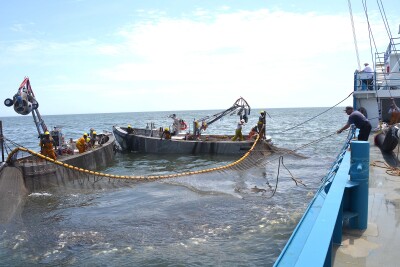
Industry groups say standard harvesting and processing practices in Alaska– such as commingling catches from multiple vessels– would make compliance extremely difficult. Those practices, they note, are long-standing and help improve product quality and efficiency while reducing costs.
“The EU’s new digital CATCH certification system introduces harvest vessel traceability requirements that are incompatible with Alaska fisheries, where catches are routinely aggregated across vessels and tenders to maintain quality and efficiency,” said Julie Decker, president of Pacific Seafood Processors Association (PSPA).“Some shipments would require several thousand data entries, imposing prohibitive costs on exporters and importers alike. Without modifications, these requirements risk halting a substantial portion of U.S. seafood exports to the EU—despite Alaska fisheries being among the most rigorously managed and transparent in the world.”
Leaders across the industry emphasized that while they support traceability and responsible sourcing, the current system needs adjustment.
“Global supply chain transparency is critical to ensure that seafood comes from sustainable, responsible fisheries,” said Matt Tinning, CEO of At-Sea Processors Association (APA).“The United States and the European Union should be advancing practical, coordinated approaches to achieve shared conservation objectives. Instead, responsible seafood producers globally now face a deeply flawed and operationally infeasible new system to sell into the EU. That’s unacceptable.”
“IUU fishing is a real challenge that threatens marine resources and undermines fair competition for responsible harvesters,” said Lisa Wallenda Picard, president and CEO of National Fisheries Institute (NFI). “It thrives where there is a lack of strong monitoring, enforcement, and fisheries' governance. That is far from the case in Alaska. U.S. fisheries operate under one of the most rigorous, science-based management and enforcement frameworks in the world, with accountability at every step.”
Industry groups warned that even companies capable of complying may opt to redirect products to other markets due to the administrative burden.
Seafood Europe, ASMI, PSPA, APA, and NFI said they remain committed to traceability but are calling on the EU to allow more time and flexibility to develop workable solutions– before long-standing trade relationships and market access are put at risk.