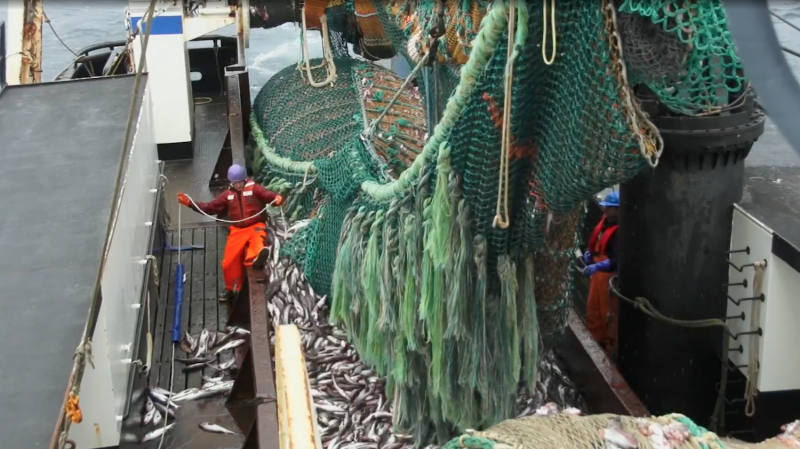
Bering Sea pollock come aboard a trawler. NMFS video image.
Key Takeaways
Federal fisheries managers are scheduled to take up pelagic trawl gear issues in Alaska's commercial fisheries when they meet June 1 to June 9in Vancouver, Wash.
Members of the North Pacific Fishery Management Council (NPFMC) plan to hear presentations from industry, processor and research entities and research updates to determine whether further action should be pursued to minimize the impact of trawl bycatch on other species.
NPFMC staff posted the June 2025 Pelagic Trawl Gear Innovation reportfor discussionat the June meetings. The council may also evaluate potential management measures to minimize the impacts of pelagic trawl gear in areas that are closed to nonpelagic trawl gear and address potential unobserved crab mortality, council staff said.
Trawl bycatch of salmon and other species in the Bering Sea and Gulf of Alaska has prompted economic controversy for years, particularly from rural residents pursuing a subsistence lifestyle. The trawl fishery plays a significant role in the economy of areas such as Kodiak Island.
Kodiak Mayor Terry Haines describes the local economy as a three-legged stool with the legs being the salmon fisheries, trawl fisheries and high value longline fisheries. "We have the luxury of being essentially able to work all year round. That means we are able to have a resident workforce for our canneries who buy homes, have families and their kids go to school here," he said.
"Without all three legs (on the stool) there would be gaps, especially for high volume fisheries like pollock that keep our canneries open for months at a time," he said. "The pollock fishery helps keep the whole town going. We have an extremely diverse fishing fleet and we want everyone to prosper. We need to fish as cleanly as possible and we want every fishery to be as healthy as it can."
Representatives of the Ocean Conservancy, Kuskokwim River Inter-tribal Fish Commission, Alaska Longline Fishermen's Association (ALFA) and SalmonState commented during an online trawl briefing on Thursday, May 28.
"It is widely known that pelagic trawls are contacting the bottom," said Emily Scott, program and outreach coordinator for ALFA."There needs to be immediate action to show you are operating as you are supposed to be, a need to work with industry on options with the immediate technology. This is not trying to shut anyone down, but we are all in this together."
"We are not trying to shut down trawling," said Megan Williams, of Ocean Conservancy. "We are trying to make it more sustainable in the long term. The fleet has been trawling on the bottom. Trawling on the bottom has a huge impact.”
"The (NPFMC) council needs to support diverse stakeholders. We are advocating for long term sustainability, not anti-fishing. If we could close this loophole that would help," Williams noted.
Kevin Whitworth, executive director of the Kuskokwim River Inter-Tribal Fish Commission, cited the collapse of salmon in the Kuskokwim River as a humanitarian crisis. "We need to close this loophole so our people can start to live again," he said, a reference to multiple families along the river who live a subsistence lifestyle.
Have you listened to this article via the audio player?
If so, send us your feedback around what we can do to improve this feature or further develop it. If not, check it out and let us know what you think via email or on social media.