




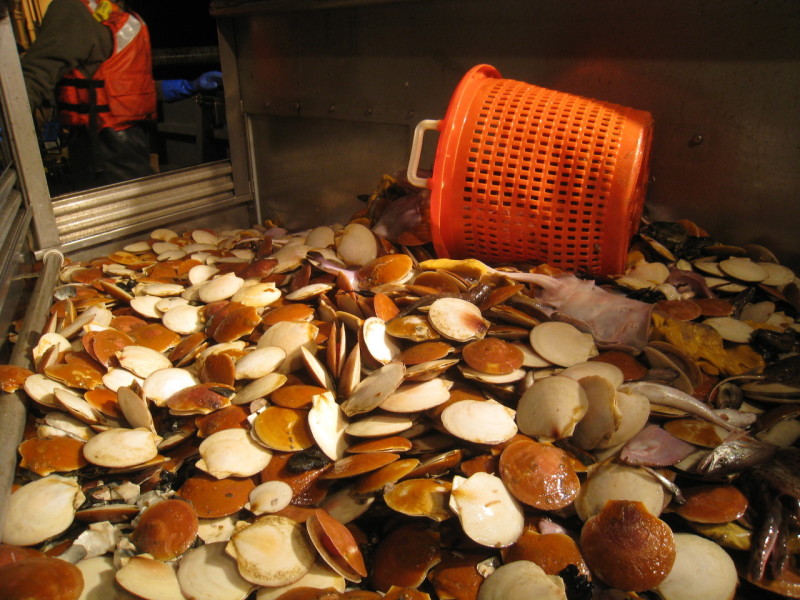
Advocates for the U.S scallop fleet hailed President Trump’s declaration of a “National Scallops Day” July 2, leading a list of NOAA Fisheries actions the administration says are aimed to “stabilize markets, improve access, enhance economic profitability, and prevent closures.”
Measures for the lucrative Northeast and Mid-Atlantic scallop fishery headed priorities announced by NOAA Assistant Administrator Eugenio Piñeiro Soler. The changes will open the Northern Edge of Georges Bank to the scallop fleet, and advance “permit stacking” on scallop vessels, two reforms the industry’s Sustainable Scallop Fund has sought for years.
“Permit stacking will let scallop permit holders consolidate operations, cut costs, and fish more safely and efficiently. Opening the Northern Edge returns the fleet to a productive, well-managed resource that has stayed closed for years,” the group says.
“We are grateful to President Trump and his team for listening to the men and women of the scallop fleet and acting on their behalf,” said SSF president John Lees. “Permit stacking and Northern Edge access will make our fishery more competitive, more sustainable, and more valuable to the American families who depend on it. This is what it looks like when Washington puts American fishermen first.”
The Northern Edge has been debated for more than 30 years in New England fisheries management. The New England Fishery Management Council had considered a framework action that would have revised habitat management restrictions and created rotational scallop access areas in the region.
The council intended habitat restrictions there to minimize fishing impacts on essential fish habitat for multiple species, including scallops, groundfish, herring, monkfish and skates. The long debate considered if opening the Northern Edge could affect long-term scallop yield, because if was thought dense scallops on the Northern Edge may serve as a larval source for that helps maintain other New England scallop grounds.
NOAA’s July 2 announcement did not provide a detailed schedule for implementation, catch projections, or final management measures for the Northern Edge or permit stacking. Piñeiro Soler said some priorities may implicate other statutory requirements and that NOAA Fisheries would work with the councils to determine how to advance them.
The scallop measures head a laundry list of changes that date back to August 2025 when NOAA asked stakeholders and the eight U.S. regional fishery management councils for suggestion on how to “improve fisheries management and science in an effort to stabilize markets, improve access, enhance economic profitability, and prevent closures.” The resulting priority list includes:
- In the New England region, NOAA’s priorities are to alleviate industry-funded monitoring burdens, modernize fleet capacity, and re-evaluate static area closures to restore yield and economic viability.
- In the Mid-Atlantic region, NOAA’s priorities are to modernize fleet capacity and improve quota distribution.
- In the South Atlantic region, NOAA’s priorities are to improve access and flexibility and advance state-led data partnerships.
- In the Caribbean region, NOAA’s priorities are to review the effectiveness of marine protected areas, evaluate the role of the territories in management of spiny lobster and queen conch, and significantly increase economic returns to the islands.
- In the Gulf of America region, NOAA’s priorities are to defend the domestic shrimp fleet from trade imbalances and optimize Individual Fishing Quota accessibility.
- In the Pacific region, NOAA’s priorities are to review trawl observer redundancies and review Pacific sardine science and management.
- In the North Pacific region, NOAA’s priorities are to review Stellar sea lion closure boundaries, prioritize efforts to remove unnecessary requirements, and increase flexibility.
- In the Western Pacific region, NOAA’s priorities are to enable commercial fishing, previously prohibited by punitive monument closures, and further consider additional management changes to improve access and flexibility, consistent with the Endangered Species Act.
- NOAA’s priorities for Highly Migratory Species are to implement international quota increases and maximize target catch retention.
The complete list of priority actions is online at the NOAA Fisheries website.
.jpg.small.400x400.jpg)
