As the Chesapeake Bay oyster fishery continue to grow and expand, the fishery is providing work for local boatyards and life for some of the oldest wooden workboats on the East Coast.
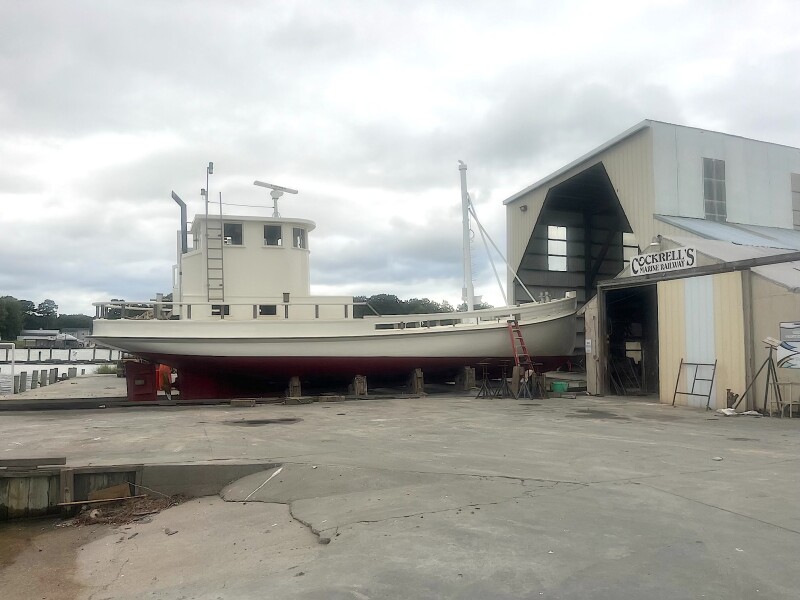
The 53’8”x18’x5.4 Connecticut clam dredge schooner Suzanna built in 1938 was one of four boats owned by Hillard Bloom Shellfish Co. of Bridgeport Conn. that in 2023 came south to work in the bay’s oyster fishery.
One of those boats, Suzanna has recently come off the rails and is spit-shined at Cockrell’s Marine Railway in Heathsville, Va. The entire hull, house and pilothouse have been coated with two layers of 2408 E-glass biaxial cloth and CPD epoxy. The boat also has all new stainless steel hardware – bitts, steps, post, and more.
“We took all the paint and hardware off her before we fiberglassed her,” says Myles Cockrell of Cockrell’s Marine Railway. “The only metal we did not replace with stainless steel was the galvanized mast. We coated the mast with Bar-rust 236, a multi-purpose, epoxy semi-gloss coating.”
“We had to replace a few pieces of wood in the pine deck but the hull looked to me just like it would have looked when she was first launched in 1939,” says Cockrell. “Other than decks (made of pine), everything else on the boat is built out of white oak."

“There is not a knot in any of the oak wood,” says Cockrell. “They must of found that wood in the Garden of Eden, because there is not a blemish in her anywhere.”The boat is owned by Jamie Harrington of Capt. Phip’s Seafood Inc. in Secretary, Md. and is being used to dredge oysters and to plant seed and shell in Maryland’s oyster replenishment program.
The other three boats that came south in 2023 were the 70.5’x22.5’x5.3’ Columbia built in 1906; the 47.8’x15.2’x4’ Bivalve built in 1912; and the 52.8’x18.1’x 5.3’Robert M. Utz built in 1917. The boats are all being worked in Virginia and Maryland oyster fisheries.
“The (round bilge) boats have a bit too much draft for some oyster grounds on the bay but there are plenty of beds in deep enough water for the boats to work,” says Cockrell.
Other work
Virginia’s aquaculture oyster fishery has brought life back to some old boats, but it sometimes takes a little tweaking to make it work.
Cockrell has recently converted a standard wooden deadrise hull with a traditional house/pilothouse into a large skiff-style platform. Myles and his father Andy own Little Wicomico Oyster Company LLC, an aquaculture farm that operates right next door to the railway.
“We took everything off the deadrise and fiberglassed the hull. The boat is going to be used in our oyster aquaculture business to work cages and dredge for oysters, he says. “We needed work and payload space more than we needed a house to keep out of the rain.”
The mast is usually positioned as far aft as possible when working oyster cages. Oystermen need for plenty of forward open space for the cages to be raised, mounded atop one another inside the boat, and taken back to the processing house for harvest.