

In the years leading up to the installation of the first turbine off the coast of Massachusetts, government officials, scientists, and fishermen convened in conference rooms and Zoom calls to discuss and debate what the fishing industry’s future could — and would — look like amid grids of steel towers.
An oft-uttered phrase was “coexistence” — a realistic goal to those backing offshore wind development, but a laughable suggestion to some fishermen. Accepting there would be impacts, other terms like mitigation and financial compensation peppered the conversations — tools to address effects on fishermen who will tow in and around the arrays as they’re erected, and once they’re operational.
Now, with more than 120 towers standing off the New England coast as of this month, the stakeholders involved can finally put their hopes, doubts, and hypotheses to the test.
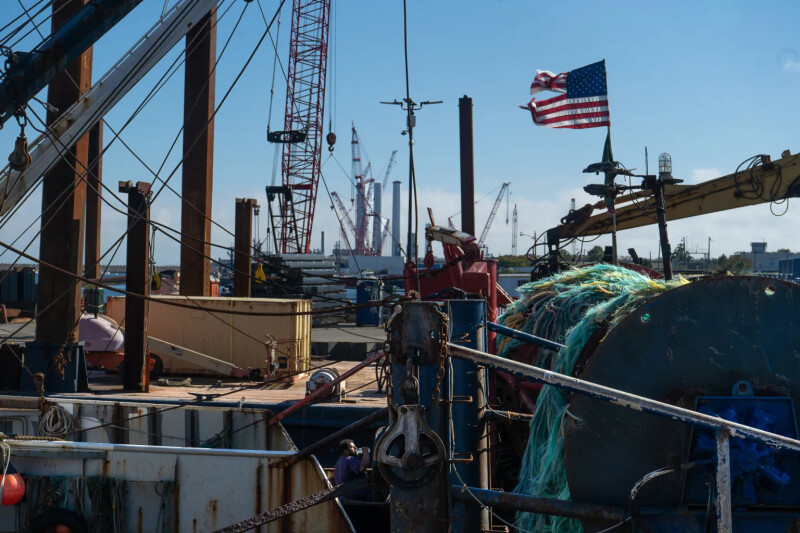
The New Bedford Port Authority and UMass Dartmouth School of Marine Science & Technology (SMAST) are partnering up for the first of its kind study in the U.S. that will measure how commercial fishing boats and their varied gear — dredges, pots, trawls, and so on — behave and operate within wind farms. The collected data, they say, can answer some unanswered questions, and inform how coexistence between the two industries can be achieved or improved.
“This project gives us the opportunity to address one of the major uncertainties in managing the interaction of offshore wind farms and fisheries,” said Steven Cadrin, professor of fisheries oceanography at SMAST.
The research project is funded by a $420,000 grant from the Massachusetts Clean Energy Center, and comes at a time when other studies that would have examined offshore wind’s impacts on commercially fished species and other marine interests, like whales, have been terminated by the federal government.
The final details have not been ironed out, but the testing may be conducted within Vineyard Wind or Revolution Wind (both projects have 80 percent to 90 percent of their turbines installed).
Blair Bailey, counsel at the New Bedford Port Authority and the project lead, said in an email that the study will not be limited to any one particular wind lease.
“The key is to get enough data,” he said. “The purpose of the study is to obtain as much information as we can regarding the interactions between commercial fishing and offshore wind.”
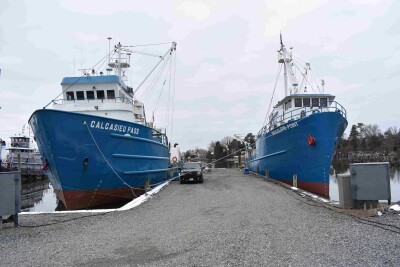
The project has started, with SMAST and the Port Authority contacting fishermen of all gear types and fished species. Fishermen will be paid for their time and participation, and the study is not limited to New Bedford vessels, he said.
A MassCEC spokesperson provided general information about the project, but did not provide comment from the agency. The project will capture real-time perceptions from fishermen as they fish within a wind array, and fulfills the agency’s mission to fill critical information gaps in how fisheries and offshore wind interact.
Information gathered may also inform ideas for new gear or vessel modifications that can address issues encountered by fishermen, or improve their experience fishing within the arrays.
The Port Authority’s project was one of a few selected from among more than 50 proposals for offshore wind research regarding fisheries, wildlife, climate technology and transmission.
In a letter last summer accompanying the Port Authority’s proposal, NOAA Fisheries officials stated the local project is “extremely important” and “highly needed.”
“Research into these elements can be used to help inform future wind lease siting, analysis of fishing vessel and associated community impacts from wind projects, and the need for and scope of … fishery compensation plans,” they wrote.
Bailey earlier this year said NOAA Fisheries social scientists would be involved in the project to document real-time thoughts and comments from the wheelhouse as captains navigate within the wind arrays. He said that remains the plan as of now.
New frontier
Unlike in Europe, fishermen in the U.S. are allowed to transit and fish within offshore wind farms, though it doesn’t mean they always will.
Captains’ decisions will depend on several factors: where the fish are; the type of gear (are they towing a net or deploying fixed gear); and the weather. The safety concern of navigating within the wind arrays is also compounded by potential turbine impacts on vessel radar.
With offshore wind, the public most readily sees what’s above the surface — the bright white towers and whooshing football-field length blades. But fishermen are concerned with what’s below the water line and their risk of snagging an exposed cable or turbine foundation with their gear.
Some research exists on impacts to fish species and recreational fishing boats among the smaller wind farms (South Fork Wind and Block Island Wind Farm), but there is not yet literature on impacts to commercial fishing vessel behavior within a commercial-scale U.S. wind farm.
“Vessel operators within the western Atlantic have never operated among such structures,” the NOAA scientists wrote last year, referencing the turbines and cables, “and it is unclear how hydrodynamics influenced by the presence of such structures” will affect their gear.
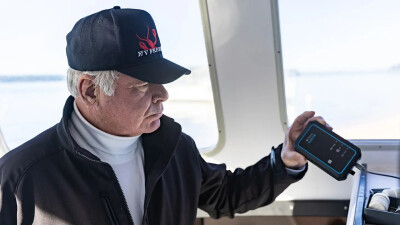
To collect data, researchers will attach devices to both the fishing gear and the vessels. SMAST already has some preliminary data, but will collect more from a variety of gear types and during various oceanographic and weather conditions.
Fishermen may successfully fish or transit within a wind farm on a sunny day, but their behavior may be conditional on the weather. Researchers could find that they avoid the wind arrays entirely in stronger winds or rougher seas.
The results may also factor into future conversations about how much wind developers should earmark for financial compensation for fishermen.
Existing funds used modeling that assumed how much fishing grounds (and income) fishermen could lose to the wind farm footprint. Broadly, models either assumed fishermen would fish quite close to the turbine bases, or not enter the wind farm at all.
The project will collect and analyze data on actual fishing behavior by commercial fishing vessels, effectively vetting those two assumptions.
In a February meeting, when MassCEC announced the grant winners, Bailey said he was “just trying to get some science behind some of the assumptions” of the earlier compensation models.
In the meeting, which draws officials from wind, fishing and government agencies, he said wind developer representatives wanted to participate and were “very excited” about the project.
This article was originally published by The New Bedford Light and is republished with permission.