


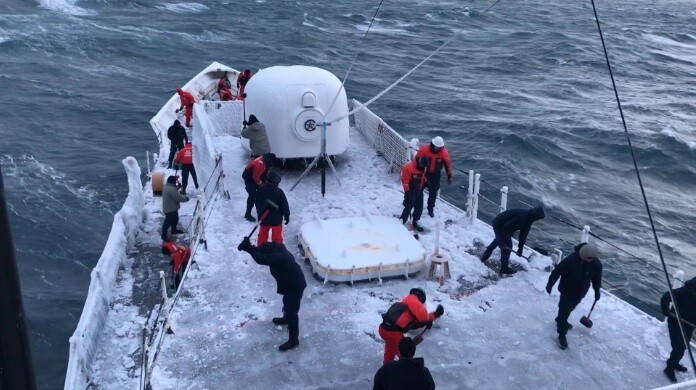
Fishing in winter at middle to high latitudes means occasionally dealing with icing conditions—when ice can build up on the superstructure and rigging of a vessel, reducing stability to the point of capsizing. In New England, as vessels approach shore, pounding against a northwest wind coming off land that is much colder than the water, icing can get severe. A ¾-inch forestay can grow to 6 inches in diameter of ice, and its heavy. Heading out on deck in the dark to pound ice off the boat in those conditions is brutal and dangerous, lifting outriggers a few feet and dropping them to snap off the ice is hard on them, but the alternative is far worse.
A 2022 Chinese study on how to de-ice or prevent ice accumulation on vessels operating at high latitudes looked at the idea of coatings to put on the rigging and superstructure, but concluded that it would wear off quickly and cost too much in time and money. “No engineered anti-icing surface is currently capable of preventing frost formation, droplet freezing, and ice accumulation in an economical and environmentally sustainable way due to the poor performance of the stability and durability of the material,” says the paper.
The paper’s authors also looked at the idea of heating some exposed surfaces, either electrically, with hot water, or with targeted infrared heat, but again concluded that such methods would not be practical for small fishing vessels.
The Chinese authors arrived at the same conclusion that most fishermen have: that manually removing the ice is the most reliable way to get it off the boat. “BFH [big effin hammer] is your friend,” says Maine fisherman, Carl Guyton. Hamilton Marine, with stores along the Maine coast from Kittery to Jonesport, sells the Garland Ice Mallet, which features a 6-inch-long x 3-inch diameter cylindrical head made from ultra-high-molecular-weight plastic (UHMW), with a 36-inch wooden handle. Garland advertises its mallets for several applications but not fishing. Nonetheless, the Garland mallets get the job done.
Russ Trombley, owner of Marine Service and Supply in Seattle, has been making mallets specifically for de-icing vessels for over 20 years. “Fishermen used to use baseball bats, sledgehammers, and things like that, but those could damage the paint,” says Trombley.
Based on what fishermen were asking for, Trombley started out making a mallet with a UHMW plastic cylindrical head. “But then fishermen asked if we could make one with sharper edges to get into tight places, so I started cutting a 5-inch-long 4x4-inch head, and then later I added the taper to one end.”
Trombley fits a 36 fiberglass handle on his ice mallet and manufactures a run of about 200 a year. “I mostly sell them to guys going to the Bering Sea, and the cod guys up around Kodiak,” he says. “And some to the Great Lakes, but not too many to the East Coast.”
The US Coast Guard issues warnings when icing conditions arise, and experienced fishermen know when to break out the mallets.