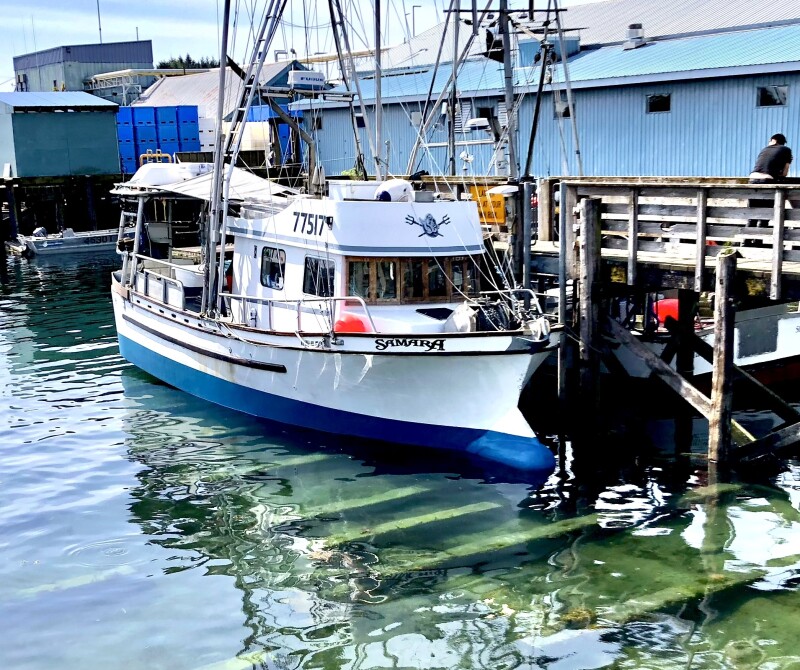
Along coastlines with big tides, fishermen can economize on haul-outs for fast jobs.
In Sitka, Alaska, fishermen went for more than two years without a haulout option until Highmark Marine from Kodiak came to town with a 150-ton lift in 2025. “They closed the lift at Halibut Point in 2022 to turn that into a dock for cruise ships,” says Eric Jordan, a Sitka-based salmon troller. “Until Highmark came all we had was the tidal grid. Either that or go to Hoonah or Wrangel. Hoonah is an 18-hour run, one way. Wrangel is 36, and with the price of diesel at $5 a gallon that’s a lot.”
Sitka’s tidal grid can handle as many as seven boats, depending on their size, and gives fishermen a chance to work on their boats in between tides. “They go in there on the high tide and tie onto the pilings and wait for the tide to go out,” says Jordan. “Then you get a chance to work on your boat for a few hours until the tide comes back. It’s good for quick jobs like changing the zincs, scraping, and making sure your cooling pipes are clean; things like that.”
But according to Darin Dunfield, manager at LFS Inc., a marine supply store in Sitka, most fishermen are well prepared with what they need for jobs on the grid. Nonetheless, working between the tides can get dicey. “I had a guy call me once in the middle of the night, asking me to meet at the store and sell him some Splash Zone, it’s a putty you use to patch small holes in the boat.”
Jordan recalls that when the grid was all they had, some folks would take on more risky jobs like replacing through-hull fittings. “When the grid was all we had, we’d do just about everything there,” he says. “Paint, change a wheel, whatever.”
Jordan notes that the grid has always been more expedient than popular. “It’s a mess down there; people have been scraping and pressure washing for years. Sometimes you have to stay up all night for the tide. I actually use a diver to change the zincs and clean the bottom.”
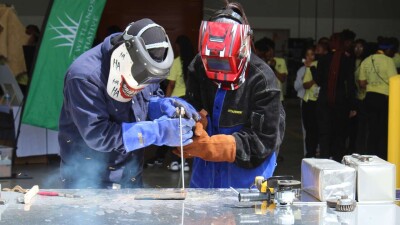
The diver Jordan hires is Kellen Shoemaker, owner of Blackwater Dive and Welding Services in Sitka. “I’ve also done work on boats on the grid,” says Shoemaker. “Usually welding zincs on. It’s not my favorite. I take some cardboard to lie down in the mud. But it’s always a mess. The leads get all muddy, you’re down there in the morning when it’s still dark.” Like Dunfield, Shoemaker has made some emergency trips to the grid. “About four years ago, a guy was down there pressure washing and he blew a hole right through the hull. He called me and I ran down and welded a patch on. He found he had some loose wires in the bilge that had eaten the steel paper thin.”
While it may be declining in popularity, Dunfield points out that the grid remains an important option in Sitka. “We’re lucky to have it,” he says. “It’s great for bigger boats that just need to do a simple job. Otherwise, they could be paying as much as $4,000 to haul out.”