

A University of California Davis (UC-Davis) study has determined that parts of the San Francisco estuary known as the Suisun Marsh are producing an abundance of zooplankton, microscopic animals that form the foundation of a fish's diet.
If wetlands managers adopted strategies to connect managed wetlands with tidal habitats, they could time seasonal flood releases to send a DoorDash-like delivery of plankton pulsing into other waters to feed more fish, according to the study, which was published in the journal Estuaries and Coasts.
"Plankton have been declining as a whole in the estuary for decades," said Kyle Phillips, a postdoctoral scholar with the UC-Davis Center for Watershed Sciences. "The food has been missing, but we found where the food is, and we figured out how to make more. When you flood managed wetlands, you can expect a big boost in zooplankton," said Phillips, lead author of the study.
These human-constructed shallow ponds that comprise the managed wetlands have been diked and culverted to control water flows with neighboring waterways. Most of them were built in the early 1900s. They have primarily been managed by duck clubs to promote migratory waterfowl and hunting. There are 52,000 acres of managed wetlands in Suisun Marsh.
"Suisun Marsh is an extremely beautiful place," said co-author John Durand, a senior researcher at the Center for Watershed Sciences and Phillips' advisor. "There are levees, ponds, and restored wetlands. It's gorgeous, diverse, and full of plants and animals. Part of the reason for that is because duck clubs have preserved the land there for 150 years. Where everything else was turned into agriculture or industry, Suisun Marsh remains a hotspot for fishes and for our imaginations."
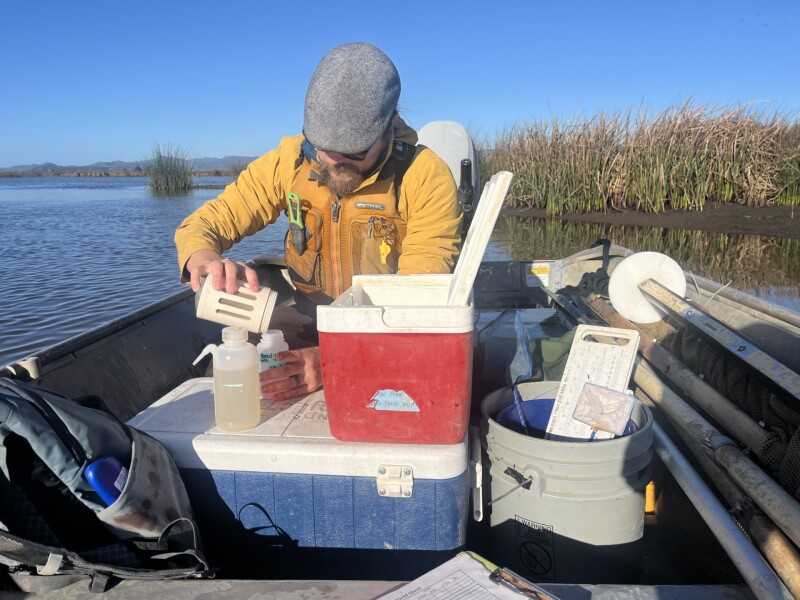
For this study, researchers collected and studied zooplankton from six managed wetlands and eight tidal waterbodies across Suisun Marsh from 2018 through 2022. They compared plankton abundance between the habitats and measured when they are most productive. These are the dynamics that inform how zooplankton may be exported through the estuary to feed fish.
"Infrastructure-wise, connecting managed wetlands to adjacent tidal restoration sites could just involve adding a tide gate to the levee that separates the two habitats," Phillips said. "For entities implementing water exchange, they'd probably want to test water quality in the managed wetland and verify if it's producing higher zooplankton densities before opening up the tide gates to export fish food."
Actual permitting would likely involve the California Department of Fish and Wildlife and other agencies because conventionally managed wetlands are thought to pose entrainment risks for fish, and those risks may need to be reweighed against the benefits that managed wetlands provide, he said. Most managed wetlands in the marsh are privately owned by duck hunting clubs, so adjusting management to implement flood pulses for fish would likely require state or federally sponsored incentives.
"In general, reconnecting floodplains to streams is well known to have a really beneficial effect on fish," Durand said. "Those floodplains create habitat and feeding (and in some cases spawning) opportunities to fishes. Our study looked at small, managed wetland ponds and found they provide these benefits as well, with the added advantage of being able to time when they open up, so there is flexibility about when they provide food."
When they exchange in the spring, for example, they are providing food for out-migrating salmon smolts. If they exchange in the summer or fall, they might be able to provide food for resident sensitive fish like endangered Delta smelt or longfin smelt.
"That is what we will be studying over the next couple of years: whether we can activate these wetlands during times of food scarcity during summer and fall," Durand said.
The ponds are owned by a diverse group of private and public landholders, including some lands held by the California Department of Fish and Wildlife (CDFW). The project itself is funded by the Department of Water Resources, which is required by CDFW to provide mitigation for smelt for water exported for agriculture and urban use.
Durand said UC-Davis will be working with colleagues from various agencies and consulting firms to understand the feasibility of the overall program. The first year of study is happening this summer.