

A new report from the National Oceanic and Atmospheric Administration (NOAA) outlines a steep decline in the economic stability of the Gulf shrimp harvesting industry, citing falling revenues, increased competition from imports, and shrinking participation in the fishery.
The report, released March 10 by NOAA Fisheries, examines the economics of the Gulf of America shrimp industry, including shrimp prices, harvest levels, costs, profits, and workforce participation. The analysis found that the industry has experienced a multi-decade decline in profitability and financial sustainability.
REVENUE AND MARKET SHARE DROP
According to the report, total Gulf shrimp revenue fell sharply between 2021 and 2023, declining from $489 million to $221 million. Overall, the U.S. shrimp harvesting industry has lost about $268 million in revenue since 2021.
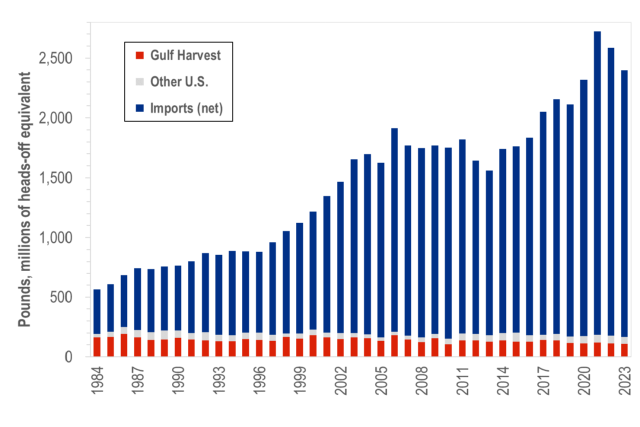
The drop has occurred despite strong consumer demand. U.S. shrimp consumption increased more than fourfold between 1984 and 2023, but most of that demand has been met by imported products.
Originally, imported shrimp were primarily wild-caught abroad. Over time, farm-raised shrimp produced through expanding aquaculture operations in developing countries became the dominant source. By 2023, shrimp harvested from the Gulf accounted for only 4.5% of the U.S. market, compared with 28.7% in 1984.
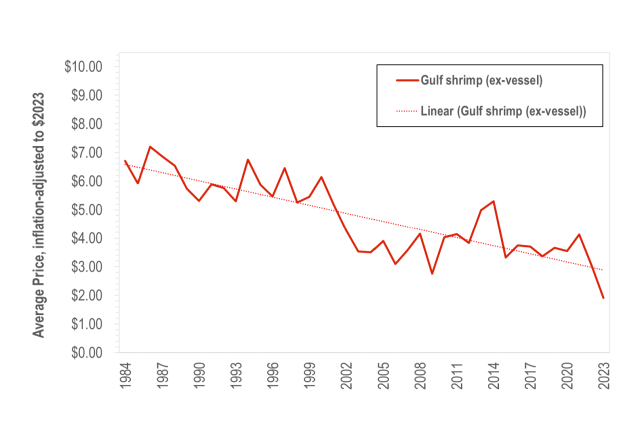
Increased aquaculture efficiency and lower-cost imports have pushed shrimp prices downward. Adjusted for inflation, the average price of Gulf shrimp has fallen from more than $6 per pound in the 1980s to less than $2 per pound in 2023.
"For decades, this fishery has been fishing down its capital stock—leading to slow attrition in good times. Bad times rapidly turn into crises," said Dr. Christopher Liese, an industry economist and lead author of the report. "The long life of shrimp vessels has masked a fundamental weakness: The fishery is not economically sustainable enough to reinvest in itself. This is an industry consuming its own capital to stay afloat, delaying a crisis rather than ensuring a future."
FEWER VESSELS AND WORKERS
Shrimp harvest levels have also declined. U.S. wild-caught landings in 2023 were 15% below the average of the previous 10 years and 24% below the average of the previous 50 years.
Scientists say the decline is not due to reduced shrimp populations. Assessments indicate that shrimp stocks remain stable and are not undergoing overfishing.
“We know from our regular assessments that shrimp abundance is not the issue here,” said Dr. John Walter, deputy director of the Southeast Fisheries Science Center. “We also know that because of declining profits, fewer vessels are shrimping, active vessels are shrimping less, and fewer crew are employed by the industry. This is driving the observed drop in landings, and exacerbating revenue declines.”
The report found that the number of active shrimping vessels dropped by 19% from 2021 to 2023, with an estimated loss of more than 1,200 jobs.
LIMITED INVESTMENTS AND MOUNTING COSTS
The fishery has operated with minimal capital investment for decades, the study found. Over the past 18 years, the industry averaged a profit margin of just 0.5%.
Economic pressures in recent years were intensified by disruptions related to the Covid-19 pandemic and inflation.
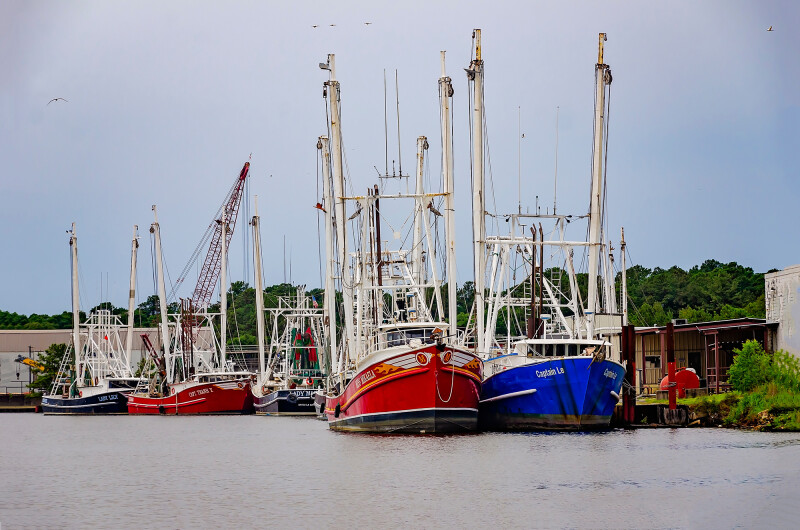
“The struggles the industry is facing are immediately apparent when walking the docks in any of the major shrimping communities,” said Dr. Carissa Gervasi, lead of the Shrimp Futures Initiative. “Docks are in disrepair while giant vessels with peeling paint sit idly.”
Low shrimp prices have led some operators to keep their vessels docked because operating them would cost more than the revenue generated from shrimping. However, prolonged inactivity can lead to additional financial strain as crews leave the industry and vessels require significant maintenance to return to service.
“But many shrimpers are stuck. One fleet owner estimated that it would cost him $4 million to sell his 14 vessels and exit the industry. Shrimpers can’t afford to shrimp, and they can’t afford to stop shrimping,” Gervasi said.
LOOKING FOR SOLUTIONS
The report is part of the Southeast Fisheries Science Center’s Shrimp Futures Initiative, which aims to identify strategies that could help restore profitability to the fishery.
Sarah Shoffler, NOAA’s national seafood advisor, said the report quantifies the economic challenges facing the industry and outlines possible paths forward.
“This report puts numbers to the economic challenges facing the U.S. shrimp industry,” Shoffler said. “Achieving a truly resilient Gulf shrimp industry hinges on its ability to sustain profitability. The path forward will likely involve a strategic combination of technological investment, market differentiation, and robust public-private partnerships. We are committed to exploring solutions that could support this industry into the future.”
The initiative aligns with Executive Order 14276 and is intended to help federal officials and industry partners evaluate actions to support U.S. shrimp fisheries and coastal communities.