

Electrically powered vessels are a growing presence in the workboat fleet, though not so much among seafood harvesters. The tight budgets common to small-scale operations impose a pragmatic approach to business on the part of independent operators that translates to reliance on tried-and-true internal combustion engines.
By the same token, outboard engines are a mainstay among small boat and inshore harvesters, particularly since the advent of fuel-efficient and comparatively quiet four-cycle outboards. More recently, commercial operators have begun turning to diesel outboards, especially in heavier watercraft, where torque is a greater consideration than speed. However, it would be getting ahead of things to assert that diesel outboards are the future.
Meanwhile, electric outboards are beginning to assert themselves beyond the realm of boaters who use them on dinghies and small sailboats. In Maine, a locally owned oyster farm on Casco Bay has embraced the role of early adopter.
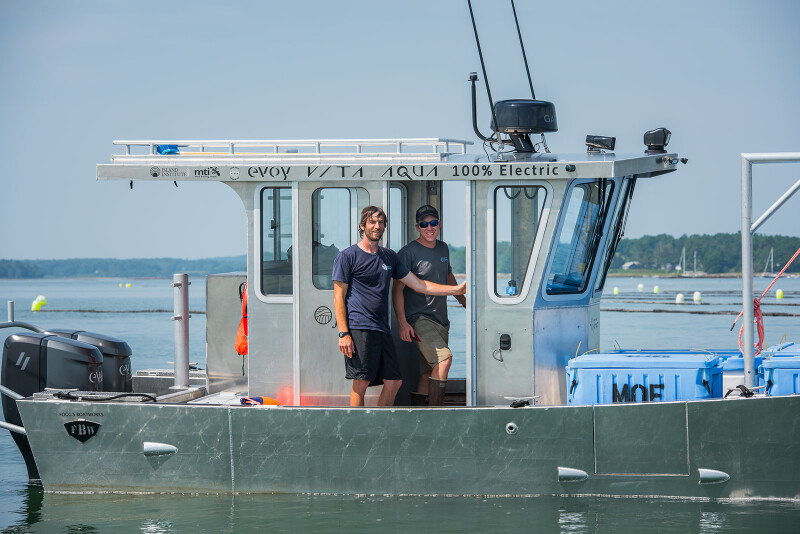
Enter the Heron, a 28'x10' x1'10" all-electric aluminum landing-craft-style workboat conceived by Eric Oransky and Willie Leathers, founding partners of Maine Ocean Farms, an oyster operation in Casco Bay. The two met as officers on sailing ships.
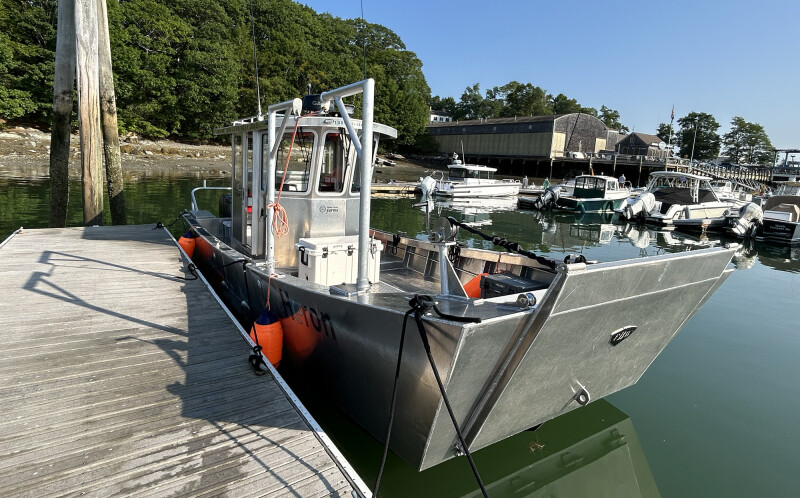
The two men knew they wanted a landing-craft-style workboat for their farm. And more. “We’re really trying to push the envelope of what aquaculture is doing here in Maine,” Oransky said.
The appeal of electric propulsion — quiet, clean, and offering a carbon footprint solely attributable to the need to charge its batteries — was hard to miss. Moreover, it loans itself to an aquaculture operation. “You get to go home every day,” Oransky said. “There’s not as many variables as to where and how long as in offshore fishing.”
The partners determined that by going all-in on electrical power they could secure grant money to help justify the investment. They were able to enlist backing from outboard manufacturer Evoy and Aqua Superpower, which partners with Evoy and operates a global network of fast-charging stations for electric boats. Maine Clean Communities and the Greater Portland Chamber of Governments also supported the electric side of their project.
The Maine Technologies Institute and the Island Institute, which supports Maine coastal communities as times and climate change, helped the partners with the vessel itself. “There’s funding available if you’re willing to pursue it,” said Leathers. The partners put their supporters’ logos on the Heron’s wheelhouse.
The investment in electric propulsion is sometimes justified as “buying all your fuel up front,” Oransky said. But he conceded that the Heron has been operating for just a few weeks, so the economics remain to be seen.
“If it makes sense for electrification of commercial waterfront, aquaculture, in my mind, is one of the easiest targets to hit,” Oransky said. “We have the same places we go every time. We can calculate those distances and ranges and duty cycles.”
The Heron’s outboards are Evoy 120+, so called because they are rated for 120 continuous horsepower, or 90kW, with a short duration rating of 185 horsepower, or 137 kW.
The wheelhouse is equipped with a Garmin 12" 8612 chartplotter, Garmin Fantom 18X radar, and a pair of Standard Horizon VHF radios with automated sound signal, loud hailer, and AIS.
The boat is also equipped with floodlights and a remote-controlled searchlight, automatic windshield wipers, washdown pump, horn, and Dometic electric steering.
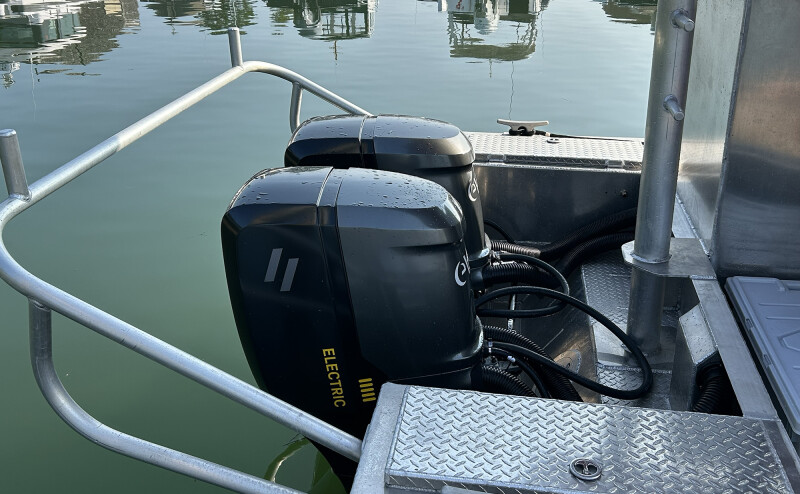
The Heron’s outboards are Evoy 120+ rated for 120 continuous horsepower, or 90kW, with a short duration rating of 185 horsepower, or 137 kW. Jerry Fraser photo
While the Heron is foremost an oyster harvesting platform, the boat is built to Coast Guard standards and can take passengers, mostly on eco-tours of the aquaculture operation. “We do some sightseeing on Casco Bay, but that’s just for people who want something else,” Oransky said. “Ninety-five percent of them are oyster farm tours.”
The relative whisper of the Heron’s electric outboards accommodates tours well. “Because it’s set up as a landing craft, not like the lobster boat, all the engine noise is behind the wheelhouse and the guests are all up here,” he said, referencing the broad foredeck. When the partners used their diesel-powered, 31' lobster boat for tours, Oransky packaged his presentations to avoid competing with the roar of the engine. No more. The crew operates the boat and he sits with the passengers and talks. “It actually cuts almost 30 minutes of stop time,” he said. “We want people to able to enjoy the scenery and have enough time to go look at the osprey nests, see some seals.
Although the boat is built to Coast Guard standards, the partners made the decision to operate uninspected to avoid having to install railings, which would be an encumbrance on a work platform. As a result, they are limited to six passengers, who derive an authentic experienceas opposed to a choreographed boat ride.
The Heron also engages in commercial diving charters, mostly doing helical mooring arrays, which are especially useful in aquaculture. The helixes are dropped into place and screwed into the sea floor. Helixes don’t creep and they don’t get fouled, and they’re easy to move, Oransky said. “You can basically lay out an entire array of a farm,” he said.
A 5'6" helix with a 10" single-plate screw weighs about 70 lbs. and can hold 3,500 lbs. extraction, he explained. “You can put a bunch of them on deck,” he said. “We couldn’t carry 20 mooring blocks.”
Using a hydraulic drill they swing from a davit through a dive door they can set even larger helixes, such as they did for the dock system in Bath, Maine. They’ve also done salvage work with the Heron.
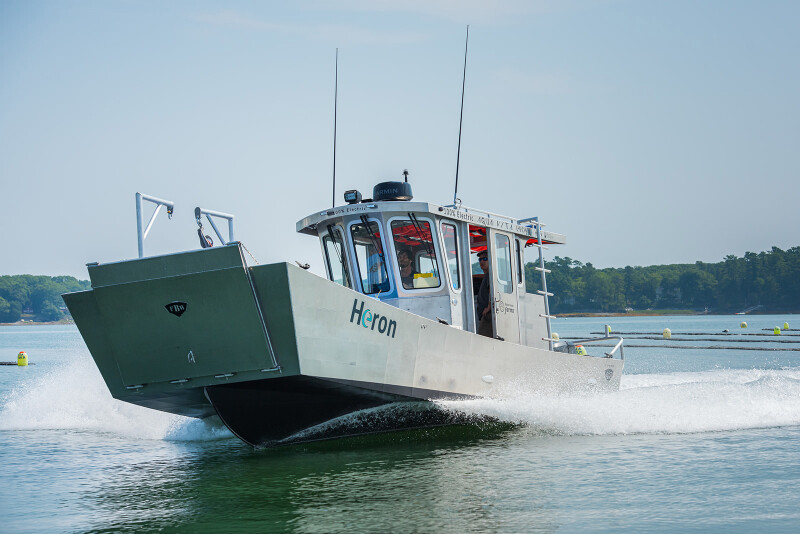
The boat was built by Patrick Fogg of Fogg’s Boatworks in North Yarmouth, Maine. Fogg, whose father founded the yard 30 years ago, described the Heron as a “unique and one-of-a-kind project for us.” Although the yard regularly turns out aluminum vessels, this was Fogg’s first all-electric project.
As a result, he said, a lot of work went into the vessel’s design. “Not only is this a purpose-built work boat specifically designed for aquaculture, it was also designed to accommodate and perform with 100% electric outboard propulsion.” The project demanded attention to weight and efficiency, “but at the end of the day Maine Ocean Farms required a boat that was incredibly rugged, versatile and one that offered ample deck space and stability.”
In some applications, vessels are built light for pairing with an electric motor. Oransky said the Heron was built to commercial passenger vessel specifications. Only then did Fogg take specifications from the motor and battery providers and design a system to propel the boat.
Nor is the boat as boxy as a landing craft might sound. And while Oransky believes it is the first fully electric aquaculture boat in the country, it has what he describes as classic New England workboat lines with a fair amount of deadrise forward. “It’s a big, square workboat,” he says, “but it’s got some nice shear and the house has a really nice kind of feel to it.”
With nothing on deck, the Heron’s two outboards push it along at a brisk 30 knots. “It was designed to not be an open-water boat, but to be a big work platform that could cut through the bay chop at 20 knots, and it does.
“We’ve had 3,000 pounds on deck and still gotten up on a plane.”
Fogg used aluminum alloy 5086, for flexibility and weldability, and 5083 for maximum strength and corrosion resistance, throughout the vessel. The Heron’s transverse and longitudinal frames are 3/8" thick and 12" apart and come up through the bulwarks to the rail. The bottom and side hull plating is 1/4". The deck is 1/4" diamond plate. Chine plates are 5/16" and the transom is 1/2" plate with an additional 1/2" doubler where the engines mount. The center vertical keel — the Heron’s backbone — is 3/4"x5".
“You would not want to play bumper boats [with us] and be the other boat,” Oranskysaid.
The boat has four watertight compartments and is equipped with high-water alarms. It also has a freshwater flush head.
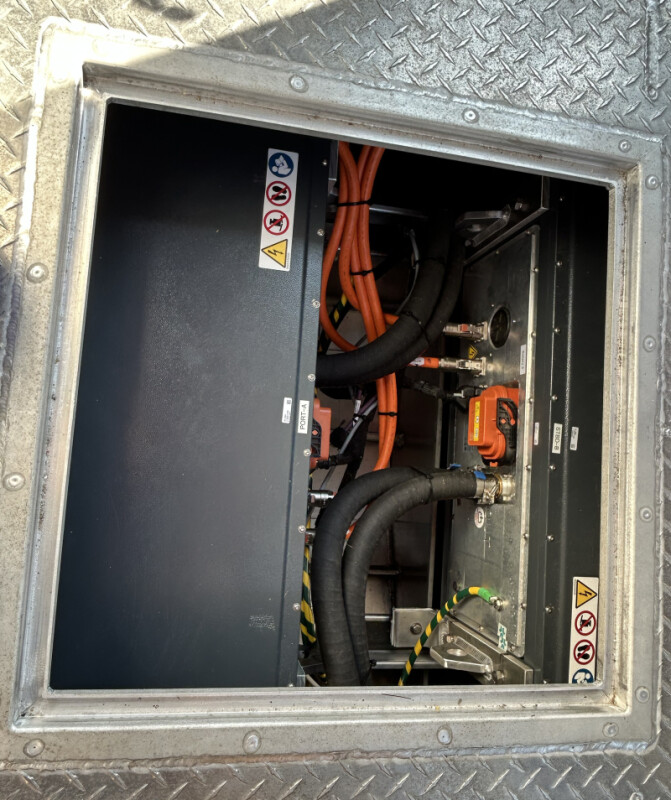
The batteries — which between the two of them weigh almost a ton and have a capacity of 126 kW hours — are located beneath the wheelhouse. They were lowered through the hatch over the main hold, then slid aft through a soft patch in the bulkhead.
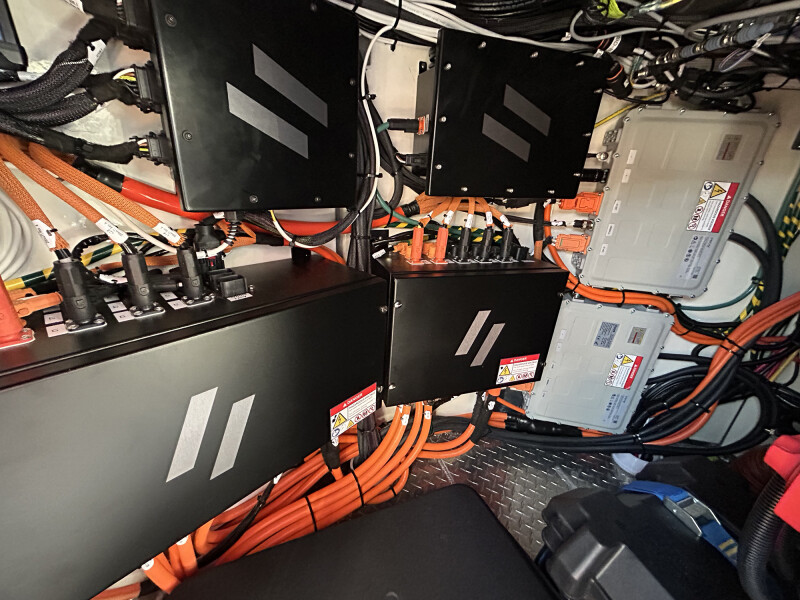
The batteries are independent, meaning only one battery can power each motor, and there are two control systems. However, the throttles are synchronized, and the charging system is integrated.
Each battery can take 44kW charging load. When the motor is running, water pumps in the outboards’ lower units push water through heat exchangers to cool the batteries. When themotors are up, separate centrifugal pumps provide water for battery cooling.
At six knots the Heron has a range of about 90 miles. By way of comparison, Oransky said that their lobster boat, with its 6BT Cummins, carries 2,000 pounds of diesel fuel, about 285 gallons, and has considerably more range when “sipping fuel” at six knots.
Oransky grew up on Casco Bay, so the partners worked with local lobstermen to find an ideal location for their farm and were able to get just what they needed: water deep enough to accommodate their lobster boat, which draws nearly 5', but shallow enough to keep moorings economical. “There’s seventy-something mooring balls,” Oransky said. As an added benefit, the farm is sited behind three or four ledges. “Nobody wants to go out there,” he said.
The farm has a one-ton diesel truck to transport oysters to Portland and bring ice back to the dock. Eventually, they hope to be able to recharge in Portland and transport oysters and ice with the Heron instead of the truck. “On plane, it’s actually not a very different timeline to drive the boat,” Oransky said.
Wheelhouse instrumentation gives the operator RPM, speed, parasitic (non-propulsion) load, battery temperature, and outboard temperature. “Once we start going, it’ll give us a range in hours and minutes and nautical miles, and our kilowatts-per-nautical-mile consumption,” Oransky said.
Prior to the arrival of the Heron, a lobster boat and a pontoon boat serving as a bargewere at the center of the farm’s operation. Moving the farm’s 300 oyster cages (about the size of a wooden pallet and 2' high) back and forth with the lobster boat was complicated by the tidesand the need to use a Carolina skiff to push the pontoon boat ashore to offload all the cages. “It’s a whole day operation at 6 knots,” he said.
The Heron will stack fewer cages, but it can carry them at 20 to 25 knots, and with the outboard trimmed up, it draws only 22 inches. The steam to shore will take 10 minutes, Oransky said. “And then we drive right up to the riverbank, tee up, use the twin screws to stem the current, drop the ramp, load cages on and off real quick and come back.
“And the whole trip could probably be an hour. And there’s going to be a charger there, too.” They’ll be able to plug in, get a little boost, Oransky said, “and just keep running trips all day.”
Meanwhile, the lobster boat can stay tied up on along one of the farm’s 24 grow lines, the barge on its hip, using it crane to raise and lower cages. The Heron will steam up and load or unload oyster cages. “So now something that was this iterative couple-day work cycle can just be a continuous process with two boats,” he said.
Following on the heel of the Heron is the farm’s second electric project, a solar-powered upweller the partners began using in August. The upweller consists of silos mounted through the barge’s deck that use pumps to suspend baby oysters in seawater. The upwelling allows for greater oyster density, and more water means more food for the oysters, Oransky said, “It should accelerate the growth of the baby oysters in this first summer.”
Bigger oysters are more robust and more resistant to cold, which will help come winter. “And it also should get us to market sooner,” he said. “Hopefully, a month or two sooner.”
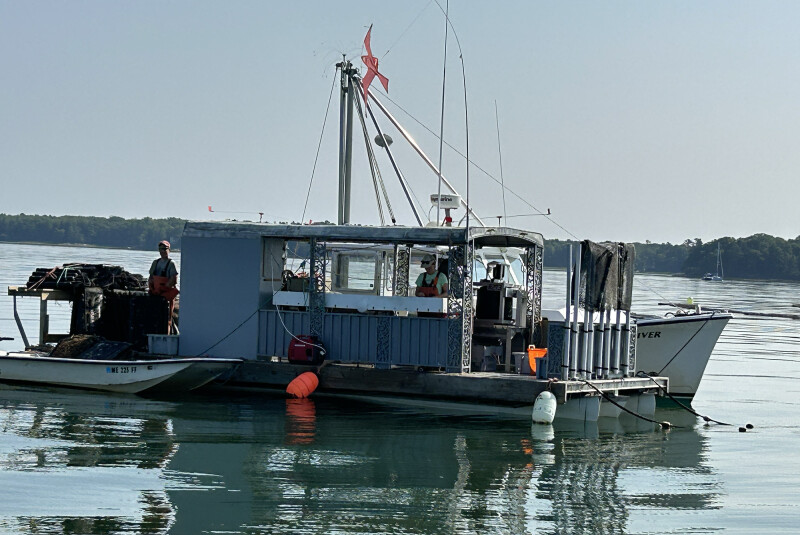
Maine Ocean Farms sells directly to a couple of markets but their volume is enough they wholesale most of their oysters. Wednesday is delivery day. “We harvest early and then deliver by early afternoon,” Oransky said.
During summer about 16,000 market oysters are suspended beneath the barge for the last two weeks of their grow-out. They go to market at the rate of about 7,000 a week. The farm crew hoists them aboard, dumps out their baskets and washes them. They count them out in hundreds and inspect them and then dump them into a slurry of half ice, half seawater that chills them down to 45 degrees. Below 50 degrees bacteria cannot reproduce.
This is their ninth year of operation and their sixth year of putting in more than a million seed in. They expect to sell 350,000 oysters to market. “Next year it will be about half a million,” he said, “which is what the farm was really designed to produce.” Seven people, including the two owners, work the oyster farm.
“It’s a lot of work, but it’s very much farming,” he said. “We’ve got rows. We’ve got the equivalents of beaning and pruning and sorting.
“But it takes three years to grow to market.”