




Searching for commercial fishing's impact on air quality it's not necessary to go very far before realizing that commercial fishing vessels significantly contribute to greenhouse gas emissions through fuel combustion, which releases carbon dioxide. That intensifies the greenhouse gas effect, leading to rising global temperatures with negative environmental impacts. Obviously, a fishing boat's greenhouse gas emissions level varies based on the vessel's size, its engine, on-deck machinery, and distance traveled, but many will tell you that any ocean emissions are bad emissions. After all, the National Oceanic and Atmospheric Administration reports that more than 90 percent of the Earth's warming
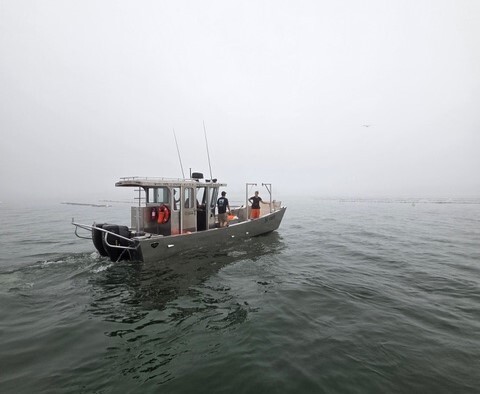
In the past 50 years, significant changes have occurred in the ocean. In fact, it was a greenhouse gas report 5 years ago involving lobster boats that triggered the Island Institute in Rockland, Maine, to focus on Maine's workboats and ask, "Where and what applications and technologies are available now that began to get people excited about electrification on the water, or smaller boats," said Lia Morris, the Island Institute's senior community development officer. It's been an ongoing focus since then. "The idea is ultimately that electric technology can substitute for the traditional internal combustion engine and deliver economic benefits because there's less maintenance, noise reduction, and not having to pay fuel prices," said Morris. That's led the Island Institute to be a partners in the grant process for a new boat when the focus was on developing an environmentally friendly boat, though not necessarily the full-paying grant provider for building the boat. One example of trying to demonstrate the benefits of electric technology for an aquaculture farm involved the building of an aluminum boat for Maine Ocean Farms, an oyster aquaculture company in South Freeport, Maine. "We supported
Twenty knots was an early estimate for the Heron's top-end speed, but the Heron ended up with a "top-end speed about 32 knots," said Fogg. He added that "it comfortably cruises 22 to 24 knots" and carries up to 4,000 lbs. of gear and oysters.
The Heron was also built with what Fogg describes as an ample amount of working deck space. "They wanted as much working deck space as they could get," he noted. Oyster harvesting off the boat is done from two davits that can be mounted either "on the starboard side or at the front of the boat. They'll harvest off the boat and transport product from farm to shore. They'll also do oyster tours out to the farm," said Fogg. The Heron is currently docked in South Freeport, Maine at Strouts Point Wharf.
Morris, based on her work with various vessel owners involved with non-traditional electric powering options, says, "Overall, I'm not finding a lot of resistance, but we are also working with people that are comfortable at the beginning of an innovation curve," with methods to stimulate that innovation curve. Moving along with its commitment to electrify Maine's work boats, earlier this year, the Island Institute committed itself to placing 100 electric outboards on Maine working boats in 2025. By mid-September, Morris said, "We've directed support to 17 electric boats for commercial use so far, and we are very intentional about where to go. We look for use cases where electric technology will clearly succeed: shorter trips, predictable routes, frequent rail use — because these early adopters become powerful proof points for the broader community."
The boats the outboards are powering are being used by "marine service providers, aquaculturists, harbor masters, and community sailing programs — basically the visible, trusted voices on the waterfront. Going forward, we're also working to narrow our focus to support harvesters specifically." Morris and the Island Institute's focus ranges much further than Maine's coast line and harbors. While Morris says that the Island Institute is "one of the frst doing demonstration projects, so people can see and believe in the technology," there are other projects the Island Institute is following; Morris mentions the "Massachusetts lobster industry is doing large scale data collecting with the eye on electrification and hybridization of vessels in Gloucester." Then out in San Diego, Calif., "seeing the first all electric tugboat in the country, with electric cranes and electric forklift." Moving up in the electrification scale, in Washington state, the Port of Friday Harbor recently received a $7-million grant as part of Washington state's Department of Transportation Port Electrification grant program, designed to foster carbon reduction programs in 11 Washington ports "to reduce greenhouse gas emissions by over 140,000 metric tons over the next decade."
Internal combustion engines will be replaced with electric alternatives. There will be battery banks, solar chargers, electric boats, "basically electrifying that port," said Morris.
.jpg.small.400x400.jpg)
