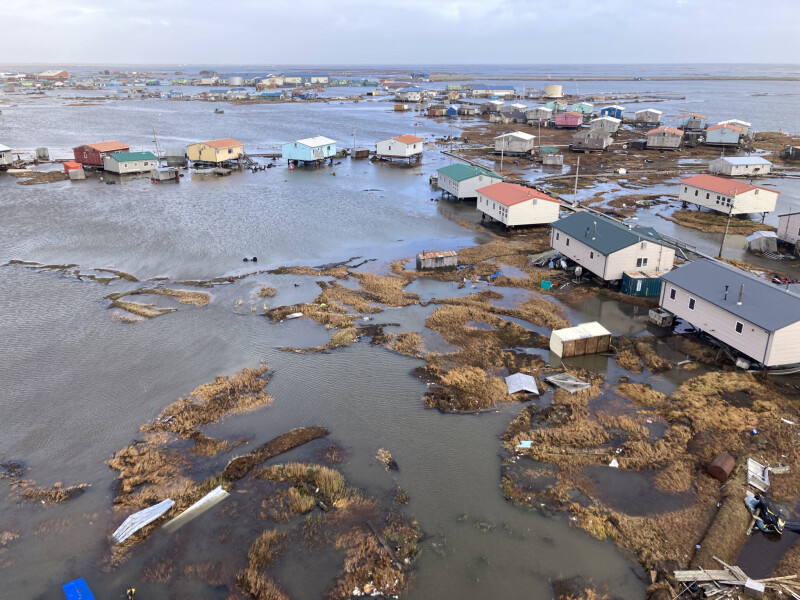
Earlier this month, remote coastal communities in western Alaska were slammed by the remnants of Typhoon Halong, leaving whole villages displaced and infrastructure in shambles. Now, the federal government has stepped in to provide critical relief.
On October 22, President Donald Trump approved a major disaster declaration for Alaska at the request of Mike Dunleavy, unlocking federal disaster aid in the wake of the storm, according to Alaska Beacon. The decision authorizes a 100 percent federal cost share for relief assistance over the next 90 days, through January, and unleashes an immediate $25 million in relief funding.
The disaster request covers areas including the Northwest Arctic Borough, the Lower Yukon Regional Education Attendance Area, and the Lower Kuskokwim region- all areas hit by the storm’s onslaught, according to the Beacon. More than 15000 residents were displaced, at least one woman was killed, and two people remain missing in Kwigillingok.
The Yup’ik villages of Kipnuk and Kwigillingok were among the hardest-hit communities. Initial assessments estimate roughly 90 percent of homes were destroyed in Kipnuk, and about one-third of residences were rendered uninhabitable in Kwigillingok. The main complication is that these places are remote, road-inaccessible villages that rely on air and water transport, complicating the response and recovery.
The Federal Emergency Management Agency (FEMA), in coordination with the Alaska Division of Homeland Security and Emergency Management, will lead recovery operations. The $25 million in federal funding is meant to cover immediate relief costs as damage estimates continue.
State officials have also shared that applications for emergency assistance to Alaska residents are already open through a state website.
According to state officials and AP News, “it’s likely that some damaged communities will not be viable to support winter occupancy.”
With the federal declaration now in place, western Alaska has a pathway to federal support. But the real test will be the speed and effectiveness of aid delivery, and the resilience of its communities in rebuilding.