

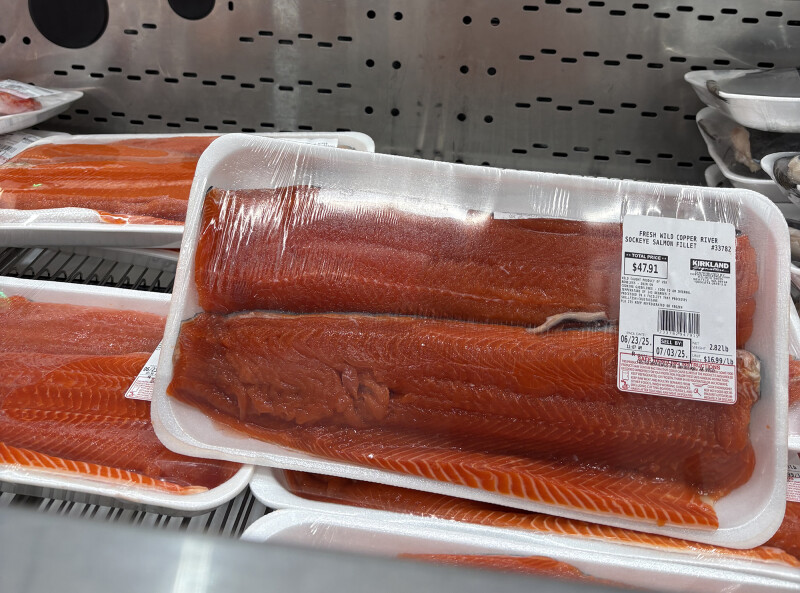
A robust harvest of Copper River sockeye salmon has not panned out for 2025, leaving customers scrambling in Anchorage, Alaska, as fillets disappear for the season, with prices ranging from $16.95 to $56.95 a pound.
Harvesters in the Cordova area of Alaska's Prince William Sound brought in just over 60,000 reds in the commercial opener that ended on June 20. "They would have been looking at about 115,000 reds based on the anticipated opener on June 19," said Jeremy Botz, a veteran fisheries biologist in Cordova with the Alaska Department of Fish and Game (ADF&G).
Pike Place Fish Market in Seattle was posting availability of Copper River reds and Chinooks, including whole sockeyes for $124.99 and whole kings for $639.99. Fishmongers there also had plenty of fillets of sockeyes for $39.99 a pound and fresh kings at $119.99 a pound.
A total of nine Copper River openers beginning on May 22 brought in an estimated 362,983 reds, according to the latest ADF&G preliminary harvest report available on June 24. An update on the newest 48-hour opener was still being compiled.
Statewide, some 2.3 million salmon have been harvested in Alaska's commercial fisheries through June 21, 1% of the season forecast, noted Simon Marks, who compiled weekly in-season commercial salmon updates at McKinley Research Group in Juneau for the Alaska Seafood Marketing Institute. The harvest thus far is dominated by Prince William Sound keta and sockeye in Prince William Sound, Bristol Bay and the Alaska Peninsula, according to Marks. Processors in Cook Inlet and Kodiak were also beginning to see deliveries of fish.
ADF&G's Blue Sheet, which tracks the preliminary overall commercial harvest statewide, put the overall harvest as of June 24 at nearly 3 million fish, including 1.4 million sockeye, 1.3 million chum, 119,000 pink, 50,000 Chinook and 1,000 coho salmon.
ADF&G has projected an 85% increase in the total annual Alaska commercial salmon harvest, primarily driver by a 245% predicted increase in the harvest of humpies. This projection aligns with the predictable two-year life cycle of pink salmon and is especially high given historically low harvest in 2024 compared to other even-year harvests, Marks said.
Bristol Bay sockeye harvest started off stronger compared to 2024, up 176%. Early season data from the Bristol Bay Port Moller Test Fishery show average fish sizes of 5.2 pounds, compared to record low averages of 4.5 pounds a year ago.
Keta harvests overall are down 7% from the 2024 year-to-date and in the Alaska Peninsula the keta harvest was down 66%, but Marks noted that the keta catch in Prince William Sound is up 245% from that region's low 2024 harvest.