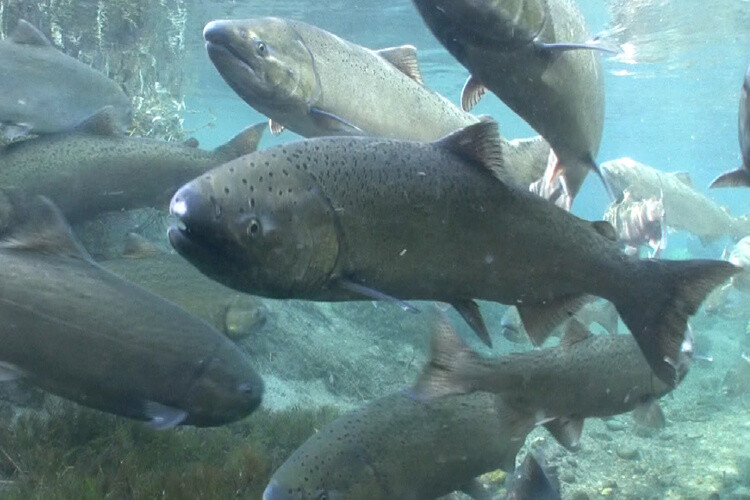
Fisheries scientists at the University of Alaska Fairbanks are on a mission to find out where Chinook salmon are at all times, not to catch them, but to avoid them.
Their research draws on a trove of data from a Chinook salmon tagging program, with a focus on helping commercial trawl harvesters avoid the depths and areas where these fish risk becoming bycatch, and where they may also be adversely affected by naval exercises in the Gulf of Alaska used to train U.S. military forces for combat at sea.
Chinook and chum salmon have been hard hit in recent years by rising ocean temperatures, anthropogenic impacts, and increased microplastic pollution.
Bycatch limits already in place for declining Chinook stocks shut down the trawl fishery in Kodiak in 2024, when two trawl boats caught so many Chinooks over a single weekend that the entire fleet had to stop fishing, leaving most of their total allowable groundfish catch in the water.
Now, researchers at the UAF College of Fisheries and Ocean Sciences have published findings in the journal Animal Biotelemetry describing a model that could help reduce trawl bycatch.
To develop the model, the team, including graduate student Marcel Gietzmann-Sanders, used data from a Chinook salmon tagging program in which tags collect data every 5–10 seconds and transmit it to satellites.
The tags are part of an ongoing project led by Andrew Seitz, a professor in the College of Fisheries and Ocean Sciences. They record depth, time of day, temperature, and light levels at the locations where salmon are found. A separate dataset from the European Union's Copernicus Marine Service added environmental context.
Gietzmann-Sanders, a machine learning manager with Viasat Inc., applied machine learning to detect patterns in the massive dataset, producing detailed charts showing the depths where Chinooks are most likely to be found at various times and locations. "It shows what you can find out when you collect enough data about a species over a long enough time," he said.
"Tagging data are complex, and they require complex analytical solutions to get an inference from them, but at the end of the day it doesn't need to be that complicated," said Curry Cunningham, an associate professor at UAF's College of Fisheries and Ocean Sciences who works on different aspects of the research with Seitz and Gietzmann-Sanders. "Marcel's research can help address a simple but important question: 'If I'm thinking of fishing here at a given time of year, what time of day should I be fishing to minimize my bycatch level?"
The tagging project is primarily funded by the U.S. Navy as part of an effort to minimize harm to salmon during exercises in the Gulf of Alaska. The ability to use that data across studies has been a boon to salmon science in the region, said Seitz.
"We have been using satellite data since 2013. It was first funded by the Arctic-Yukon-Kuskokwim Sustainable Salmon Initiative. Then we got the Pollock Conservation Cooperative Research Center for more tagging, and then the Pacific States Marine Fishery Commission. Since 2019, the Navy has sponsored the research," he said.
The next phase of the research will focus on where Chinooks occupy horizontal space across seasons — whether they range further west or east in the Gulf of Alaska in spring, summer, fall, and winter, Cunningham said. This builds on the current work, which established where the fish sit in the water column.
"Over the course of the season, the Chinook salmon tend to be shallower in the spring and summer and deeper in the fall and winter. That may overlap with where the pollock gear is out fishing, so they may have to think about seasonal planning. The hope is that this research can provide some guidance on where we expect to see the king salmon," Cunningham said.
In addition to publishing their findings, the researchers present at industry meetings such as those of the Pollock Conservation Cooperative. Seitz and Cunningham also work closely with state and federal fisheries managers to share results from this and other fisheries studies.
"We want this tool to be useful, and we want feedback," Seitz said. "We are just getting into the good stuff. We have no plans for stopping now. We hope this is another tool in the toolbox."