
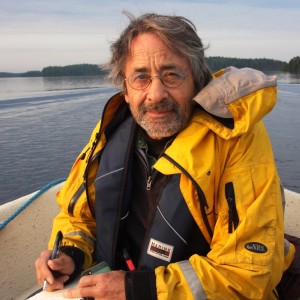
Tom Rossiter has taken CatchCam technology all around the world. It has been used to monitor crab traps, smart buoys, and innovative cod ends, and other gear in the USA, and this past summer, Finnish fisheries expert Petri Suuronen worked with CatchCam to find ways to expand Finland’s freshwater commercial fishery for perch, pike, and roach. “We have abundant resources here in Finland,” says Suuronen. “Our lakes are underfished, which means the fish are smaller.”
While Finland has 188,000 lakes—more than any other European country—and 10 percent of the country is water, its freshwater commercial fisheries account for only 3 percent of all fisheries production. The commercial lake fisheries, primarily for perch and a salmonid known as vendace, land just over 5 million kilos, while recreational lake fishing lands 28 million kilos.
Suuronen has a number of objectives he hopes to advance with the project. “We want to get young people into the fishery and increase the number of fishermen,” he says. “We are only 5 million people in Finland, and we can’t eat all this fish, so we want to expand our export market,” Petri notes that while target species like perch make up a small percentage of the national fish landings, they are much higher in value than the species caught in the salt water of the Baltic Sea.
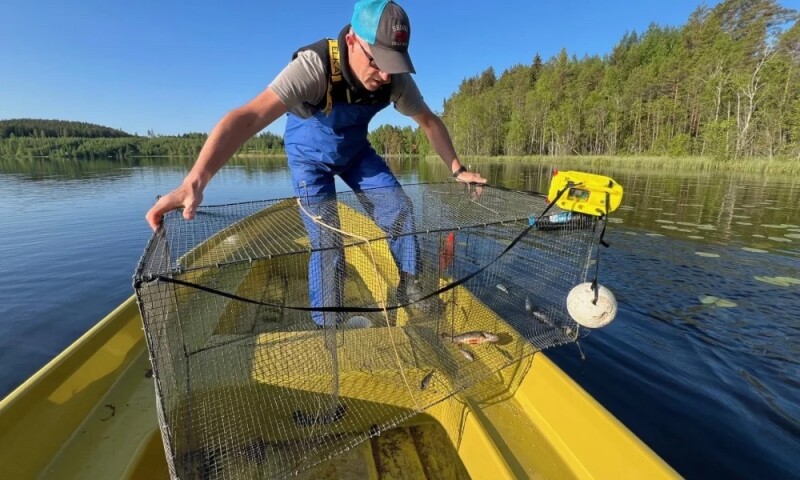
In the summer and fall, perch seldom enter traps, and fishermen use gill nets to catch them and other freshwater fish. Suuronen and Rossiter have been using the CatchCam cameras to learn how to improve the trap fishery for these fish. In Finland, many lakes are privately owned, and commercial fishermen have to get permission to fish. “The advantage of the traps is that you can leave them alone for a couple of days and still release the bycatch alive,” says Suuronen. “Which is important to the lake owners.”
Suuronen and Rossiter attached standard 300mm CatchCam cameras to four different trap designs and studied how fish entered the lightweight wire traps and whether they could get out again. “In the spring, the fish go into the traps to spawn. There is no bait; they are attracted to the rigid form of the trap for laying their eggs. But after spawning, the catches go down. By watching the fish with the cameras, we realized the funnel design is very important. But also, we wanted to find a way to attract fish into the traps after the spawning season.”
Suuronen and Rossiter tried different baits—including dogfood, as well as a wheat-based recipe—and were able to see how fish reacted. “The cameras allowed us to see what the fish were actually doing,” says Suuronen. “We had good results, 1.5 kilos per trap was the best, but we need 3 kilos per trap for a viable fishery. Next year, we want to try using lights. We also have a three-anchor trap net, like a pound net, that we will use the cameras to study.”
Suuronen reports that several young fishermen have expressed interest in the project. “They are more comfortable with the technology,” he says. “We want to give this to them.” He notes that most of the funding for the project came from a European Union fisheries development program and that his company, International Seafood Consulting Group, provided volunteer support. “We just cover our costs, not salaries,” he says. “Our main business is to export the fish.”
.png.small.400x400.png)