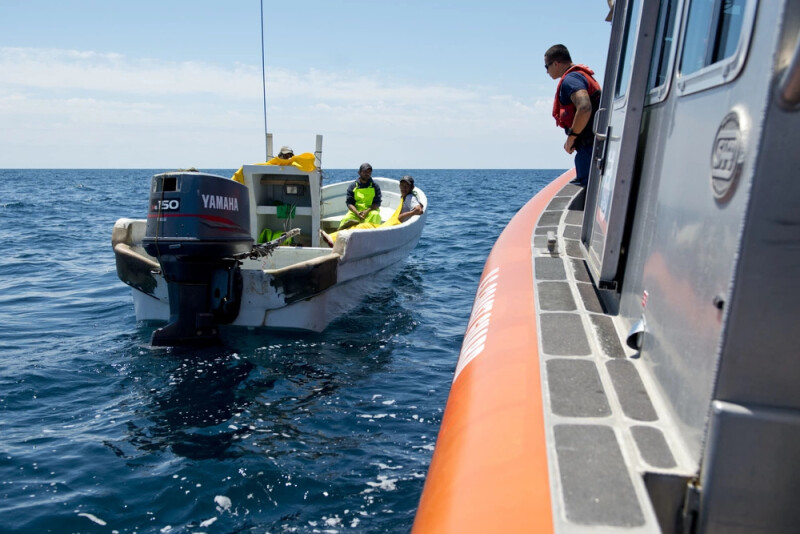
Calls to the U.S. Coast Guard station in South Padre Island, Texas, often come in the middle of the night–reports of fast-moving lanchas spotted in federal waters, frequently loaded with red snapper.
These small 20-to-30-foot boats, powered by outboards, launch from the Mexican Gulf coast and run north under cover in the night, targeting regulated species like red snapper and sharks. Crews often use gear banned under U.S. law and exceed legal limits, with little regard for size or season, according to the Louisiana Illuminator.
“It’s a common problem and it’s been a problem that the Coast Guard has been tackling for decades,” said Lt. Phillip VanderWeit, commanding officer with the Coast Guard’s Gulf Regional Fisheries Training Center.
According to the Illuminator, officials and researchers, many of these operations are tied to organized crime, particularly the Cártel del Golfo, with lanchas operating out of Playa Bagdad in Tamaulipas.
“Fish are just as profitable as drugs,” said Kesley Banks, a fisheries research scientist at Texas A&M Corpus Christi and vice chair of the Gulf Council, a federal regulatory and advisory body for fisheries in the Gulf of Mexico. Red snapper in particular can be an extremely lucrative source of income for cartels, she said.
Once landed, the fish can re-enter the U.S. market through the black market, sometimes mislabeled or falsely reported as legally caught. With red snapper fetching up to $30 per pound, the incentive remains strong.
“The lanchas are not discriminating on … ‘This is a mama fish, this is a baby fish,’” Banks told the Illuminator. “They’re just taking whatever they get on their line.”
For fishery managers, one of the biggest challenges is that the scale of illegal harvest remains largely unknown. Banks estimates roughly 780,000 pounds of red snapper may be removed annually through illegal, unreported, and unregulated fishing (IUU), none of which is accounted for in stock assessments.
Senator Dan Sullivan, R-Alaska, is the head of the Fighting Foreign Illegal Seafood Harvest (FISH) Act, which was advanced out of the Senate on March 22 and is now in the U.S. House for consideration. Sullivan called IUU fishing cancer on fisheries throughout the world.
“None of these fish leaving the back door are actually accounted for in our stock assessment,” Banks told the Illuminator. “We actually have no idea how big this problem is.”
That uncertainty complicates management of a fishery that has otherwise been considered a rebuilding success. Red snapper populations, once depleted to just 2 percent of healthy levels in the 1990s, have rebounded under strict regulations. A charter captain with 37 years on the water told the Illuminator, “That’s why there’s so much poaching of it.”
Illegal gear adds further concern with miles of recovered abandoned nets floating out to sea, with turtles and dolphins entangled in them.
Federal enforcement has ramped up in recent years. The Coast Guard seized more than 18 tons of illegally caught fish from Mexican lanchas in 2024, and the number of cartel-linked vessels detected dropped from 250 in 0224 to just over 100 in 2025.