

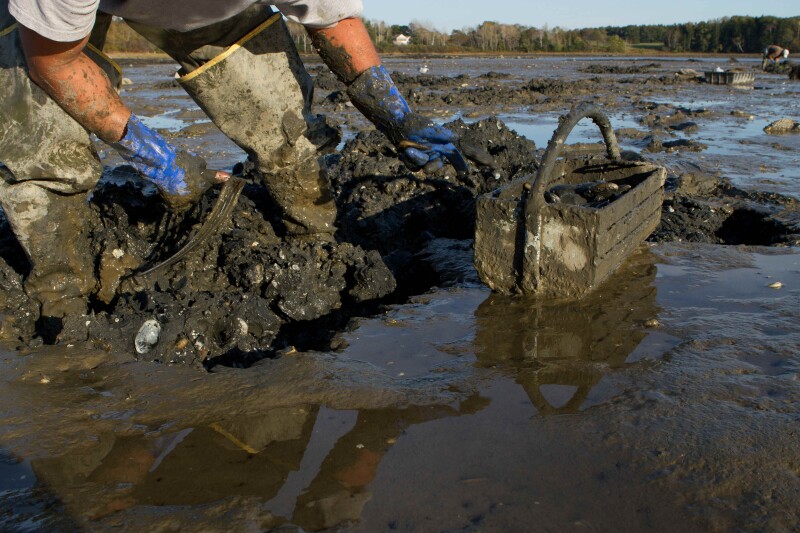
Clam harvesters in Lubec, Maine are continuing hands-on efforts to rebuild local flats through a combination of transplanting juvenile clams and planting hatchery-raised seed.
The Maine Monitor shared in early May, harvesters worked with the town’s shellfish warden to collect and relocate juvenile clams from the Narrows flats to Pirates Creek. The receiving area will remain closed until Dec. 1 to allow the clams to reach market size.
The work is part of a two-pronged strategy led by the Lubec Shellfish Committee. Transplanting juvenile clams remains the more cost-effective and accessible method but requires temporary closures of receiving flats, typically for a least six months.
Seeding with nursery-raised clams offers a potentially higher success rate and allows flats to remain open, but comes with higher costs, permitting requirements and ongoing maintenance. Seed plots require protective netting and monitoring for predators, sediment and storm impacts.
Kyle Pepperman of the Downeast Institute has worked with the committee on seeding efforts and is scheduled to lead additional planting June 10 at several Lubed sites. Downeast Institute has conducted research for over 30 years on commercially important shellfish species along the entire coast of Maine.
WGME shared that clamming in southern parts of the state over the past year has remained challenging with severe declines of soft-shell clams due to invasive green crabs and warming waters.
Managers are also implementing a rotational closure system at Mowry Beach, splitting the area into two sections to manage harvest pressure through the season.
Lubec has issued 61 clamming licenses this year, with two nonresident licenses to be awarded through a June lottery. The combined approach reflects ongoing efforts to balance conservation with continued access to the resource.
 (1).jpg.small.400x400.jpg)