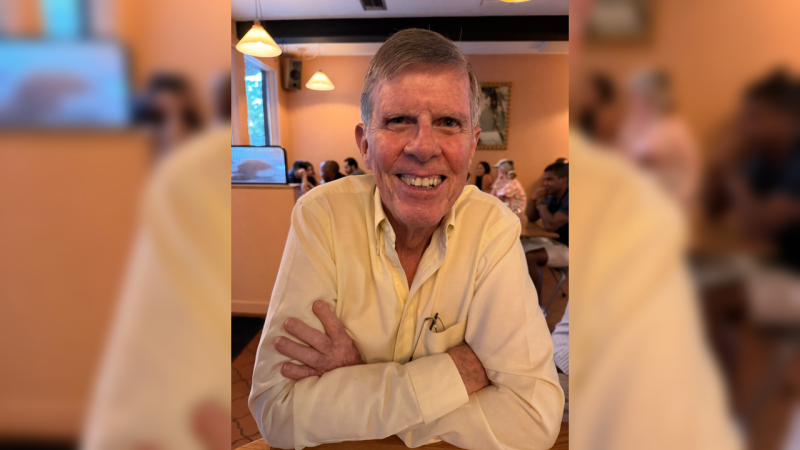
Saltwater has been a constant in Robert Gill’s life, taking him to the Navy and a career in ships and engineering. After 25 years, the tide flowed again, carrying Gill to a second act in the Gulf of Mexico.
For the past four decades, Gill has been deeply engaged in Gulf fisheries business, policy, management and education – so much so that he received 14 nominations for this year's National Fisherman Highliner award.
Gill has served as chairman and vice chair of the Gulf Fishery Management Council; a member of the Department of Commerce Marine Fisheries Advisory Committee; and was instrumental in developing the Marine Resource Education Program (MREP) that helps fishermen better understand and participate in the management process.
A hallmark of Gill’s work has been a commitment to helping young fishermen get a foothold and learn to succeed in the business. He’s worked closely with the National Future Fishermen Coalition and organizers of the first National Future Fishermen Summit, coming Nov. 20 at Pacific Marine Expo.
Gill has worked with the Gulf of America Reef Fish Shareholders Alliance and its Gulf Commercial Fisherman Program, a project to help solve the region’s so-called “graying of the fleet” with training and mentoring of young fishermen.
“Bob was part of GCFP from day one, even before I came on board,” said Ashford Rosenberg, director of regional policy and special projects for the Shareholders Alliance. Rosenberg and alliance deputy director Eric Brazer “had started brainstorming ideas around how to address the graying of the fleet in the Gulf and the shortage of deckhands, and when I joined the Shareholders’ Alliance in 2018, I was thrilled that young fishermen training became one of my work priorities,” Rosenberg said.
“From concept, to Steering Committee member recruitment, to curriculum development, to garnering broad industry support, to grant proposals to fund executing our first training, Bob has been a leader and champion of this program. GCFP, and the National Future Fishermen Coalition, would not exist without him,” she added.
It was only in spring 2026 that Gill, 83, began to step back somewhat from his time commitments. He’s still connected and quips: “I’m in the mode of deciding what to do with my life when I grow up.”
Gill’s first academic venture in the mid-1960s was at the University of Maine, where he enrolled to major in forestry and wildlife management. But in his second year, Gill detoured to work for the U.S. Forest Service in Washington State, and then applied to the U.S. Naval Academy.
After graduating from Annapolis with an engineering degree, he served for a decade in Navy ships and shipyards, earning postgraduate ocean and mechanical engineering degrees from the Massachusetts Institute of Technology. Following his Navy service, Gill worked for Ingalls Shipbuilding in Pascagoula, Miss., and General Electric’s marine gas turbine business before landing in northern Indiana, where he was president of a forge that made automotive parts.
After 25 years in engineering, Gill made a major career and life change in 1986, when he bought Shrimp Landing, a small dock and seafood business in Crystal River, Fla. Before then, Gill says, he had “no connection to fishing at all.”
With his new investment, Gill almost immediately came to understand the impact of management conflicts. “I was trying to grow the business and saw it could have a dramatic impact,” he said.
Crowding and competition in Florida commercial fisheries were creating more conflict in the 1980s. In 1995, recreational opponents targeted the Florida commercial mullet fishery with a state ban on nearshore nets.
Amid those stormy years, Gill applied to serve on the former state marine fisheries council and was later appointed in 2006 to a seat on the Florida Fish and Wildlife Conservation Commission, which replaced the old commission. . By 2014 he was on the Gulf Seafood Institute’s board of directors, participating with the Center for Sustainable Fisheries on workshops about reauthorizing the Magnuson-Stevens Sustainable Fisheries Act.
Gill had been steadily building Shrimp Landing into a dockside wholesale and retail seafood business. Meanwhile, regional industry and management issues were demanding just as much attention.
“It grew and grew until it took over,” Gill recalls. In 2019, he handed off full-time management of the business while continuing to work for the fishing community’s overall betterment.
With his years of experience, Gill has seen how conflicted that community can be.
“It still is. But it is less warlike,” said Gill. Even today, the Florida state Fish and Wildlife Conservation Commission “is largely a political beast at this point,” he says. Gill remarked that there’s a push for new cownose ray regulation as the latest popular cause, despite little science. The old gill net ban is still in place, but “the problems in the recreational fisheries haven’t changed in 30 years.”
He recalls that at times the collective identities felt by fishing factions were so powerful that people could not talk to one another. But he adds, “let’s be honest, we all use as much of the resource as we can.”
Fundamentally, managers “tend to go where the money is,” namely the recreational side with its demands, said Gill. But that drives state-by-state management that “tears apart the fabric of Magnuson.”
“From a political aspect there’s only one fish in the Gulf, that’s red snapper.” Allocations are political, and “stock has grown tremendously.” There’s a perpetual push to always allocate more, and “that’s created massive discontent on the recreational side.”
For all that pressure, “the federal process hasn’t changed a whole lot,” says Gill. However, in recent years there typically has been only one commercial fisherman on the Gulf council, so “currently it’s very unbalanced.”
Still, Gill still says opportunity exists for young fishermen in the Gulf region.
“I think you can do it,” said Gill. Looking back on his own 40 years in the industry, Gill talks about the hard work and ingenuity he’s witnessed.
“In 1986 when I came down my son was in 10th grade,” said Gill. The teenage John Gill then started fixing up traps, over time got into mullet, stone crab and oysters, and eventually invested in a Cedar Key clam farm. He is still fishing part time at age 55.
“A hard-charging, right thinking kind of person can make it happen,” said Gill. “You can make a decent living even today starting at the bottom.”