In a couple of months, after all the back-to-school and Halloween hoopla, American families will get their annual reminder to set their clocks back an hour – and change the smoke alarm batteries.
It’s a ritual dating back half a century, zealously promoted by local volunteer fire companies and public service announcements.
But for mariners at sea, the most common smoke detector is their nose.
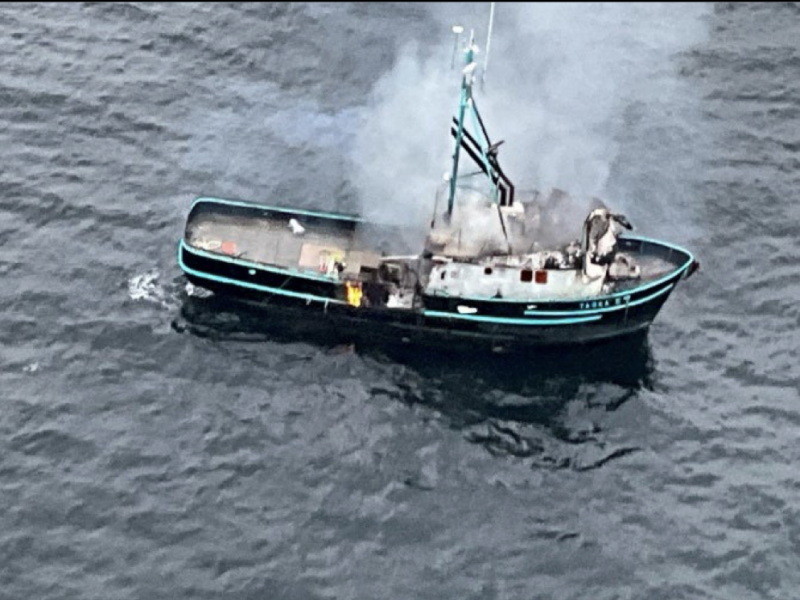
Additional smoke and fire detectors, not always required, can give fishermen more warning in engine rooms and other uncrewed spaces during the early stages of fires breaking out, the National Transportation Safety Board recommended in its recent report on a Pacific Northwest crabber that burned and sank off Washington a year ago.
The 66’x16’ Tarka II did not have a smoke or fire detector in the engine room, where a fire broke out around 4 p.m. Sept. 2, 2024 as the boat was transiting near Tatoosh Island, Wash.
“The captain’s first indication of a fire was seeing smoke coming from the vessel’s exhaust stacks,” according to an NTSB accident report.
The captain was at the helm, so he put the engine in neutral and went to the engine room to investigate. When he opened the engine room door, white smoke activated a smoke detector just outside the engine room, followed immediately by another smoke detector in the galley going off.
A closed-circuit television camera in the engine room was not operating at the time, and a small fire had been smoldering undetected near the hydraulic tank and hydraulic pump in the engine room. As the fire intensified, the captain and a crew member abandoned the vessel into a life raft, to be rescued without injury by the Coast Guard.
The exact cause of the fire could not be determined because the Tarka II later sank, a total loss estimated at $460,000.
In a “lessons learned” postscript to their report, NTSB investigators noted additional smoke and fire detectors “in spaces that are typically uncrewed when underway, such as the engine room, allows for the earliest detection and notification of a fire, maximizing the time for operators to respond to the fire or take actions to abandon the vessel.”
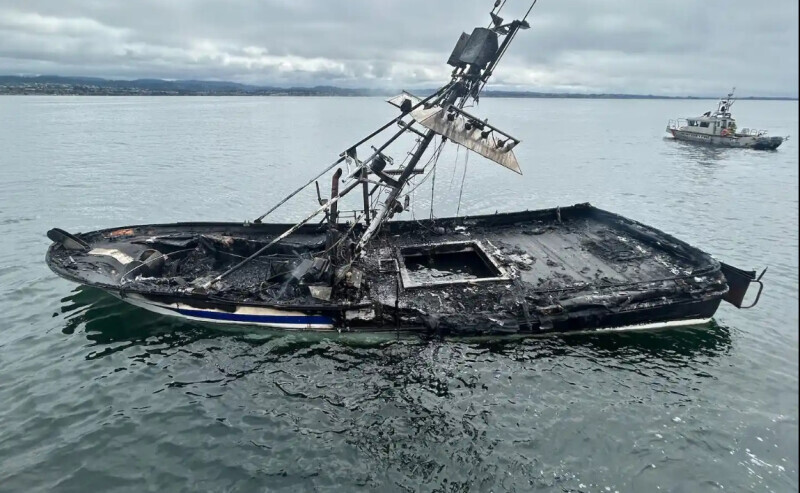
The Tarka II crew was lucky. Sudden fires are not uncommon on fishing vessels, with mostly small crews often preoccupied with routine operations. The 45-foot vessel Navigator had been fishing for squid and was at anchor off Santa Cruz, Calif., July 16 when it was engulfed in flames around 7:40 a.m. Two crew on board quickly alerted emergency responders, who brought the fishermen to shore and extinguished the fire.
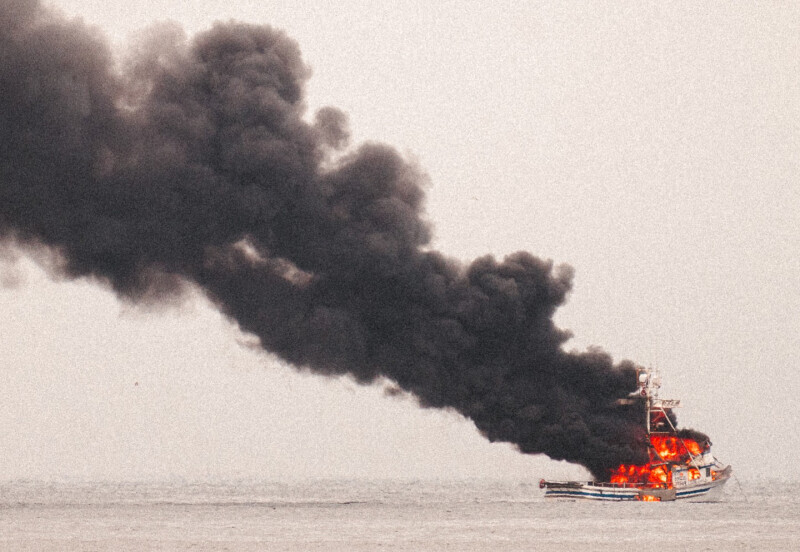
A crewman told local media that he believed the fire was triggered by an onboard generator that malfunctioned and caused the boat's insulation to catch fire. The fisherman said he woke up to smoke in the cabin.
Six years ago a catastrophic boat fire in southern California waters focused safety advocates on calling for new Coast Guard requirements.
The Sept. 2, 2019 fire happened on the dive boat Conception, which was anchored for the night off California’s Santa Cruz Island with 33 passengers and a crew of six on board. In the early morning hours, the 75’x25’ wood and fiberglass vessel caught fire, burned to the waterline and sank about 100’ from shore. All 33 passengers and one crewmember died in the fire.
In a detailed report, the National Transportation Safety Board recommended new smoke detector requirements, along with requiring safety management systems for small passenger vessels, which had already been a priority for the safety board since 2012.
With the Conception burned to the waterline, the NTSB could not conclusively determine an exact ignition cause, although suspicion focused on an array of rechargeable batteries and devices plugged in below deck.
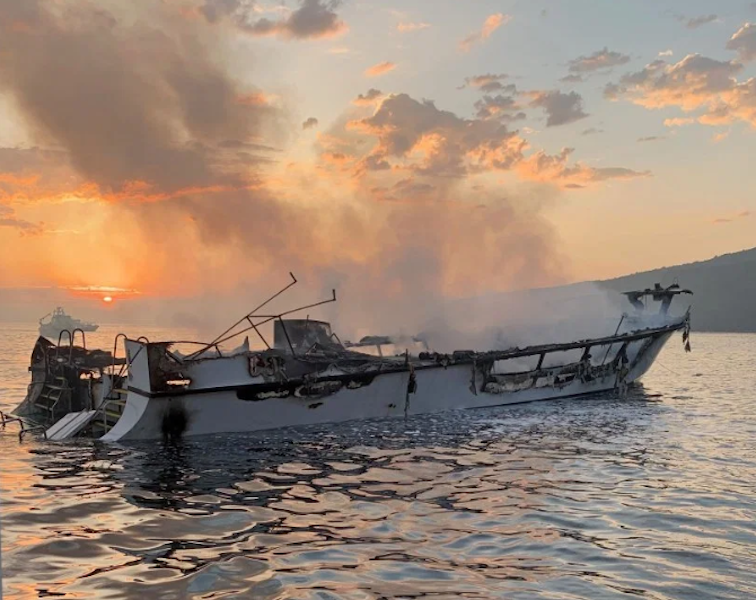
The NTSB report was clear in assessing how the sleeping divers were not alerted to the danger. “Contributing to the undetected growth of the fire was the lack of a United States Coast Guard regulatory requirement for smoke detection in all accommodation spaces,” the agency report said.
The NTSB recommended that passenger vessel operators “install smoke detectors in all accommodation spaces and ensure they are interconnected so when one detector goes off, they all do. While the Conception berthing space did have smoke detectors, they were the only ones on the vessel and would only alarm locally in the berthing space and not throughout the entire vessel.”
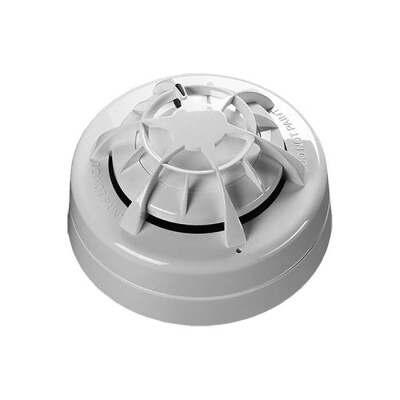
It's a lesson all mariners should learn from, said John McDevitt, a retired marine surveyor from Drexel Hill, Pa., and longtime advocate for increasing the use of smoke alarms in the marine industry.
Growing up in a family of firefighters, McDevitt said his interest in marine fire safety grew when he acquired his first boat in the 1980s. When he began reading the National Fire Protection Association’s standards, he was surprised to see no mention of smoke detectors for boat
“I thought it was just an oversight,” said McDevitt. After it was suggested he join an NFPA advisory panel in 1990s, “I wrote a proposal for the committee for smoke alarms to go into boats with enclosed cabins,” he recalled, “and you’d thought I recommended putting a hole in the bottom of the boat.”
McDevitt’s proposals focused on recreational boats, and industry groups like the National Marine Manufacturers’ Association and American Boat and Yacht Council filed technical objections. The Coast Guard too has been reluctant to press the issue, he said.
The industry has been good on other safety issues, McDevitt said.
“These guys have done a good job with carbon monoxide, but they haven’t done the same for fire protection,” he said. “As leaders in the marine industry, you need to make this happen…so your customers can be protected by this 60-year-old technology.”
Last year NTSB chair Jennifer Homendy spoke at a five-year memorial service for victims of the Conception fire and called again for action on her agency’s fire safety recommendations.
“The NTSB first recommended SMS in the marine mode 20 years ago, and specifically called for it on small passenger vessels since 2012. Additionally, Congress authorized the Coast Guard to mandate SMS in 2010,” said Homendy.
“It’s 2024, and here we are, with no action. We know our recommendations save lives. I call on the Coast Guard to finish its work implementing solutions to prevent such a tragedy from occurring again.”
.png.small.400x400.png)