

A fire on a Pacific Northwest fishing vessel last year showed how additional smoke and fire detectors – while not always required equipment – can give operators earlier warning of danger in uncrewed spaces, according to the National Transportation Safety Board.
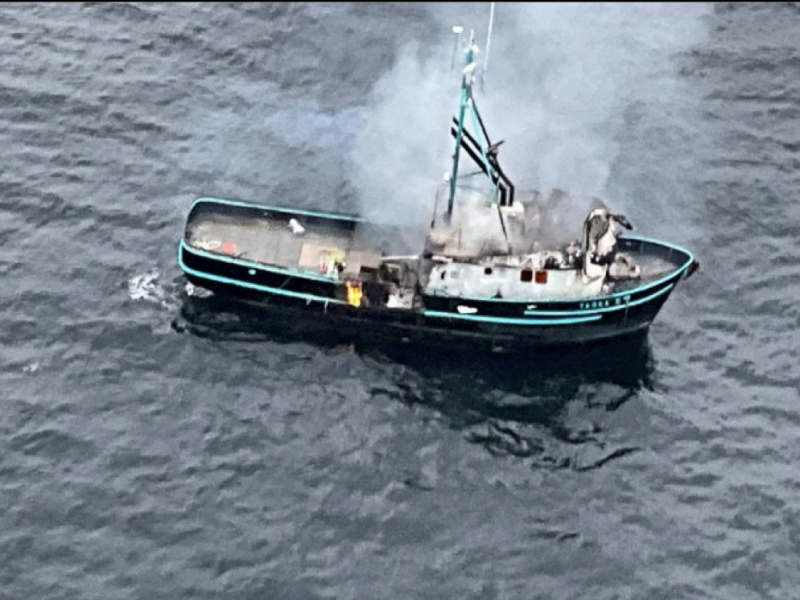
The 66’x16’ crabber Tarka II did not have a smoke or fire detector in the engine room, where a fire broke out on Sept. 2, 2024 as the boat was transiting near Tatoosh Island, Wash.
“The captain’s first indication of a fire was seeing smoke coming from the vessel’s exhaust stacks,” according to an NTSB accident report.
The boat did have a closed-circuit television camera in the engine room but it was not operating at the time. “The smoke detectors outside the engine room and in the galley did not activate until the captain opened the engine room door,” and the captain shut down the generator and main engine, investigators wrote.
A small fire was smoldering fire near the hydraulic tank and hydraulic pump in the engine room, and as the fire intensified, the captain and a crew member abandoned the vessel into a life raft, to be rescued without injury by the Coast Guard.
The cause of the fire could not be determined because the Tarka II later sank, a total loss estimated at $460,000.
The Tarka II had been about 4 miles southwest of Tatoosh Island around 4 p.m., with the captain at the helm with the main engine and the no.1 auxiliary generator running, when he first noticed the white smoke coming out of the side of the vessel’s exhaust stacks located just aft of the wheelhouse.
He put the engine in neutral and went to the engine room to investigate, and when he opened the engine room door, white smoke activated a smoke detector just outside the engine room, followed immediately by another smoke detector in the galley going off.
“There were no smoke or fire detectors inside the engine room, nor were they required,” NTSB investigators noted in their narrative. The captain put on a mask used for shipyard work and entered the engine room.
“Despite poor visibility from the smoke, the captain manually shut down the no. 1 auxiliary generator and main engine,” investigators wrote. When lights in the engine room went out, “the captain noticed a smoldering fire on the port side near the vessel’s hydraulic tank, hydraulic pump, and stores of spare gear oil and hydraulic fluid.”
“The captain told investigators that the hydraulic equipment was 1–2 feet from the main exhaust and that hydraulic lines ran “inches” away from it. The hydraulic pump for the crab pot davit was not running or pressurized; however, the hydraulic pump for the steering system was running and its lines (pipes and hoses) were pressurized.”
The captain left the engine space after 30 to 40 seconds, and “as he exited the engine room, he saw a flash, and the smoke turned from white to black as the flames increased. The captain shut the engine room door to ‘try to cut oxygen’ to the fire and went back to the wheelhouse.”
Concerned about the danger of an explosion, the captain decided to abandon the boat, and made a VHF radio mayday call to the Coast Guard. In the life raft, the captain used a cell phone to call 911. A dispatcher connected him to Coast Guard watchstanders, who told him that a boat crew from Station Neah Bay about 12 miles away from was responding to their location.
At 4:43 p.m. a 47-foot motor lifeboat crew arrived on scene and brought the Tarka II captain and crewmember aboard.
In a “lessons learned” postscript to their report, NTSB investigators noted additional smoke and fire detectors “in spaces that are typically uncrewed when underway, such as the engine room, allows for the earliest detection and notification of a fire, maximizing the time for operators to respond to the fire or take actions to abandon the vessel.”
“Vessel operators can improve fire safety by installing detectors in all areas susceptible to fire (such as the engine room and galley, and spaces that contain machinery, hot exhaust tubing, and fuel sources). Additionally, the detectors should be capable of notifying crewmembers throughout the vessel of fire or smoke and be routinely checked to ensure they are in good working order.”