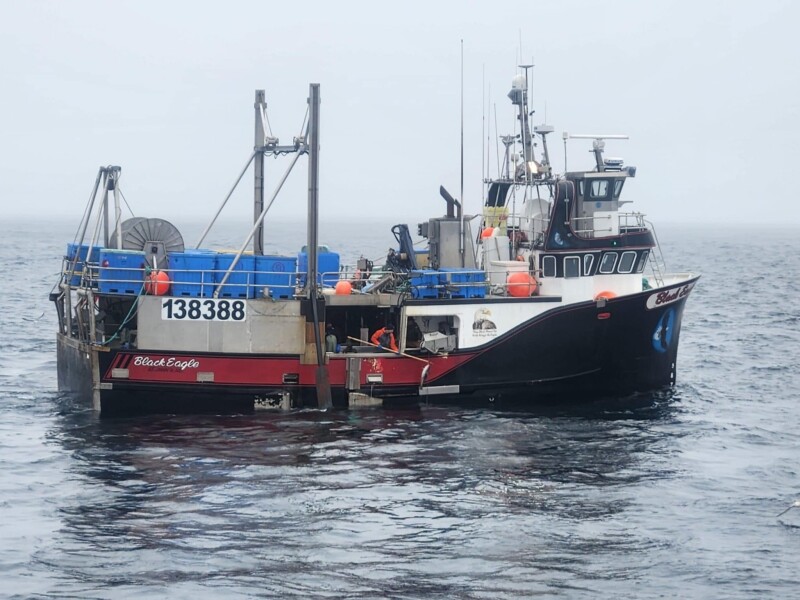
Growing up in Harbour Round, near Carmanville, Newfoundland, Jake Payne knew what boat he wanted to fish on, the Black Eagle. Owner Melvin Starkes had had the 65-foot fiberglass boat built at All 4 One Fibre Products in La Scie, Newfoundland, in 2003. Starkes had been fishing for shrimp, crab, cod, turbot, and seal when Payne approached him for a site.
“I was 16. He said if I could work it out with high school, I could go on a trip. So, I’d made a crab trip, and after that, he said I could fish with them. We’d come in, and Melvin would send me to school to get caught up.”
Payne did two years like that. He missed months of high school but managed to keep up and got his diploma. “Melvin told me then to go on and get my ticket, and then one night in 2021, he came down to the boat and he had nothing with him. I said, ‘Where’s your stuff? We’re going out, aren’t we?’ He said, ‘You are, I’m not.’ I didn’t even know. I asked him, ‘Where should I go?’ He said, ‘You’ll figure it out.’”
For the last four years, Payne has been figuring it out, and in the Black Eagle, he has the tool for the job. Powered by a 600-hp Cummins K19 with a Twin Disc MG516 gear at 6:1 turning a 5.5-inch stainless steel shaft and a 68x55 four-blade propeller, the vessel is engaged in a number of fisheries. “In the spring we fish crab,” says Payne, “We fish 1,200 traps, 75 to a string.” The Black Eagle has a 17-inch crab block for hauling the strings of traps with the hydraulics running off the main.
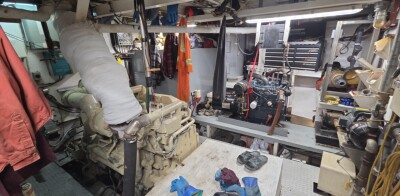
“If we need to, we can run the hydraulics off the Kubota genset,” says Paine. “We just have to close some valves, open some others, and clutch it in.” Once crab ends, they take the block and sorting tables off and rig up for turbot.
The Black Eagle is built for fishing the rough weather of the North Atlantic, with a deep 16-foot draft, a 21.5-foot beam, and a shelter deck. “We have the fin stabilizers,” says Payne. “They work going up and down. It could be blowing 50, waves breaking over the house, and you would never know it.”
Atop the shelter deck is a Mid-Island Marine net reel and a Pullmaster PL8 winch for bringing the net and cod end aboard. The big trawl winches, built by East Coast Hydraulics, are set up staggered on the main deck with the port side winch forward of the starboard winch, which is set aft to make room for hauling the crab traps and longline. “They each hold 1,200 fathoms of wire,” says Payne. “When we fish turbot, we might fish as deep as 500 fathoms, so we’ll set out 1,100 fathoms and tow at around 2.8 knots. We also gillnet turbot later in the year.”
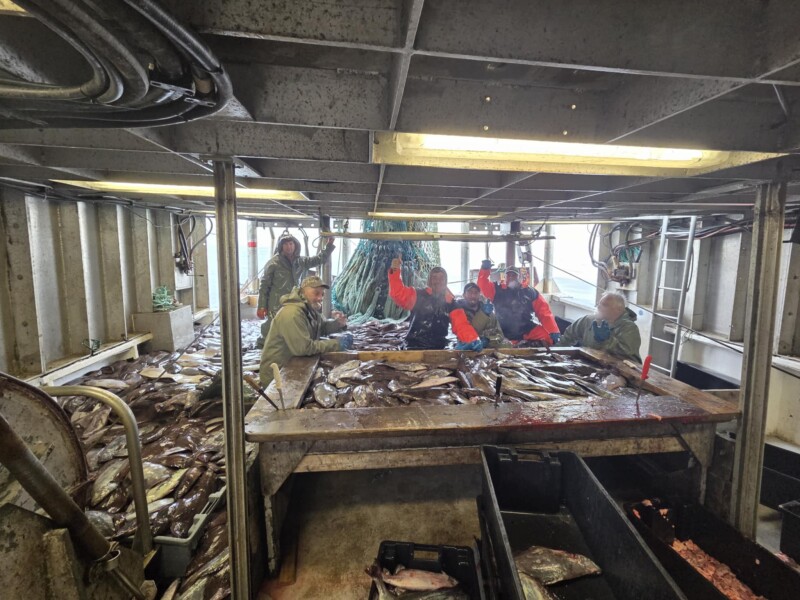
The Black Eagle uses a Furuno FCV-1900 fish finder with frequencies from 15 to 200kHz. “You need that for when you’re fishing that deep water, you have to have low frequency and high power,” says Grant Pinsent, owner of Northeast Supplies Ltd. “I sell Furuno and TimeZero,” says Pinsent. “I also do service. I’m ready to go out the door anytime anyone has a problem.” As Pinsent explains, the Furuno FCV-1900 is a chirp sounder that can be tuned down to a frequency of 28 to 30 kHz. “That’s what you need just to reach the bottom in 500 fathoms,” he says. “And you have to have the power, at least a 2kW transducer.”
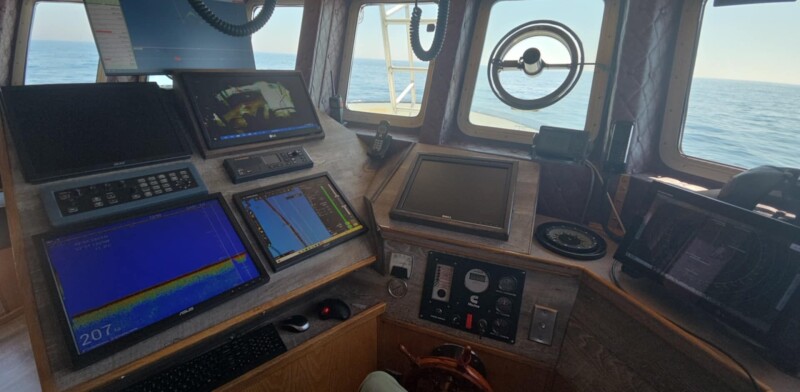
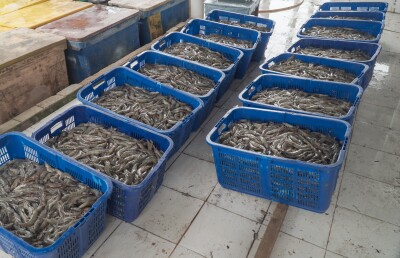
After landing 180,000 pounds of turbot, Payne and crew rig over for shrimp and continue fishing deep water up to 270 fathoms, as much as 150 miles offshore. “We’re expecting to get 400,000 pounds of shrimp,” says Payne, who relies on a Notus Echo sensor on his bycatch reduction grate to monitor the amount of shrimp going into his net. “It works great as long as there’s not too much bycatch.”
“I just put that Notus net sensor on the Black Eagle,” says Pinsent, noting that many young fishermen won’t sail without it. “And the TimeZero pro, before that. I believe it's version 4. It’s tied into everything: the radar, GPS, and satellite compass. It’s got a 3D sounder and 3D charts, bathy, raster, vector.”
That will come in handy after shrimp when Payne rigs over for fishing in 150 fathoms for cod, the high point of his year. “We have a Mustad autoline system,” he says. “We’ll put that on in September and go longline for cod. I’m looking for 600,000 pounds.” Payne has the Mustad Coastal System on board, and he fishes 14,000 hooks with it.
“He has the hook magazines and the EZ Baiter that baits 3 hooks per second,” says Kerwin Whalen, the Mustad sales rep in Newfoundland. “And he can haul 25 hooks a minute.”
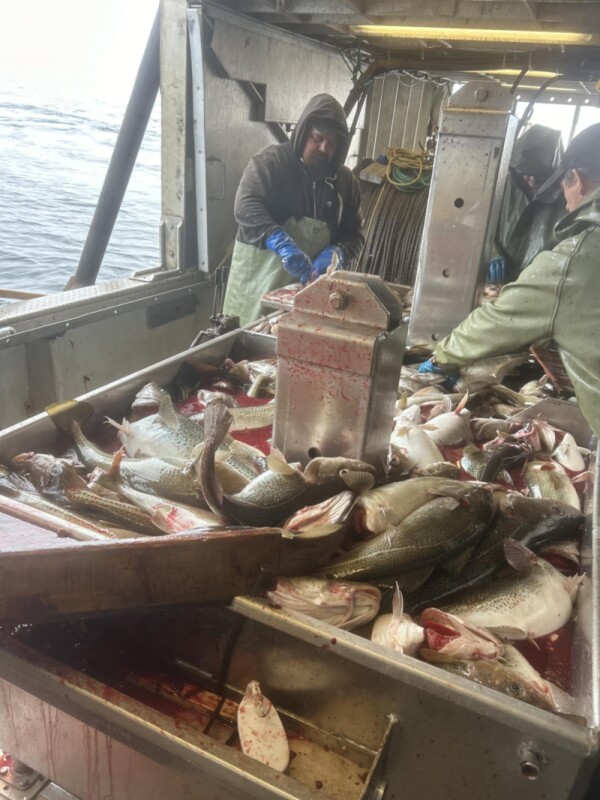
There’s so much cod now that Payne, who usually takes a crew of six or seven men, will take as many as nine for cod fishing. “We’re taking good care of the fish, and you have to have three guys gutting all the time,” he says. “We bring the fish aboard, cut the gills and put’m in a tank to bleed. Then the bottom of the tank rises up and the fish go into another tank where they gut’m. Then the bottom of that one raises up, and they go into a wash, and then we send them down into the hold into big blue tubs full of slush ice and brine."
"We fish for three days, and by the time we get in on the fourth day, the fish from the first day are almost frozen,” Payne adds that they are getting a slush ice machine for the boat, so they won’t have to bring ice and make the brine.
After longlining cod, Payne will rig up for dragging cod, until the cycle starts again with sealing. “I’ve only been once,” he says. “Melvin usually takes the boat sealing.” The Black Eagle has a couple of unique features for sealing. One is a steering station and shooting platform on top of the wheelhouse that provides better visibility for pushing through the ice and spotting seals.
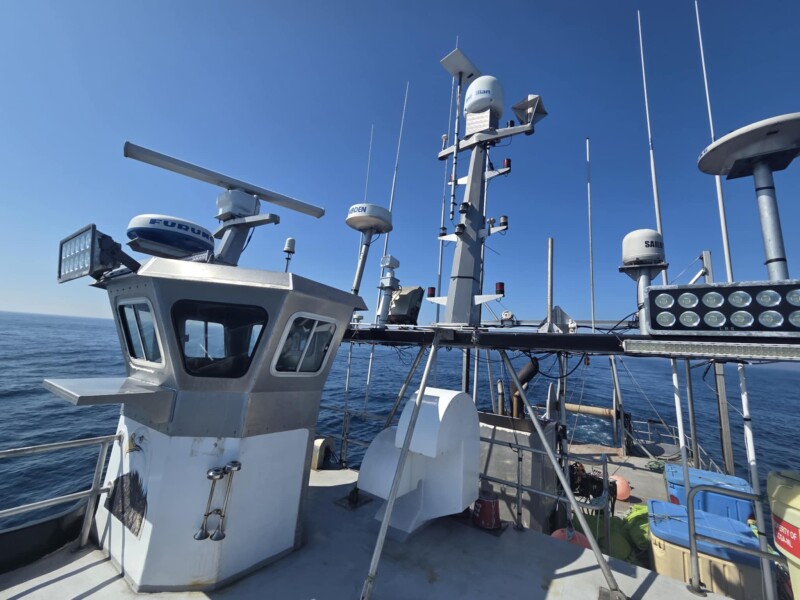
“And we sometimes set up a platform for another shooter,” says Payne. “We shoot them from the boat and then gaff them aboard. Or we can pick them up with a skiff and outboard that we sometimes carry on the roof and put in and out with the crane.”
Catching big hauls of fish, crab, shrimp, and seals is as much fun as it is profitable. The versatility of the Black Eagle as a fishing platform, combined with the skill and enthusiasm of a young captain and an experienced crew, means the owner, Melvin Starkes, and all of them can look forward to continuing seasons of fun and profit.