




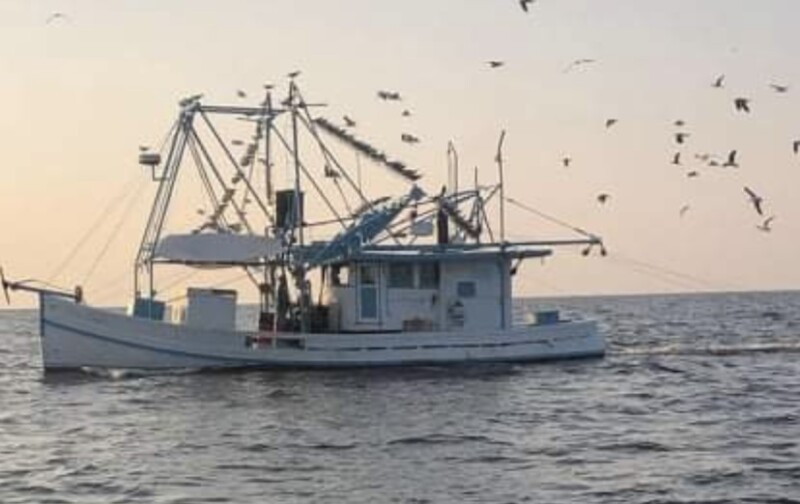
Some may argue differently, but no boat has a soul like a wooden boat. No material breathes with the waves like wood, creaking and groaning in heavy weather. “Sometimes all you can do is let the boat find her own way,” an old fisherman and wooden boatbuilder once said. Down in Mobile, Ala., the 85-year-old shrimp boat Miss Caylee knows her way.
With David Bryan for the last 27 years, the 48-foot lugger-style shrimp boat Miss Caylee has been fishing the waters of Alabama, Mississippi, and Louisiana since she was launched in Biloxi in 1941. “I like the lugger style,” says Bryan. “With the cabin in the back so I can watch the crew and see what’s going on.”
The Miss Caylee comes from an old design: 17 feet wide, with a shallow fish hold, but drawing 4 feet, mostly from a deep keel. “It’s not the first one I had,” says Bryan. “I started fishing in 1975 when I was 14, and bought my first boat in 1981, and that boat was built in 1918.”
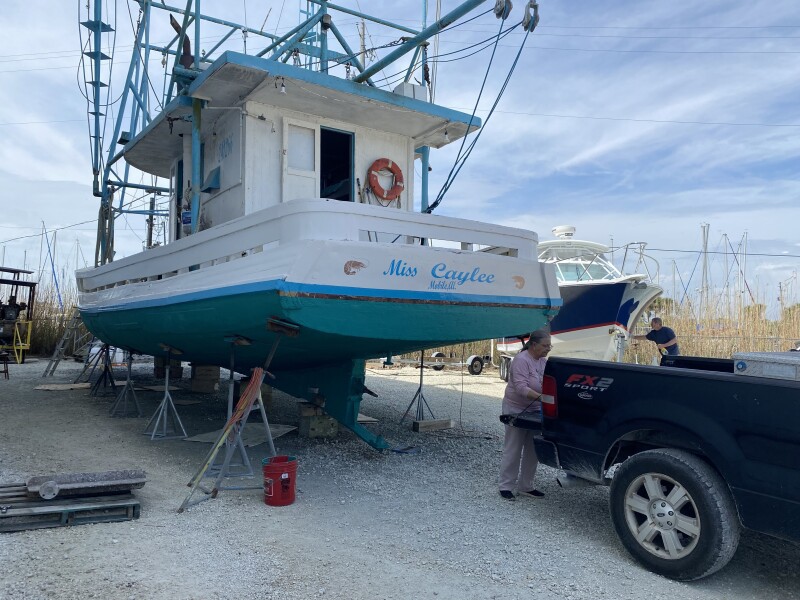
The longevity of these boats comes from the wood itself. “She’s made of all black cypress,” says Bryan. “And 75 percent, maybe 80, of the hull is original. When it was built, it was all black cypress, the frames, the planking, the deck, but a lot of that has been replaced over time.” The black cypress is long gone, almost impossible to find, Bryan notes. “We use juniper, or heart pine, I think it’s longleaf pine. There’s a mill that will pressure treat it with 6.0 (0.60 pcf pounds per cubic foot chemical) and then put it in their kiln and dry it.”
Juniper is a common name in the South for Atlantic white cedar. It is a very aromatic and rot-resistant wood, almost as good as the old black cypress. “We use that for the planking. We had to do some work on the stern, replace some planking and horn timbers. We use the pine heart for the framing on the deck and bulwarks.”
Like a lot of old timers, 66-year-old Bryan has learned how to do his own work. “In this business you have to be everything,” he says. “Mechanic, welder, electrician, carpenter. I was lucky, Wardell Zirlott used to build boats in Bayou La Batre, and he showed me a lot of tricks. I once had a plank out and had to put a new one in. The plank had a curve and shear, and I said to him, ‘I really don’t know how I’m going to do this.’ He said, ‘Alright, I’ll show you, one time.’ And he showed me how to make a jig and get the shape and all and cut it out, and that plank just fell right in. And I never forgot it either. I can still do it.”
When Bryan was in his 20s and early 30s it was flush times in the shrimp business. He married his wife, Debra, and they did well. “Back then fuel was 60 cents, a block of ice was $3, and a 5-gallon bucket of oil was $15. Now fuel is $5, a block of ice is $15, and a bucket of oil is $85, and the price of shrimp hasn’t changed.”
Like many U.S. shrimpers competing with low-priced imported shrimp of dubious origins, Bryan is concerned about the future. “We have a sign in the shop saying to support American seafood, because if we’re gone, you won’t know what you’re eating. This is the best you can get right here.”
In early September, Bryan reports good fishing. “After two drags we’ll have 1,500 pounds,” he says from his boat. “We’re getting two kinds: 16-20s and 26-30s. If I were to take them over to the peelers in Bayou La Batre, I’d get around $2.10 for the 16-20s and $1.60 for the smaller. I couldn’t make it on that. My wife and I set up a retail store, Miss Caylee Seafood, at our dock and we sell all our own now. And we freeze some at our shop at the house. That’s the only way we can make it.”
Keeping up an old boat requires a lot of work, Bryan points out. “We haul her out every two years,” he says. “Unless there’s a bad leak or something. But there’s always something to do on her. Everything on her is old school.”
Bryan currently runs a Detroit 671 in the Miss Caley. “It originally had a Case engine,” he says. “Then an old 471, and the fellow before me replaced that with a 671, and I replaced that with another one a while back. I think it’s around 185 or 200 horsepower.” The Miss Caylee’s power train consists of a Twin Disc gear at 3:1, turning a 2.5-inch Aquamet shaft, and a 34x30 four-blade Rice propeller.
“There’s no hydraulics,” says Bryan. “It has a Twin Disc power take off on the front end and a chain drive winch, and chain steering.” The winch is original, Bryan notes, an old McElroy built in Biloxi. “It’s a big, long thing, with double drums and a cat head on each one,” he says.
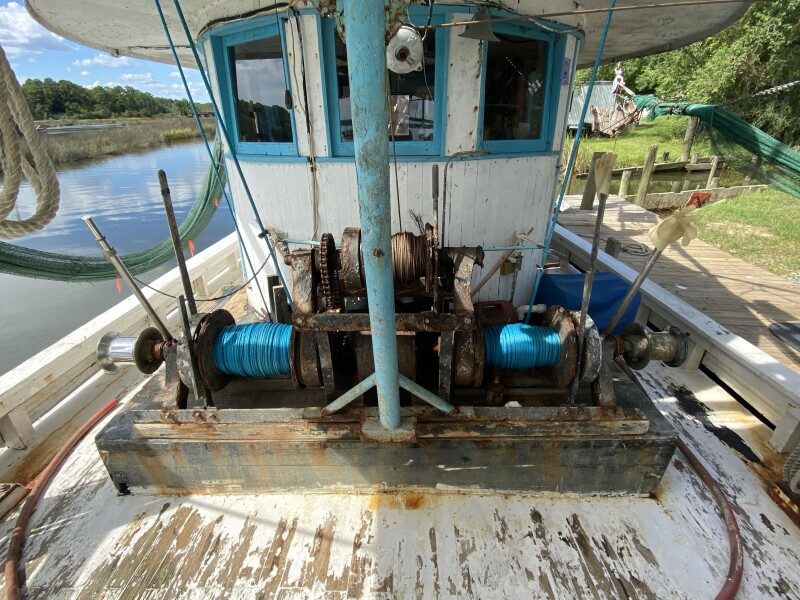
With the cabin aft, Bryan hauls the bag in over the side. “We tow a 50-foot net we call a mongoose,” he explains. “Douglas Sprinkle makes them and his family has been making them for 100 years. His great-grandfather made them. I spread that with a set of 8 x 36 trawl boards.” After winching the doors up, Bryan leaves the net in the water and makes a slow turn while his crewman brings a line they call “the lazy line” forward to the cat head and draws the bag alongside where they can hook the falls to it and lift it over the side. “When we’re done fishing we bring the cork line and roller line in and pile it all on the stern,” Bryan says.
While he used to stay out a few days and fish as far as Louisiana, Bryan now fishes primarily in Mobile Bay. He sets a 12-foot try net every ten minutes or so to see what he’s catching and makes tows of an hour to an hour and a half.
He heads out before dawn, makes as many tows as he needs to fill his 2,000-pound deck box and sometimes the stern box, and then takes his catch to his own dock, where his wife Debra sells it for a retail price at least twice what he could get selling to a buyer.
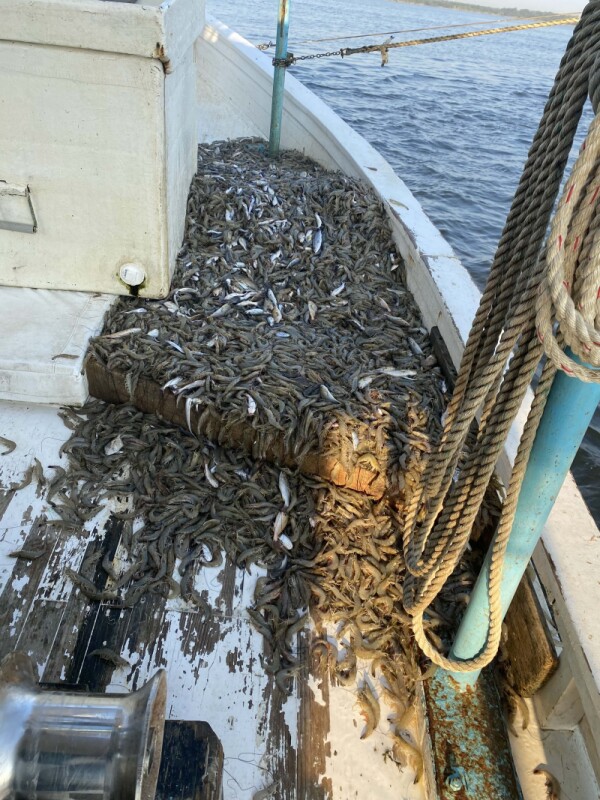
“We started doing that to get more for what we were catching,” he says. “I have a box on deck that holds about 2,000 pounds, and I have another on the stern that’ll hold another 1,000 pounds, so we can land 3,000 pounds. I used to use the fish hold and put about 55 100-pound boxes in there. But not anymore.”
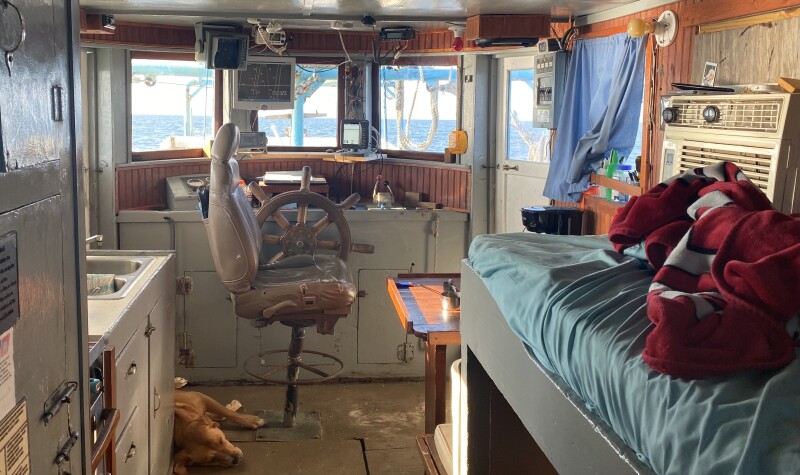
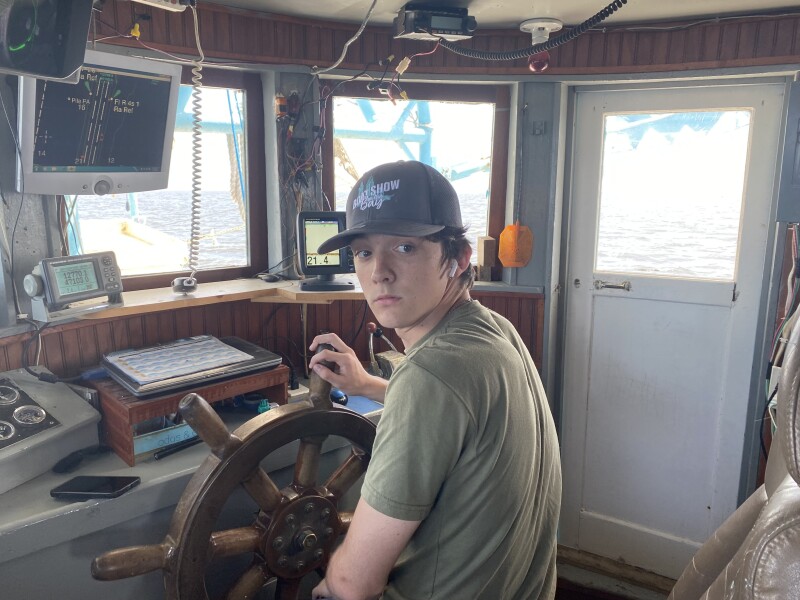
The one place where the Miss Caylee gets close to modern is in the cabin. “I have a 7.5kW generator that runs the lights, the AC, the electronics, and all that,” says Bryan. “The heat index right now is 105, so when we dump the tail bag we have to work quick to keep the quality. I have an awning over the deck and fans blowing down, and I go out and help, but we’re happy to get back inside with the AC.”
At the helm, Bryan’s electronics suite includes Starlink, a 42-mile Furuno radar, a Raytheon sat nav, a down sounder, and a computer with P-Sea WindPlot. “We mark all our hangs and wrecks and plot lines on that,” Bryan says. “A lot of guys around here use WindPlot so we can trade information.”
Crew comforts in the Miss Caylee are basic: two bunks, a fridge, a gas stove, and a little galley table for eating. “I just go with one guy,” says Bryan. “And his dog, Lady, we call her the drag inspector. When we dump the bag, she comes out and sniffs it and then goes back to her bunk. She’s been on here 7 years – since you could hold her in your hand.”
Miss Caylee specifications
F/V Miss Caylee
Home Port: Mobile, Ala.
Owner: David Bryan
Builder: Unknown in Biloxi, Miss.
Hull Material: Black cypress
Year built: 1941
Fishery: shrimp
Length: 48 feet
Beam: 17 feet
Draft: 4 feet
Engine: Detroit 671
Power Train: Twin Disc @ 3:1, 2.5 inch Aquamet shaft, 34 x 30 four blade Rice propeller
Fuel capacity: 600 gals.
Water capacity: 100 gals.
Cruise: 8 knots @1500 rpm
Hold capacity: hold with 5,500-pound capacity, but currently using two deck boxes with a combined 2,500-pound capacity.
Crew accommodations: 2 bunks in cabin, galley with fridge, gas stove, and table
Electronics: Starlink, 42-mile Furuno radar, Raytheon sat nav, down sounder, and computer with P-Sea WindPlot
Deck gear: Double drum McElroy winch with two cat heads. All chain driven by a Twin Disc PTO on the front of the main engine.
.png.small.400x400.png)

