

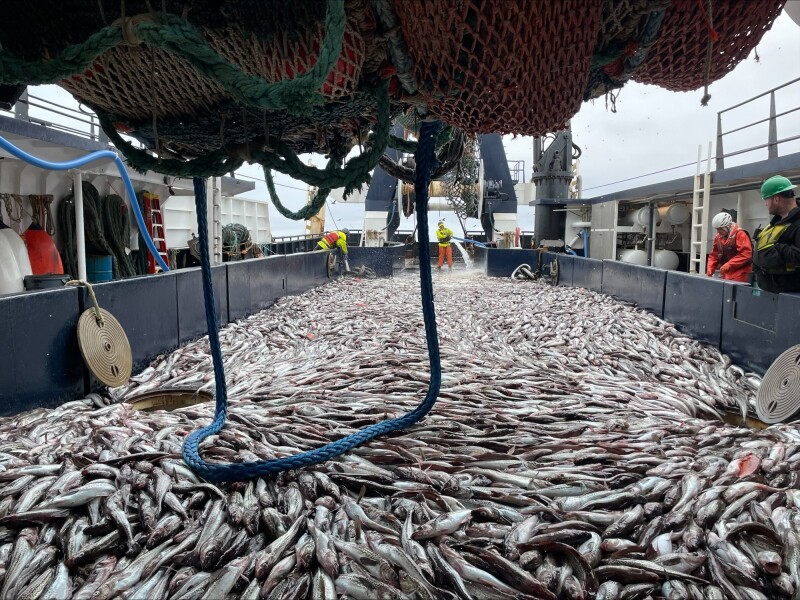
Alaska pollock is the biggest catch in the United States. But the fish drawing the most attention are the ones the fleet never meant to pull up.
For Sam Murphy, vice president of the Alaska Pollock Fishery Alliance (APFA), the focus on bycatch misses a much larger story.
That argument comes at a pointed moment for the fishery. In February, the North Pacific Fishery Management Council (NPFMC) voted 8-3 to recommend the first mandatory limit on chum salmon bycatch in the Bering Sea pollock fishery, an annual cap of 45,000 Western Alaska chum, paired with a corridor closure near the Alaska Peninsula between June 10 and Aug. 31, apportioned among the at-sea processor, catcher vessel, mothership, and Community Development Quota (CDQ) sectors.
The NPFMC heard testimony from more than 170 people over four days, including tribal leaders, subsistence fishermen, CDQ groups, and pollock industry participants. The new rules are not expected to take effect until June 2028 at the earliest.
Murphy didn't dismiss the difficult conversations about salmon bycatch or the challenges facing Alaska's fisheries. Those discussions are necessary, he said. But after spending the past year and a half aboard fishing vessels, touring processing plants, and visiting fishing communities across Alaska, he believes the conversation had become too narrowly focused on a single issue while overlooking the broader role pollock plays in the state's seafood economy.

"I don't really see it as an argument," Murphy said in an interview with National Fisherman. "To me, it's simply the reality that I hope more people start to recognize."
That reality, he said, was one of interdependence.
Murphy described Alaska's seafood economy as a three-legged stool. Commercial fishermen harvest the resource, processors transform that harvest into products consumed around the world, and coastal communities provide the workforce, ports, and infrastructure that allow the system to function.
"Remove any one of those three legs, and the whole thing starts to wobble," Murphy said.
That connection, he said, was why framing Alaska's fisheries as rivals missed the point.
"Pollock doesn't exist in a vacuum. Neither do salmon, crab, cod, or halibut," Murphy said. "These fisheries are connected economically, operationally, and culturally."
More than a bycatch conversation
Murphy acknowledged that salmon declines deserve attention, as do bycatch levels and questions about fishing gear. But he argued those discussions should also include the scientific management system governing Alaska's fisheries and the efforts fishermen continue to make to reduce unwanted catch.
The numbers behind those discussions move considerably from year to year. Chum salmon bycatch in the Bering Sea pollock fishery totaled roughly 151,000 fish in 2025, most of it hatchery-origin, according to a report presented to the NPFMC at its February meeting.
Annual totals have ranged from about 13,000 chum in 2010 to 546,043 in 2021 — the second-highest figure since 1991 — before dropping to just over 35,000 in 2024. On average, about 20% of the chum taken as bycatch originates in Western and Interior Alaska rivers, according to the Kuskokwim River Inter-Tribal Fish Commission (KRITFC), with most of the remainder traced to Asian hatchery stocks.
Chinook salmon bycatch has moved in the other direction more recently, rising from 8,049 fish in 2024 to 19,797 in 2025, the KRITFC reported. Genetic analysis attributed nearly 64% of the 2025 Chinook bycatch to Kuskokwim and Bristol Bay stocks. Chinook has been capped for years, unlike chum; the 2026 limit sits at 45,000 fish, the lower of two levels, triggered by weak returns the previous season.
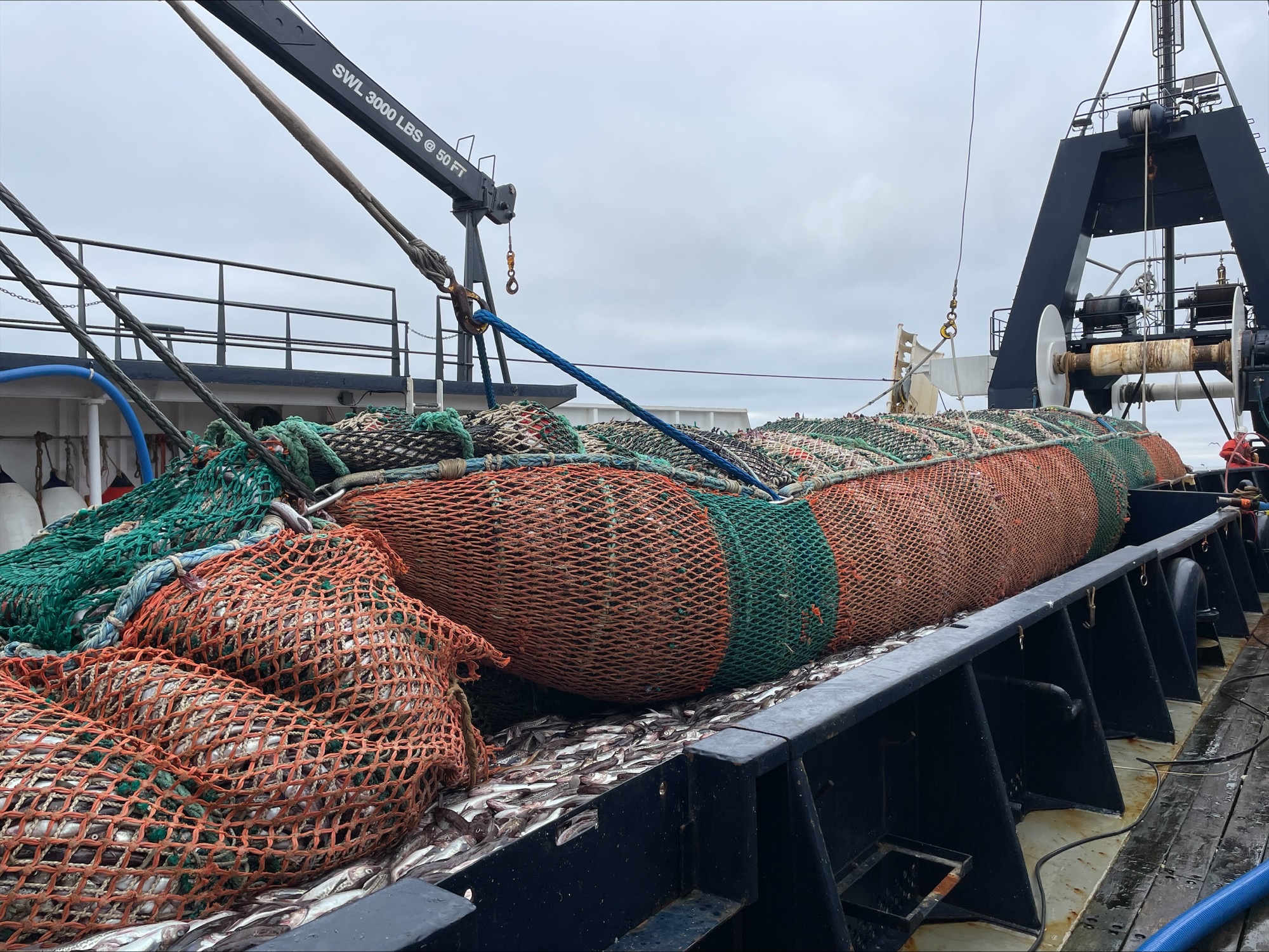
Chinook salmon bycatch by the pollock fleet totaled 8,049 fish in 2024 and 19,797 in 2025, according to genetics reports prepared by Alaska Fisheries Science Center scientists and presented to the NPFMC in June. Preliminary analysis using new genetic baselines, still undergoing scientific peer review, attributed nearly 64% of the 2025 Chinook bycatch to Kuskokwim and Bristol Bay stocks. Chinook has been capped for years, unlike chum; the 2026 limit sits at 45,000 fish, the lower of two levels, triggered by weak returns the previous season.
"The reality is Alaska's fisheries are among the most closely monitored and conservatively managed in the world," Murphy said.
He said two realities could exist simultaneously: Alaska pollock can remain one of the world's largest and most sustainably managed fisheries while still facing the challenge of bycatch.
"One doesn't diminish the other," he said.
Murphy also pushed back on the idea that bycatch is unique to pollock, noting that every commercial fishery encounters some level of unwanted catch. The more meaningful measure, he said, was what a fishery does to reduce it.
"We're harvesting wild fish in a dynamic ocean, not picking apples from a tree," Murphy said. "Nobody likes bycatch. Nobody celebrates it. But pretending it's entirely avoidable isn't an honest conversation."
Murphy said success should not be measured against an impossible standard of zero bycatch. Instead, it should come from continually finding ways to fish more selectively and responsibly.
He pointed to decades of improvements that include refined salmon excluder technology, voluntary hotspot avoidance, genetic stock identification during B Season, and increasingly sophisticated communication between vessels.
Perhaps the biggest advancement, Murphy said, was the speed at which information now moves across the fleet.
Captains routinely share information about where salmon are appearing, allowing other vessels to adjust fishing plans before bycatch increases. Satellite communications, including Starlink connectivity, have accelerated those conversations and made it easier for vessels fishing hundreds of miles offshore to respond in near real time.
That level of cooperation came as a shock to Murphy while he spent time with the fleet.
"When people ask me what surprised me most about this industry, it's probably that," Murphy said. "I expected to see competition. I didn't expect to see the level of collaboration that exists when it comes to stewardship."
For Murphy, that willingness to continually adapt was an important part of the pollock story. Fish behavior changes. Ocean conditions change. Technology changes. The fishery, he said, had to evolve with them.
"If the people in this industry thought they'd figured everything out, I'd probably be more concerned," he said.
Telling the fishery's story
Helping tell that broader story is part of why APFA exists.
The organization grew out of Genuine Alaska Pollock Producers (GAPP), which has long worked to build awareness and demand for wild Alaska pollock. APFA's mission puts greater emphasis on the fishery itself, including the fishermen, communities, and infrastructure behind one of the nation's largest commercial fisheries.
For Murphy, that meant helping people understand the fishery beyond the debates that most often make headlines.
According to APFA, Alaska pollock supports more than 6,300 Alaska jobs while generating roughly $2.5 billion in annual economic activity across the United States, including nearly $830 million that remains in Alaska.
Two 2025 studies commissioned by GAPP and conducted by Northern Economics and the McKinley Research Group found the fishery supported 6,318 Alaska jobs in 2023 and generated roughly $2.54 billion in economic output nationally, including $832 million in Alaska. Alaskan workers earned nearly $337 million in wages, and the fishery produced an estimated $25 million in state and local taxes.
Those numbers tell only part of the story, according to Murphy.
The fishery's year-round processing plants, transportation systems, and cold storage infrastructure create economies of scale that many seasonal fisheries rely upon to process and market their own catch.
"Pollock doesn't just support pollock," Murphy said.
Without that year-round foundation, he believes the economics of processing seafood in many of Alaska's remote communities would look significantly different.
Murphy also pointed to the CDQ program as another often-overlooked component of the pollock fishery.
Today, 35% of Alaska pollock fishing interests are held by Alaska-based entities, including the six CDQ groups that receive 10% of the Eastern Bering Sea pollock allocation. Those organizations reinvest fishery revenues into 65 western Alaska communities through scholarships, workforce development, infrastructure projects, and fisheries programs.
According to Murphy, CDQ groups invested more than $52 million into those efforts during 2023. "Those aren't side benefits," he said. "They're foundational to Alaska's seafood economy."
A fishery built to feed people
Murphy also believes conversations about pollock often overlook one of the simplest reasons the fishery exists: to feed people.
According to APFA, Alaska pollock provides enough seafood to produce more than three billion meals annually while remaining one of the world's lowest-carbon commercial protein sources.
"It's incredibly important, and I don't think the two conversations have to compete with one another," Murphy said when asked about balancing food production with concerns over bycatch.
Pollock harvested by the fleet is processed into fillets, surimi products, roe, fishmeal, and fish oil, with very little going unused. When food-grade bycatch cannot enter commercial markets, partnerships with organizations such as SeaShare help donate those fish to food banks and hunger relief organizations.
Those donations are not a substitute for reducing bycatch, Murphy emphasized.
"The goal is always to avoid bycatch in the first place," he said. "But when it does occur, making sure those fish help feed families rather than go to waste reflects something I've consistently seen throughout this industry: respect for the resource."
Looking beyond the headlines
Murphy said debates over pollock, salmon, and bycatch were unlikely to disappear — nor should they.
But for fishermen in other Alaska fisheries who believe pollock is harming their future, Murphy cautioned against placing the challenges facing Alaska's fisheries at the feet of a single fleet.
What mattered, he said, was how fishermen respond to bycatch. He believes the pollock fleet had demonstrated a long-term commitment to fishing cleaner through technology, communication, research, and changes in fishing behavior.
Rather than treating Alaska's fisheries as competitors, Murphy said the focus should remain on keeping all of them healthy and productive for the fishermen and communities that depend on them.
That is also how Murphy measured what success could look like for APFA in the years ahead. Success, he said, would not mean difficult conversations about bycatch had disappeared. It would mean the public had a more complete understanding of the fishery alongside them: a fishery that acknowledges its impacts, continually works to reduce them and remains focused on sustainably harvesting a resource that feeds millions of people.
"It's easy to reduce pollock to a single headline," Murphy said. "It's harder, but far more honest, to look at the full picture."
.jpg.small.400x400.jpg)