




After fish passage was fully restored on Maine’s Bagaduce River four years ago, one of the towns along its banks celebrated a long-awaited milestone. This spring, Penobscot held its first commercial alewife harvest in more than half a century, a testament to years of restoration work and community collaboration.
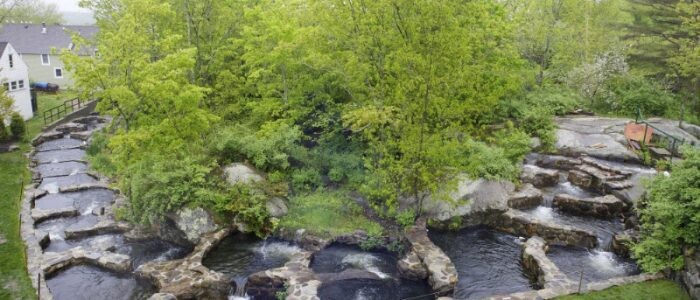
But even with that success, alewives had continued to struggle at one critical site along the river. That changed this month when town officials gathered to celebrate the reconstruction of the Pierce Pond fishway, a project designed to make upstream passage easier for the fish that return from the ocean to spawn.
Alewives can now move more freely through 14 newly constructed weirs, carefully arranged stone pools that slow and hold water to ease their passage. Once a common sight in Maine’s tidal rivers, these small herring are not only vital as lobster bait and local food, but also as a key link in coastal ecosystems.
For generations, Maine’s rivers were dammed to power mills and industry, including those that once operated on Pierce and Wight’s ponds. Those blockades, combined with pollution, overfishing, and poorly sized culverts, led to a sharp decline in traditional alewife runs. But over the past decade, communities like Penobscot have begun to undo the consequences of those industrial legacies.
The new fishway is the latest in a string of projects across the Bagaduce River watershed, which in 2021 became the first in Maine to be fully restored for fish passage, according to Walztoni’s reporting for Bangor Daily News.
Ciona Ulbrich of the Maine Coast Heritage Trust, who has worked on conservation projects in the region for two decades, said that meeting local advocate Bailey Bowden, a longtime alewife champion, changed her understanding of watershed conservation.
“He was able to make clear to me how and why land trusts should also be thinking about these stream restoration projects, if you’re trying to think about the health of ecology in a watershed,” Ulbrich said.
Since then, about two dozen organizations have joined forces to fund and carry out restoration work in the Bagaduce system, securing millions in outside funding and stabilizing or removing several dams, including an old dam at Pierce Pond and another at Wight’s Pond.
When the Pierce Pond fishway was first installed, fish still struggled to climb it- “nearly impassable at times,” according to Ulbrich. The new weirs are expected to help improve reproduction by conserving the fish’s energy during migration.
Penobscot plans to partner with the Maine Department of Transportation to replace a tidal barrier damaged by storms early in 2024 and restore the surrounding marshland. Educational signs and school programs are also being added to connect local youth to the returning fish and “create future stewards,” Walztoni reported.
Statewide alewife landings have averaged 3 million pounds worth more than $1 million, up from a 1994 low of 150,000 pounds, according to National Fisherman, reported by Paul Molyneaux in May.
"It takes a lot of work to open a run for commercial fishing,” Bowden told Molyneaux, who has the contract for the Wights Pond fishery on the Penobscot. “I started working on this in 2015. At the time, the state wanted four years of data, but that has since changed to 10 years.” Bowden has been operating a pilot fishery at Wights Pond for the last five years, harvesting a limited amount of alewives and collecting data. “It’s been frustrating at times, because the state wants to see 235 fish per acre, and I had 927 per acre, but not the 10 years of data.”
Bowden told Bangor Daily News that focusing on sustainable harvests helps ensure restoration work continues long-term. Smaller runs and tributaries require openings in beaver dams at least 200 hours of work a year, which is a costly effort without income from the fishery.
Two more restoration projects are planned to include replacing a tidal barrier and rebuilding nearby marshlands. Penobscot’s efforts continue to serve as a model for other Maine towns weighing their own fish passage projects.
.png.small.400x400.png)

