

Alaska's commercial salmon catch jumped from 21.2 million to 29.5 million for the seven days through July 14, as retail prices generally held, with 24% of the projected annual harvest now met.
Silver Bay Seafoods has adjusted its 2026 Bristol Bay sockeye price to $2 a pound for chilled, floated, bled fish, the Bristol Bay Fishermen's Association said on Tuesday, July 14. The company will continue to evaluate the season's financial results, with the final profit share to be calculated and reviewed by the fishermen's board at the spring meeting, said Janis Harsila, business manager for the BBFA.
On July 15, Trident Seafoods announced a base price increase from $1.25 to $1.65 a pound, bringing its Tier 1 chilled price to $2.
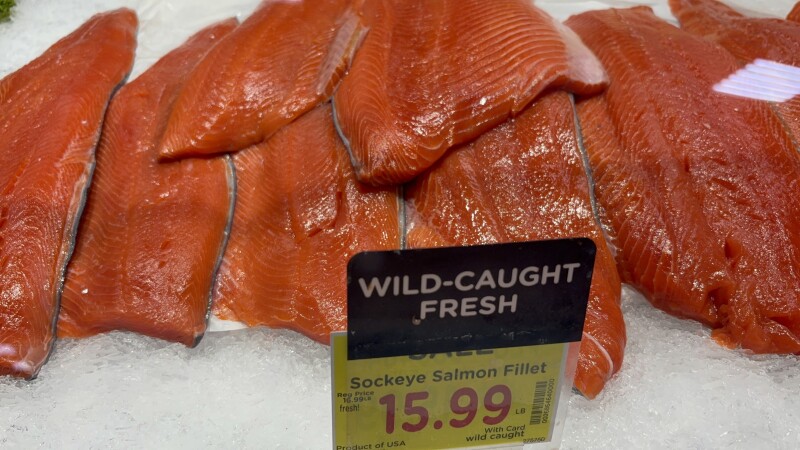
Consumers found fresh fillets of red salmon on sale at Costco warehouses in Anchorage for $14.99 a pound, down $2 from a week earlier. Seafood managers at New Sagaya in Anchorage had Alaska red salmon fillets for $12.95 a pound, while 10th & M held firm at $16.95 a pound. Carrs-Safeway customers with a store card could purchase those fillets for $16.99 a pound, but the regular price was $38.99 a pound.
McKinley Research Group, which compiles weekly reports for the Alaska Seafood Marketing Institute during the salmon season, noted that the sockeye catch in Bristol Bay is down 42% compared to a year ago.
Year-to-date harvests were also down 73% for Chinook, 93% for coho, 67% for keta, and 40% for pinks.
Following an estimated harvest of 2.3 million sockeye on July 4, the harvest in the Bay remained relatively consistent throughout the week, averaging 1.36 million fish daily. This pattern follows historical run timing, with the harvest season peaking on July 4, according to fisheries economist Simon Marks of McKinley Research Group.
Keta harvests have declined 67% year-over-year, with harvest down in all regions except Chignik, where it is up 135%, the report said. Harvest volume has changed the most in Prince William Sound, although the decline there is partially due to the unusually high harvest in 2025.
The Copper River drift gillnet fishery received its first opener in the main district since June 11. On July 9, the fishery opened for 24 hours, allowing for the first sockeye harvests in the Copper River district since statistical week 24, according to this fifth harvest update.
The overall Prince William Sound preliminary harvest report through July 14 stood at 1.3 million salmon, including 557,000 sockeye, 723,000 chum, 17,000 pink, 3,000 Chinook, and 2,000 coho.
For the Central Region overall, it was 22.6 million fish, including 21.6 million sockeye, 949,000 chum, 17,000 pink, 4,000 Chinook, and 2,000 coho.
In the Westward Region, the preliminary count was 29.5 million fish, led by 25.4 million sockeye, plus nearly 3 million chum, 1 million pink, 51,000 Chinook, and 12,000 coho. In Southeast Alaska, the preliminary harvest was 1.7 million salmon, led by 1.5 million chum, plus 127,000 sockeye, 45,000 Chinook, 32,000 pink, and 7,000 coho.
For the Arctic-Yukon-Kuskokwim, only 6,000 salmon were caught commercially this season, among them some 5,000 chum and 1,000 pink salmon in the Norton Sound region.