

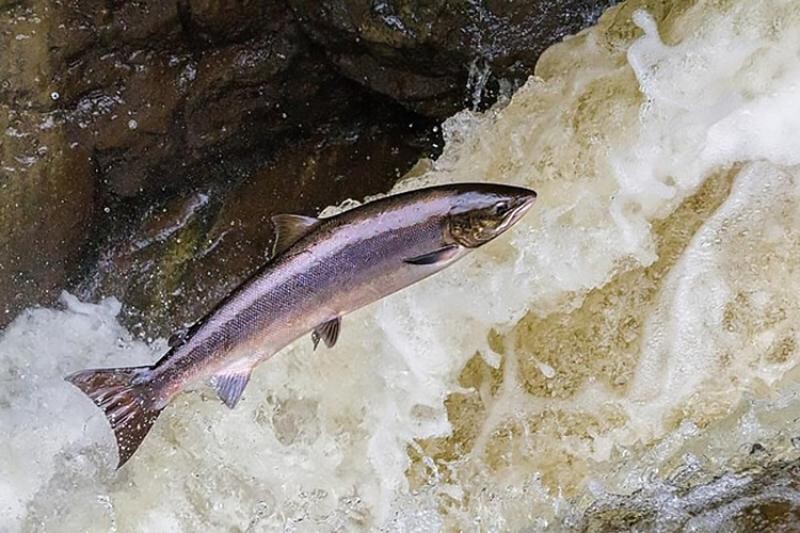
The Maine Department of Marine Resources (DMR) is asking federal fisheries officials to evaluate whether existing authorities under the Endangered Species Act (ESA) could help accelerate Atlantic salmon recovery while maintaining current protections.
In a June 4 letter to the National Marine Fisheries Service, DMR Commissioner Carl Wilson requested that NOAA review whether the ESA could provide additional flexibility to expand Atlantic salmon recovery efforts. The Bangor Daily News reported that the request could eventually create opportunities for tightly controlled, conservation-oriented catch-and-release fishing if the species recovers.
The request follows decades of habitat restoration, fish passage improvements and river connectivity projects that have benefited Atlantic salmon and other sea-run fish. However, Sean Ledwin, director of the DMR Bureau of Sea Run Fisheries and Habitat, said adult Atlantic salmon returns remain very low despite those investments.
The state is also pursuing expanded salmon production through new rearing capacity and partnerships aimed at increasing the number of adult fish available for restoration. Ledwin told Bangor Daily News those efforts could significantly boost spawning in Maine rivers and restore salmon to suitable historic habitat that is currently unoccupied.
Wild Atlantic salmon fishing in Maine has been closed since 1999, and the Gulf of Maine distinct population segment has been listed as endangered under the Endangered Species Act since 2000.
Wilson's letter specifically references Section 10(j) of the Endangered Species Act, which allows certain reintroduced endangered species populations to be designated as nonessential experimental populations. While the authority has not been used for species recovery in Maine, NOAA Fisheries has applied it for salmon and steelhead recovery efforts on the West Coast.
Looking ahead, Wilson's letter also raises the possibility of future "conservation-oriented recreational fisheries" if Atlantic salmon populations recover. Ledwin emphasized that recovery remains the department's primary objective, adding that reconnecting the public with Atlantic salmon and Maine's rivers could help build long-term support for conservation. In the meantime, DMR plans to expand volunteer restoration projects, citizen science initiatives and educational programs.
NOAA Fisheries has acknowledged receiving the letter but has not indicated whether it will conduct the requested review.