
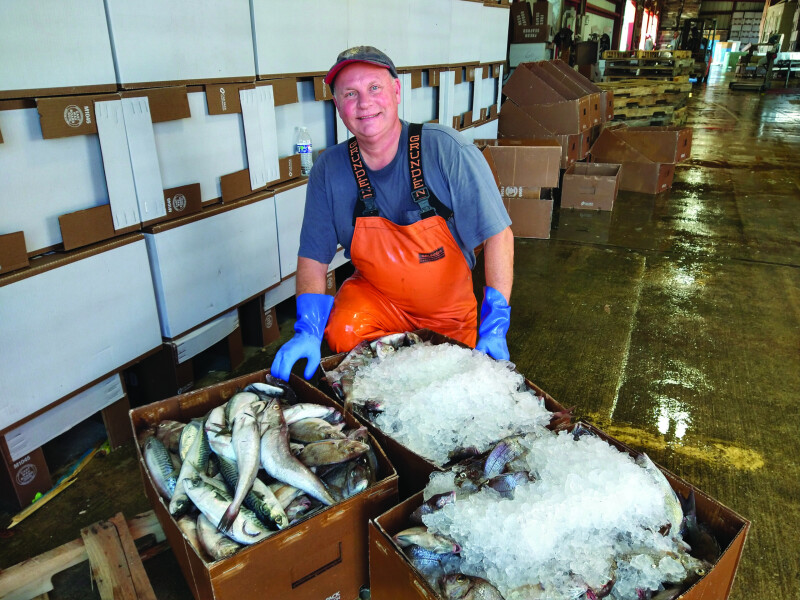
With decades of experience and leadership in the commercial fishing industry, Brick Wenzel has become one of New Jersey’s most steadfast advocates for fishermen and food security.
A respected voice on national policy, Wenzel has testified in Washington, D.C., on the impacts of industrial wind development on the nation’s seafood supply. And in 2018, he founded American Gleaned Seafood, a nonprofit that delivers seafood — a top source of protein — directly to food banks, soup kitchens, churches, and food pantries. Since its founding, the program has distributed the equivalent of more than a million servings of fresh seafood. Through it all, Wenzel has shown how commercial fishermen can lead with both innovation and compassion, ensuring access to nutritious seafood while safeguarding the working waterfronts that make it possible.
But long before the testimony, sturgeon research, and policy battles, Wenzel’s story began on the beach.
“I was a doryman,” he said. “You would push the boat off the beach, set a 300 or so foot net by hand, and row back in. We’d sell weakfish, bluefish, kingfish — three fish for five dollars — to tourists.”
Wenzel laughed, remembering the early days that helped shape the career that was to follow. “Tourism on the barrier island in the small town of Lavallette eventually took priority, and the people started pushing fishermen out, so I ran for public office.”
One letter explained that he had lived in the town longer than his five opponents combined, launching him into history at only 19. “I became the youngest elected official in the state of New Jersey,” he said.
Wenzel didn’t grow up in a fishing family. His family was comprised of developers and builders, but fishing grabbed hold of him early. By 16, he was landing 60 to 200 pounds of fish per trip, which he sold to local co-operatives in the state. “All the major buyers in New Jersey allowed me to bring my small-volume catch,” he said. “You start off small, and eventually you become big.”
Because he wasn’t tied to a single generational fishery, Wenzel found freedom to innovate. “I grew up catching bait before I caught food fish,” he said. That perspective led him to target underutilized species and develop new gear- including the fly net, “basically an otter trawl made out of monofilament.” His innovation spread fast and was quickly outlawed in other states within five months, he shared.
His approach paid off. “Because I was going for fish that most people weren’t targeting, I was landing fish that weren’t being landed before,” he said. This gave Brick the historical landings that qualified him for many species permits, making him the largest license holder in New Jersey for various fisheries.
His curiosity didn’t stop with gear. While fishing in Delaware Bay, he observed sturgeon behavior that contradicted official consensus. “They said there were only two biomass: the Chesapeake and Hudson,” he said. “I argued there was a third in Delaware Bay.”
Wenzel partnered with the Littoral Society to secure grant funding and develop a sturgeon tagging program that ultimately proved the existence of the third biomass.
Protecting the Mud Hole
When asked what accomplishment he’s most proud of, Wenzel didn’t hesitate.
“Protecting the area around the Mud Hole from development,” he said. The Hudson River deposits silt into a sharply contoured region off New Jersey, creating an essential fish habitat that supports more than 200 species. When offshore wind developers eyed the area, Wenzel took a different approach than other opponents. “Most people were fighting the environmental impacts and economic impacts,” he said. “I went after their funding source.”
At a New York offshore wind industry meeting, where the entry cost $10,000, he spoke directly with the financiers. He was the first person to show them the risks. The result: when the Hudson North area went up for lease, they received no bids.
“Saving that essential fish habitat was definitely my largest accomplishment,” he said. Years later, when whales began washing ashore, people remembered that he had predicted the risk more than a decade earlier. “Everybody thought I was one of those crazy environmentalists,” he said. “And then people came up to me going, ‘Oh my god, you were right.’”
That credibility now carries weight at every level of government, according to Wenzel. “When I call, they pick up,” he said, noting that he was only three phone calls away from President Trump during his first term. More recently, he shared, “Within two days, there was an executive order based on a call I made.”
One of Wenzel’s proudest moments came during the American Farm Bureau Federation’s 100th anniversary, when the organization created a new seafood commodity group. For the first time, commercial fishing was formally recognized as a commodity sector, and the Federation even hired a lobbyist to represent the industry. It marked the first time the nation’s largest agricultural organization officially backed wild fisheries — and Wenzel played a role in making it happen. “That’s something I’m really, really proud of,” he shared.
Giving back through seafood and safety
The Fishermen’s Dock Cooperative of Point Pleasant Beach, N.J., has been around for over 70 years, and Wenzel takes pride in not only selling his seafood to the co-op but also being a fisheries liaison for other commercial fishermen who sell to the dock.
Just as importantly, he shares safety and knowledge with the next generation. “I’ve seen more injuries at the dock than at sea,” he said. So, he teaches the basics of using gear safely, why a baseball hat might save your eyes, and what to watch for when using a winch. “It might sound like minor things, but when you share that knowledge, that’s when you gain respect.”
He sees it as a responsibility not only to young fishermen but also to scientists, observers, and enforcement officers. “You need to share your knowledge with others so they don’t get hurt or make a mistake you may have already made,” Wenzel said.
A lifetime filled with boats
Wenzel has owned four boats over the years, but none more memorable than Salty Tours, his jet-powered, just under 50-foot gillnet boat with 800 horsepower and a 20,000-pound fish hold. “At over 40 knots, we could get to the fishing ground, catch our limit, and be back in under four hours,” he said. The shallow-draft — 3.5 feet, and only 18 inches on a plane — enables him to work both offshore and in the bays. Salty Tours was even featured in National Fisherman’s “Last Set.”
Today, some have shared that Wenzel is more important on land than at sea. However, when mentioned to him, he takes it as an honor, but not a replacement. “I love being out there. I love fishing, and that’s why I advocate for the industry,” he said.
Wenzel’s life has been a continuous thread of fishing, innovating, advocating, and connecting dots long before others see the pattern.
“What a humbling recognition,” he said of being named a Highliner. “My whole life has been dedicated to the commercial fishing industry, and I wouldn’t have it any other way.” And the industry — from New Jersey and the Mid-Atlantic, to far beyond — is better for it.