Parasitic worms may not sound like good news for Chesapeake Bay’s blue crabs, but researchers at William & Mary’s Batten School of Coastal & Marine Sciences and the Virginia Institute of Marine Science (VIMS) believe they may hold a key to better managing the Bay’s most important fishery.
A new study published in the journal PLOS One has found that the egg-eating worm Carcinonemertes carcinophila, which lives on the egg clutches of female crabs, could serve as a valuable biomarker for understanding crab reproduction. The discovery comes at a time when the most recent Winter Dredge Survey, conducted by the Batten School, VIMS, and Maryland’s Department of Natural Resources, recorded historically low numbers of blue crabs.
The worms feed on blue crab eggs, but not enough to dramatically reduce reproductive output. What makes them useful is that they grow and change color after feeding, leaving visible signs that a female crab has spawned. Until now, scientists had been unsure whether the worms could survive the wide range of salinity levels found across the Bay.
“Other species of Carcinonemertes cannot survive in salinity levels below 20 parts per thousand, which is a common occurrence in the Bay’s tributaries and during high-precipitation events,” said Professor Jefferey Shields of VIMS. “We found this worm to be much tougher than other species.”
The study, led by William & Mary undergraduate Alec Pomroy and former VIMS student Alexandra Schneider, Ph.D., tested worms collected from female crabs across varying salinities. The team found that while the worms thrived at 20-30 parts per thousand, they could also survive at a practical salinity unit (psu) of 10 and withstand short periods of up to 39 hours at salinities as low as 5 psu.
"Female crabs often migrate from low-salinity waters to high-salinity waters to lay eggs. We found that the worms had a wide salinity tolerance, and that they survived well at the lower salinities representative of where crabs might begin their migrations," said Pomroy. "This means that the worms are likely to infest crabs throughout their adult lives, confirming their potential as biomarkers for reproduction."
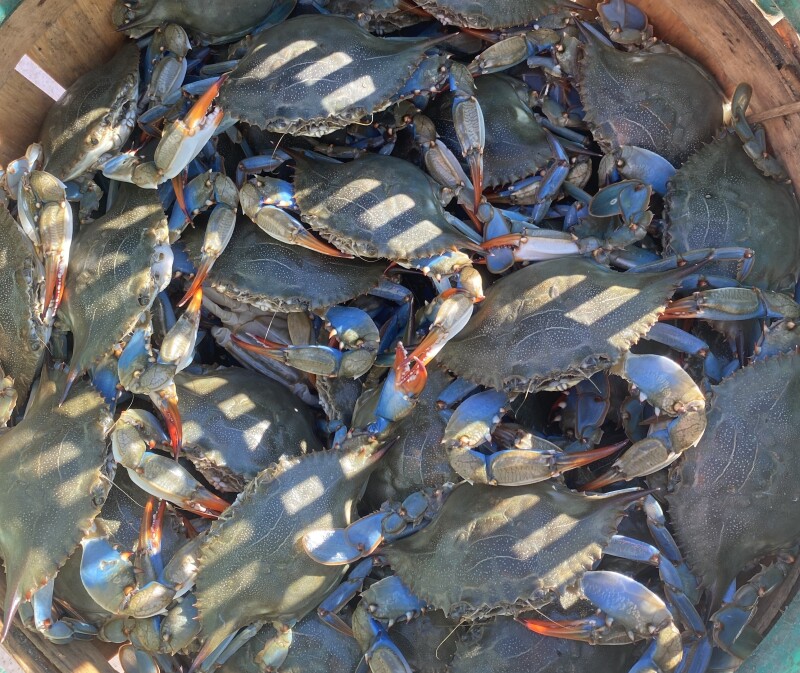
Blue crabs are both a commercial and cultural staple of the Bay. Egg production plays a central role in fishery models, but managers have long struggled to identify how many times a female has spawned. Primiparous females, those spawning for the first time, produce the largest clutches, while multiparous females have reduced reproductive potential.
Schneider’s earlier work showed that nearly all crabs spawning in June were primiparous, while those spawning later were mostly multiparous. In a related study, she and her colleagues used the worms to estimate, for the first time, the number of crabs that had spawned during the winter months —a critical piece of information for predicting population health ahead of the fishing season.
"If you're trying to increase the blue crab population in the Bay, it makes sense to protect the primiparous crabs if they are producing more offspring," said Schneider. "The presence and physical characteristics of this worm can serve as a sort of living history of whether a crab has spawned, potentially giving us a tool to identify how fecundity changes over a female's life and which crabs are the most productive."
VIMS will continue tracking the proportion of multiparous spawners in the Bay, using the worms as biological markers. The results are being shared with fishery managers across state lines as they work to balance harvest pressure with rebuilding efforts. For fishermen on the bay, the research reveals how unexpected creatures, such as egg-eating worms, might help chart a more sustainable course for the future of the fishery.