Across every U.S. coast, a new kind of ocean industry could be taking shape. Towering turbines have steadily multiplied in the same waters where generations of commercial fishermen have hauled their gear. For fishermen already navigating regulations and higher fuel costs, the emergence of tidal and wave energy, also known as marine energy, marks a challenge and potential opportunity.
The ocean has long been viewed as an untapped powerhouse. According to a January 2025 report published by Yale Environment 360, the waves off the East and West Coasts of the U.S. could theoretically provide more than 60 percent of the nation’s electricity needs if fully harnessed. Efforts have ramped up to convert that power into usable energy. “It’s expensive and it's challenging, but the opportunity is just so great,” said Lindsay Bennett, executive director of the Fundy Ocean Research Center for Energy (FORCE) in Nova Scotia, which focuses on tidal projects.
The Biden Administration announced in September 2024 $112.5 million in funding for prototypes for the Department of Energy’s Water Power Technologies Office, which is the largest U.S. investment in wave energy to date; however, it was likely that this funding was cut in October 2025 when the Trump administration directed the Department of Energy to terminate $7.5 billion in clean energy awards.
While early marine energy devices have come and gone, researchers say modern systems are stronger and smarter. According to Yale Environment’s study and University of Western Australia engineer Hugh Wolgamot, “People often ask, why wave energy instead of solar? It’s really wave energy and solar…The key thing is the value of its persistence.” Unlike the sun or wind, the ocean rarely rests.
For fishermen, the rise of these projects could add more obstacles in already crowded seas. The American Bureau of Shipping (ABS)’s 2025 Energy Transition Advisory identifies offshore renewable energy installations (OREI), including wind, tidal, and wave systems, as a growing external risk to commercial fishing vessels and crews.
According to ABS, these offshore energy structures “can disrupt vessel radar systems and complicate navigation,” especially when charts or navigation aids lack OREI data. The report warns that construction and maintenance work may “temporarily close transit lanes” or reroute vessel traffic, leading to long trips, fatigue, and a heightened risk of collisions and grounding.
Search and rescue operations could also face challenges, since restricted maneuverability within energy fields can slow emergency responses. To prepare, the report recommends that fishermen receive targeted training for navigation and emergency response in these environments, as well as updates to charts and communication systems.
“The development of offshore renewable energy installations represents a transformative challenge for the commercial fishing sector over the next decade,” ABS stated, emphasizing the need for collaboration between energy developers and fishermen from the earliest planning stages.
Despite the concern, some see promise in how marine energy could support working waterfronts. Yale Environments noted that small-scale wave power could help supply localized energy for remote coastal operations, such as refrigeration for fisheries, dredging, or desalination. Boston-based Resolute Marine has explored how wave-powered systems could run desalination plants in small ports, cutting diesel use and expanding clean water access.
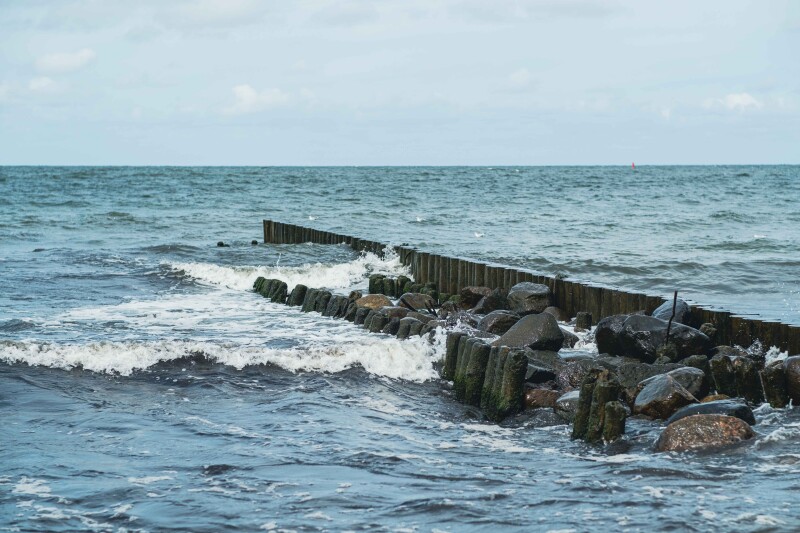
Even more practical for fishing communities may be the integration of wave energy into harbor infrastructure, such as within breakwaters. A project in Spain, the Mutriku breakwater project, has operated for decades, demonstrating how ports can harness incoming waves to generate onshore electricity. For harbors that rely on diesel generators, these developments could hint at future cost savings and reduced emissions.
The U.S. commercial fishing fleet remains almost entirely dependent on fossil fuels. The ABS report estimates that fishing operations produce 41 million tonnes of carbon dioxide equivalent annually, with emissions varying widely by fishery type. Crustacean and large pelagic fisheries are among the most fuel-intensive, while small-boat fleets in New England, the Gulf, and Alaska face different hurdles depending on their operating range.
Diesel’s energy density and reliability have made the industry as rugged as it is today, but ABS research warned in its report that “this reliance is increasingly unsustainable” as policy and fuel costs evolve. Hybrid systems combining batteries and diesel engines with nearshore electrification could reduce costs and noise while improving efficiency, though upfront investment and access to charging remain barriers.
The report does mention safety concerns tied to new fuel types such as hydrogen, ammonia, and methanol- each introducing unique hazards ranging from toxicity and flammability to cryogenic storage risks. The report mentioned specialized crew training on properties, safe handling, and hazards of these fuels, as well as drills simulating fire and vapor leaks to ensure preparedness.
The ABS report stressed that the next decade will require “updating regulatory frameworks, bolstering emergency preparedness, and prioritizing specialized crew training” to maintain both safety and economic viability. Meanwhile, researchers in the Yale Environment report say that momentum is finally building and there’s a lot of power in new power sources such as waves, but also a lot of risks. The challenge is finding the balance between innovation and access, clean energy and working waterfronts.