Reopening the waters around the Pacific Monuments will help the U.S. fleet, but they still need to fight a battle in the marketplace.
On April 17, U.S. tuna fishermen in the Pacific welcomed President Donald Trump’s executive order (EO) 14276 directing Secretary of Commerce Howard Lutnick to review marine national monuments and remove commercial fishing restrictions that conflict with national seafood priorities. Trump also issued a proclamation immediately opening the waters around the Pacific Remote Islands Heritage Marine National Monument, one of the four Pacific monuments.
“The president’s proclamation, issued the same day as his EO 14276, basically opens up the waters between 50 and 200 miles around the Pacific Remote Islands Monument – the islands of Wake, Johnston, and Jarvis – for commercial fishing,” says Eric Kingma, executive director of the Hawaii Longline Association (HLA).
The waters between 50 and 200 miles around the Remote Islands and three other monuments in the Pacific – Papahānaumokuākea, Marianas Trench, and Rose Atoll – had been closed since 2016 to protect tuna and generate spillover of tuna from the protected areas into surrounding waters.

Kingma notes that tuna are highly migratory species. “If the objective is to protect tuna, you’d have to close half the Pacific,” he says. “These areas that were closed are relatively small. They are not tuna reserves where tuna are going to spawn and fill the ocean.”
Kingma recalls that the spillover was predicted by an economist, not a fisheries scientist. “Guys like Ray Hilborn (a University of Washington marine scientist) disproved this years ago,” he says.
When U.S. longliners fished the newly opened waters around Johnston Atoll, they reported that their catches per hook were not significantly different from the waters outside the previously closed areas. “What we like about opening these up is the opportunity to fish there when the fish are there,” says Kingma. “Most of our effort – 80-90 percent – is on the high seas, and we’re competing with the foreign fleets. But when the fish are inside 200 miles around the islands, we can go in and fish without that competition.”
He notes that the HLA members primarily benefit from the opening of the waters around Johnston Atoll. “Wake and Jarvis are too far. The purse seiner fleet fishing out of American Samoa benefits from opening Jarvis. The entire economy in American Samoa depends on tuna.”

While American tuna purse seiners and longliners are reaping the benefits of the April 2025 proclamation, they and many other fishermen are waiting to see what happens with the other monuments. Trump’s executive order directs the regional management councils – in this case, the Western Pacific Regional Fisheries Management Council – to make recommendations for reducing regulatory burdens of fisheries.
“The council has long supported restoring commercial fishing access to waters around Wake, Johnston, and Jarvis, and welcomed the President’s proclamation reopening those areas,” stated council chair Will Sword. “Now, under EO 14276, the council is preparing its comments on the broader review of opening the three remaining U.S. marine monuments in the Pacific to commercial fishing. We are engaging with islanders across the region to ensure our input reflects both the best available science and the needs of our fishing communities."
According to Sword, the council will continue to advocate for fisheries, like those in the Northwestern Hawaiian Islands. “These areas were being sustainably managed before they were closed, and those closures should not override science-based fisheries management,” he says.
“These waters remained ‘pristine’ even while fishing was allowed – demonstrating that conservation and sustainable use are not mutually exclusive. This was thanks to the management the council provided under the transparent, bottom-up approach of the Magnuson-Stevens Act. With strong federal oversight and long-standing conservation measures already in place, we believe it's possible to both protect marine ecosystems and provide fair access to our domestic fishermen.”
It's believed that the council will recommend reopening all the waters between 50 and 200 miles around all the monuments, benefiting small-scale fishermen, as well as the purse seiners and longliners.
But while giving fishermen access to the highly regulated U.S. territorial waters may help them avoid competition while fishing, HLA Executive Director Kingma notes that they still need protection in the marketplace. “Reducing regulations and opening these areas is good,” he says. “But the real battle is in the market—that is our biggest concern, and it needs to be elevated. We need action that addresses foreign subsidized imports.”

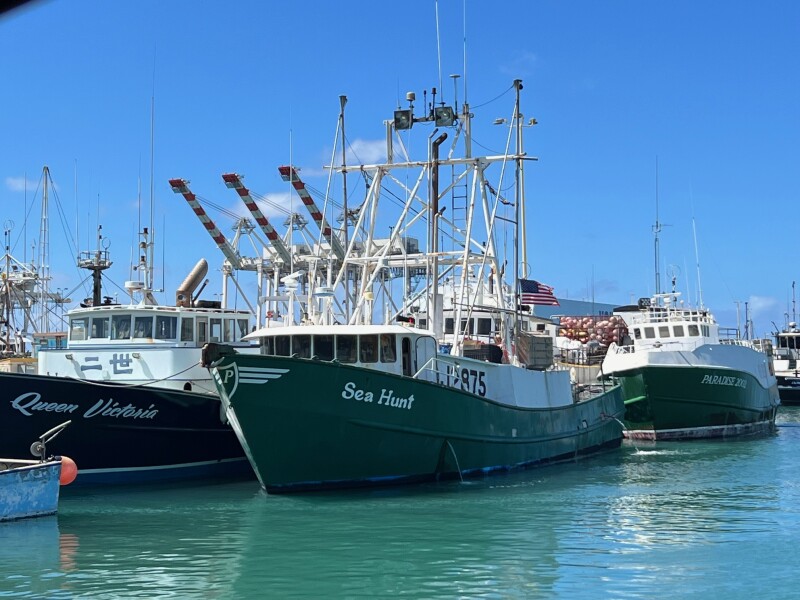
As tuna longliner and HLA board member Peter Webster notes, the Hawaiian longliners have gone to great lengths to become a model fishery. “We have to jump through all these hoops to prove we’re fishing sustainably and ethically,” Webster says. “Everyone’s looking at us, but nobody’s looking at the buyers.”
The HLA boats are certified sustainable by the Marine Stewardship Council, Kingma points out. “But our guys don’t see a return on that. And if they don’t have the label, they can’t sell, but buyers will buy from the Chinese longliners. Give me a break.”
Webster notes that Hawaii just passed a law on seafood labeling. “Governor (Josh) Green signed a bill requiring all retail establishments in the state to label all raw ahi with its country of origin,” he says. “The law came into effect on July 1.”
Kingma is looking for more protection at the federal level. “We’re looking at trade rules,” he says. “We could use the Marine Mammal Protection Act to invoke sanctions against some of these cheap imports. We’re also looking at labels that would benefit our fishermen, we could have our own Hawaii label or a NOAA label, where our guys would see the price premiums.”
Sword points out that fishing in the western Pacific region supports more than just economies. “It provides food security, sustains cultural practices and supports the livelihoods of Pacific Islanders,” he says. “These fisheries are also strategically important to the United States. By supporting domestic fleets, the United States maintains its presence, strengthens alliances and upholds sovereignty in Pacific waters.”
At its June 9-11 meeting in Honolulu, the council voiced its support for the reopening of the Pacific Remote Islands monument area and voted to urge the president to go further and lift the prohibition on fishing in Papahānaumokuākea, the monument surrounding Hawaii’s northwestern islands, noting that the area was being managed sustainably before it was closed to fishing.
The council also voted to:
· Endorse a preliminary list of recommendations to reduce regulatory burdens on U.S. fisheries.
· Initiate a review of existing fishing prohibitions in Pacific marine national monuments to inform federal decision-making on regulations.
· Send a letter to the Secretary of Commerce and the U.S. Trade Representative outlining unfair trade practices and proposing corrective measures under the America First Seafood Strategy.
“This EO gives us a real opportunity to reform outdated policies and support our fisheries more effectively,” council Executive Director Kitty Simonds said in a press release.